

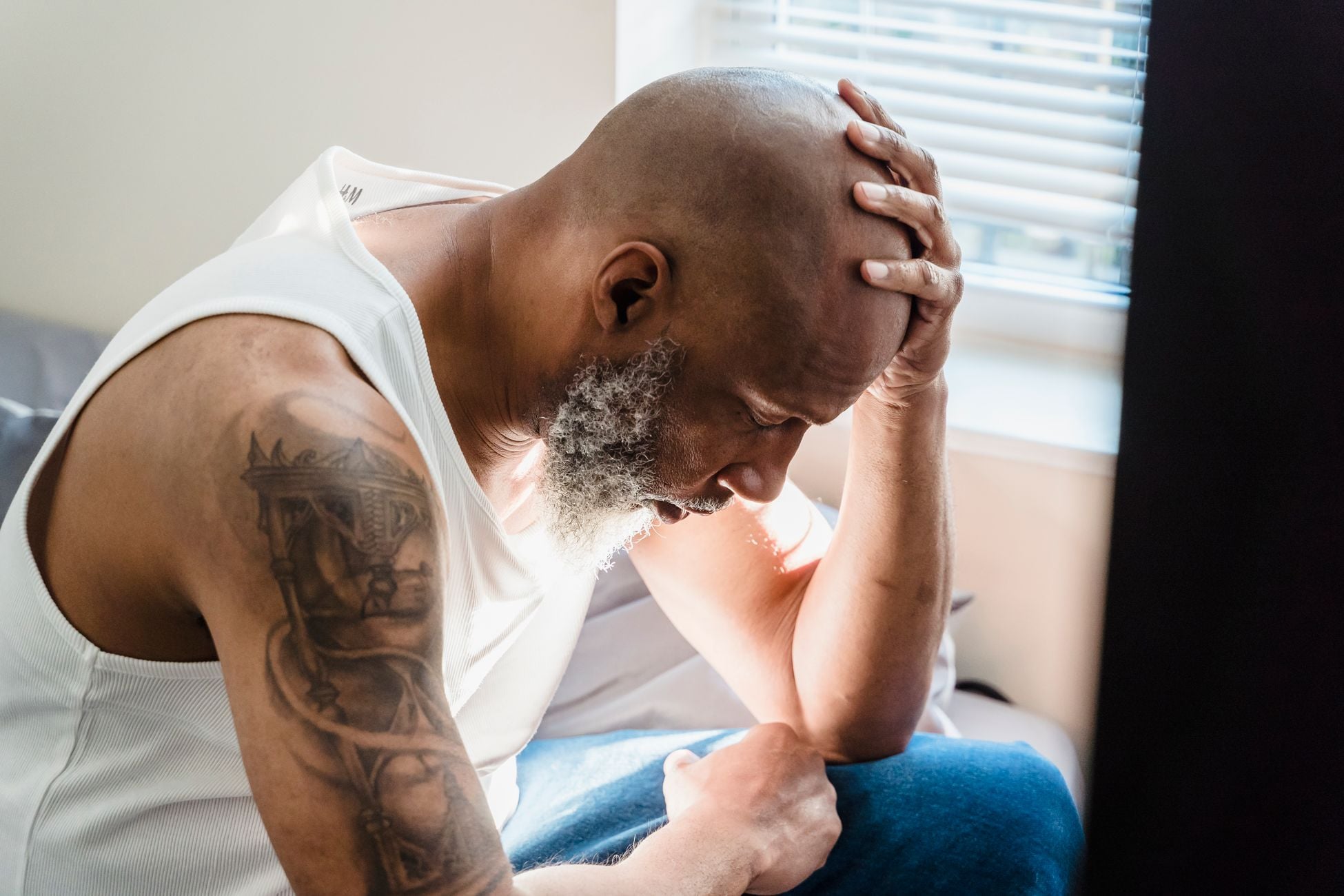
The men currently turning seventy were among the last cohorts raised inside an almost unbroken consensus that feeling and showing emotion were two different acts, and that the second one was a failure of the first. Their fathers had come home from a war that nobody wanted them to describe in detail. Their mothers had been instructed, often by magazines and family doctors, that a boy who cried easily was a boy who would struggle. The schools reinforced it. The playgrounds enforced it. By the time these men were earning paychecks in their twenties, the rules had hardened into something close to a private language, and the language had almost no vocabulary for sadness, fear, loneliness, or doubt.
Conventional wisdom now treats this as a story of repression that older men can simply choose to undo, as though a habit set in childhood and reinforced for fifty working years could be lifted off the shoulders the way a coat comes off in a warm room. The truth is harder. They are being asked, often by adult children and aging spouses and a culture that has changed at extraordinary speed, to perform a translation for which they were never given a dictionary.
Men born roughly between 1953 and 1958 are passing through their early seventies right now, and they sit on the seam between two emotional worlds. The fathers above them were often allowed to die without ever being asked what they actually felt about their own lives. The sons below them, now in their forties, were raised by mothers who had read attachment theory and fathers who had at least heard the phrase emotional availability said out loud. The men in the middle were trained for the first world and are being graded on the second.
The grammar they were given
The vocabulary problem is not metaphorical. A boy raised in the late 1950s and early 1960s in much of the English-speaking world was given a working set of permitted feelings that fit on a small index card. Anger was permitted, sometimes encouraged. Pride was permitted in narrow forms. Stoicism in the face of physical pain was praised. Almost everything else was treated as a private weakness to be managed alone, and ideally never named at all. Writing on masculinity and anxiety has examined how the cultural template of the strong, silent type can promote emotional suppression and make asking for help feel like a failure of manhood.
The script worked, in a narrow operational sense, for the world these men were sent into. Factory floors, military service, sales territories, hospital corridors, courtrooms — these were rooms in which the cost of an unscripted emotion was high and the reward for visible composure was promotion. The men who succeeded in those rooms were not pretending. They had, in many cases, genuinely learned not to show the things that would have been inconvenient to show.
That is the part that gets lost in well-meaning conversations about getting older men to open up. The assumption is usually that the feelings are sitting there intact, sealed in a jar marked do not open until retirement, waiting to be poured out once permission is granted. The reality, for a meaningful share of this cohort, is that some of the emotional channels were not just closed but unused for so long that the habit of speaking through them never developed. You cannot retrieve a vocabulary you were never taught. You can only build one, late, and the building is slow.
What the Rosenhan story still says about labels
The deeper problem is what happens when men in this cohort do finally try to describe an internal state and the people around them interpret what they say through the wrong frame. The history of psychiatry is, in part, a history of confident misreadings, and a useful corrective sits inside David Rosenhan’s 1973 paper On Being Sane in Insane Places, in which pseudopatients presented themselves at psychiatric hospitals reporting a single mild auditory symptom and were admitted with serious diagnoses they could not later shake.
The granular details of that experiment — the volunteers who reported hearing words, the staff who recorded normal note-taking as a sign of illness, the real patients who spotted the impostors that the doctors missed — illustrate how a label, once attached, can rewrite the past it lands on.
The relevance to a seventy-year-old man trying to describe what he feels is not abstract. When a man whose entire emotional grammar consists of two or three permitted states finally says something like I have been feeling strange about my father lately, the people listening — adult children, a younger spouse, sometimes even a professional helper — are often fluent in a language he is not. They hear old grief, family patterns, low mood, avoidance. He meant something closer to strange. The label is attached before the sentence is finished, and like Rosenhan’s volunteers, he now has to argue his way back out of a frame he did not ask to enter.
Why the timing feels so unusual
Earlier generations of men often did not face this gap in the same way because the culture above them was not asking the question. A man born in 1905 who reached seventy in 1975 was surrounded by other men who had also been trained not to speak, and by women who had largely been instructed not to ask. The silence was load-bearing. It held a marriage and a family and a workplace in place because every adult in the room had agreed, without ever discussing it, to leave certain rooms in the house permanently closed.
The men turning seventy in the mid-2020s are among the first to arrive at late life inside a culture that has dismantled much of that silence and now treats the closed rooms as evidence of a problem to be solved. Their adult children, raised on a different vocabulary, want conversations their fathers were specifically trained to avoid. Their wives, many of whom have spent decades in therapy or in friendships that processed feeling out loud, want a partner who can meet them where they are. The grandchildren ask direct questions. The doctors ask about mood. The retirement seminars include modules on emotional connection.
There is a real biological question underneath all of this, which is whether the aging brain and aging habits can still make room for patterns that were not practiced earlier. The older brain appears to remain more adaptable than mid-century assumptions allowed, but adaptation requires sustained novel input and active engagement, not simply the wish to change. The wish is the easy part. The decades of practice required to lay a habit of emotional articulation into someone who has spent fifty years practicing the opposite habit — that is the harder arithmetic.
Late-life well-being is not, however, fixed. A study covered by ScienceDaily in October 2025 followed adults over sixty who had initially reported poor well-being and found that nearly one in four returned to a state of optimal well-being within three years. The recovery was real and measurable. The conditions that supported it, in the data, were unglamorous — physical activity, sleep, emotional and social support, and other steady forms of daily scaffolding. None of them required a sudden personality transformation. They required showing up to specific rooms repeatedly. Men in this cohort are, in many cases, quite good at showing up. The translation problem sits one layer deeper than attendance.
The cost of the old grammar
The cost of carrying a small emotional vocabulary into late life is not only social. A scoping review published in Nature maps how interior design factors are associated with physical, physiological, and mental health outcomes for older adults, while a separate study in Scientific Reports examines how social isolation can mediate the relationship between cumulative heat exposure and poorer mental health among older adults. The wider point is simple: late life is shaped by environments, bodies, routines, and social connection at the same time. Men who have spent a working life routing every uncomfortable feeling into productivity, drink, or silence often arrive at retirement with the routing system intact and the routes themselves gone. The job is over. The pub closed. The friends moved or died. The silence remains, and it now has nowhere to discharge.
Writers on this site have explored the adjacent terrain — the lonely competence of people trained to handle everything alone, and the quiet that descends on the most dependable person in a family sometime in their late fifties. The men now entering their seventies are often standing in both rooms at once. The dependability was rewarded. The grammar was not given. The bill arrives at retirement.
What a fair expectation looks like
A fair expectation of this cohort is not that they will suddenly speak the emotional language their grandchildren speak. A fair expectation is that they will, in the time they have, learn enough of it to be understood by the people who love them, and that the people who love them will learn enough of theirs to understand what they have always been saying in their own way. Practical guidance for older adults on maintaining mental and physical health frames healthy aging as a set of small, repeatable behaviours: moving the body, sleeping well, eating steadily, and building or maintaining social connection.
The men in this cohort are not, on the whole, refusing to feel. Many of them are working harder at emotional translation than the people around them realise, in a second language they began learning in their sixties. The Rosenhan lesson applies in reverse here. The label of emotionally unavailable, once attached, rewrites everything they do — the long walk taken in silence, the practical favour done without fanfare, the awkward phone call placed for no reason — into evidence of an absence rather than the form their presence has always taken. Some of what looks like withdrawal is fluency in a language nobody is listening for anymore.
The grammar will keep shifting. The men turning seventy in 2035 will have been shaped by different forces and will arrive with a different vocabulary. For now, the cohort on the seam deserves something more careful than impatience. They were raised to keep many feelings out of view and are now being asked to discuss them. That they are trying at all, this late, in a language they were specifically trained not to learn, is the part of the story that tends to get missed.