


Chris Butler, the Honolulu-born surfer who renamed himself Siddhaswarupananda Paramahamsa and built a global Krishna-derived movement called Science of Identity, has reportedly not appeared in a verified public photograph since the mid-1980s. He reportedly stopped giving sit-down media interviews in 1977, the year his Hawaii following went from beach gatherings to organized ashram life, and the handful of grainy images that still circulate online, including the cover portraits used on his own audio cassettes, are now roughly four decades old. He is reportedly 78 years old, and almost no one outside his inner circle claims to know what he currently looks like.
That absence is the point of the movement, and the engine of its mystique.
The surfer who became a guru
Butler reportedly grew up in Honolulu in the 1950s, the son of a prominent local doctor and anti-war activist. He was reportedly a competitive surfer on Oahu’s North Shore in the 1960s, drifted through LSD and Vedanta, and around 1970 became a disciple of A.C. Bhaktivedanta Swami Prabhupada, the founder of the International Society for Krishna Consciousness, who gave him the Sanskrit name he still uses on cassette labels and book jackets.
By the early 1970s Butler was running his own offshoot in Hawaii, drawing a few hundred followers to lectures in Honolulu apartments and Kailua living rooms. He was photographed often during this period. He wore the saffron robes, the shaved head with the single tuft of hair at the back, and the painted clay markings on the forehead common to ISKCON monks.
1977: When the in-person guru began to recede
Something shifted in 1977. By most accounts from former members, Butler scaled back his public lectures that year and moved into a residence in Kailua, and the movement reorganized around audio cassettes of his talks rather than in-person darshan. Followers gathered in homes to listen to the tapes together. He did not disappear overnight, though. Through the 1980s he hosted a late-night Hawaii television program, Chris Butler Speaks, on which he delivered spiritual and theological lectures. It was only from the 1990s onward that he withdrew from public view almost entirely.
He reportedly gave one extended interview to a Honolulu reporter around the late 1970s. He has reportedly given no comparable on-the-record interview since. Requests from major media outlets over the following decades were reportedly either ignored or routed through intermediaries who declined on his behalf.
The clearest surviving portraits of him date from a small window in the early-to-mid 1980s, the same era as the television show. After that, the visual record essentially stops. A 1990s photograph occasionally surfaces in former-member forums, but its provenance is disputed.
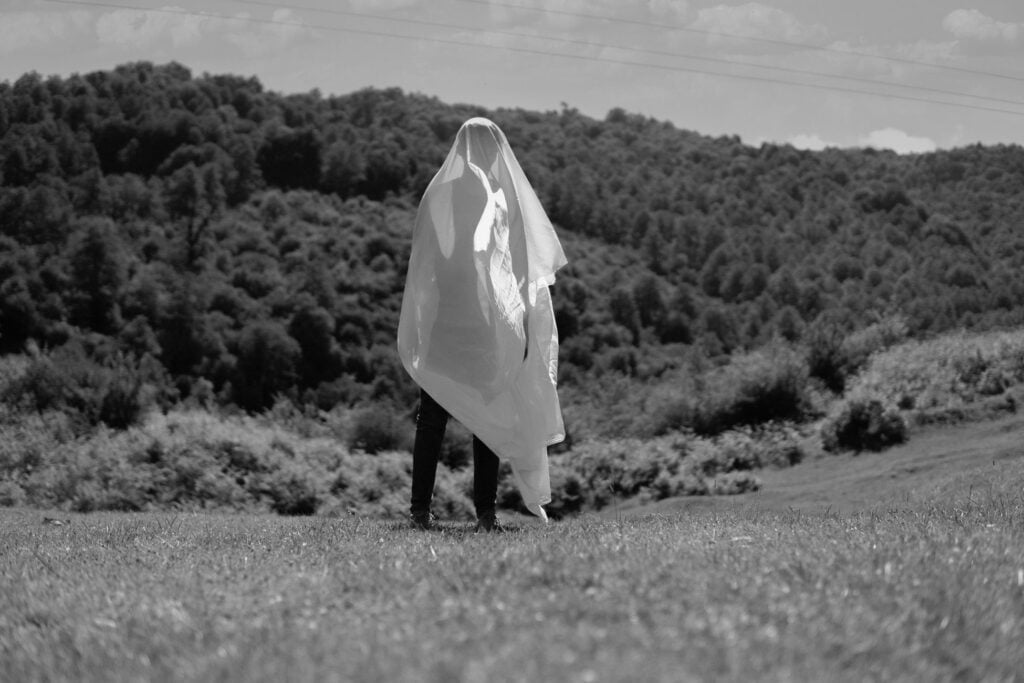
A movement built on cassettes, then MP3s
Science of Identity Foundation, the nonprofit Butler reportedly founded in 1977, distributes his teachings through recorded lectures, books published under the Siddhaswarupananda name, and a network of affiliated yoga and meditation studios. The movement has claimed adherents across Hawaii, the Philippines, Australia, and New Zealand.
Followers describe a structure in which Butler’s voice is constant and his face is absent. New initiates may spend years inside the organization without ever seeing a recent photograph of him. The cassettes carry the same 1980s cover portrait. The MP3 files that replaced them carry the same portrait scanned to digital.
The pattern is a familiar one in accounts of charismatic movements: the deliberate cultivation of distance. The leader becomes a voice, a doctrine, a felt presence. The body recedes.
The Gabbard connection
Most of what the wider public knows about Butler arrived through political coverage of Tulsi Gabbard. Gabbard was reportedly raised inside the Science of Identity community in Hawaii. Her father, Mike Gabbard, was reportedly a prominent Butler follower before his own political career. When Tulsi Gabbard ran for Congress in 2012, then for president in 2020, then was nominated as Director of National Intelligence in 2024, reporters tried to photograph her childhood guru and were unable to do so.
Major publications including The New Yorker, The Intercept, The Daily Beast, and New York Magazine have published profiles attempting to describe Butler. None of them included a current photograph. Every illustration in those pieces used the same handful of decades-old images, sometimes cropped, sometimes color-corrected, always old.

Why old photographs make a person larger
The psychology of absence has been studied for years in the context of celebrity, romance, and authority. The scarcity principle in social perception holds that people assign greater value and intensity to figures who are harder to reach. The harder it is to see someone, the larger they tend to become in the imagination of those who wait. A guru you cannot photograph is, by that logic, more compelling than one who shows up on Instagram.
A related strand of work on attraction and what psychologists describe as love’s scarcity principle suggests that limited availability tends to signal importance, and that the absence of fresh information can produce a more intense bond than constant presence does. The pattern, first mapped in romantic relationships, translates to spiritual organizations with little distortion.
What former members describe
Accounts collected over the past decade from people who left the movement describe a community organized around a leader they rarely saw. Senior followers, sometimes called the inner circle, would occasionally travel to meet him. Rank-and-file members would not.
Some former members say they spent ten or fifteen years in the organization without ever being in the same room as Butler. They listened to him every day on tape. They quoted him. They prayed to a photograph of him taken before they were born.
One former follower said she had no idea what her guru’s voice sounded like at his current age. Only what it sounded like in 1982.
The visual record, frozen
If you search for Chris Butler today, you will find perhaps a dozen distinct images. A young surfer at Sunset Beach. A robed monk lecturing in Honolulu in 1972. A close-up portrait used on cassette covers, undated but stylistically consistent with the early 1980s. A long-lens photograph that may be from the 1990s and may not be him at all.
There is no verified photograph of him aged 60. None aged 70. None aged 78, which is his current age. The man who has shaped the daily life of thousands of households for half a century is, visually, a person who stopped existing during the Reagan administration.
Historical figures whose visual record is incomplete tend to be remembered through whichever image dominates the archive. Lincoln is the bearded president, not the clean-shaven lawyer. Einstein is the white-haired Princeton sage, not the patent clerk. Butler is the young Hawaiian monk on the cassette cover, because that is the only Butler the archive contains.
The Honolulu compound
Butler is widely reported to live in Kailua, on the windward side of Oahu, in a residential property owned through trusts associated with the Science of Identity Foundation. Reporters have described high walls, mature vegetation, and no visible activity. Neighbors have reportedly said they have lived next door for decades and have never seen him.
The property is roughly seven miles from Waikiki Beach, where he learned to surf in the 1950s.
A face the size of a generation
Forty years of visual silence is an unusual span. It covers the entire commercial history of the internet. It covers the introduction of the camcorder, the digital camera, the camera phone, the selfie, and the doorbell camera. A person who has not been photographed in forty years has, in effect, opted out of the visual era of human history.
The cassettes still play. The yoga studios still open in the mornings. The portrait on the cover, taken when Ronald Reagan was in his first term, is still the face that thousands of followers picture when they close their eyes to chant. The man himself, somewhere behind the wall in Kailua, is now closer in age to his own teacher Prabhupada at death than to the young surfer in the photograph.
The image does not age. The movement, organized around it, does not need it to.