

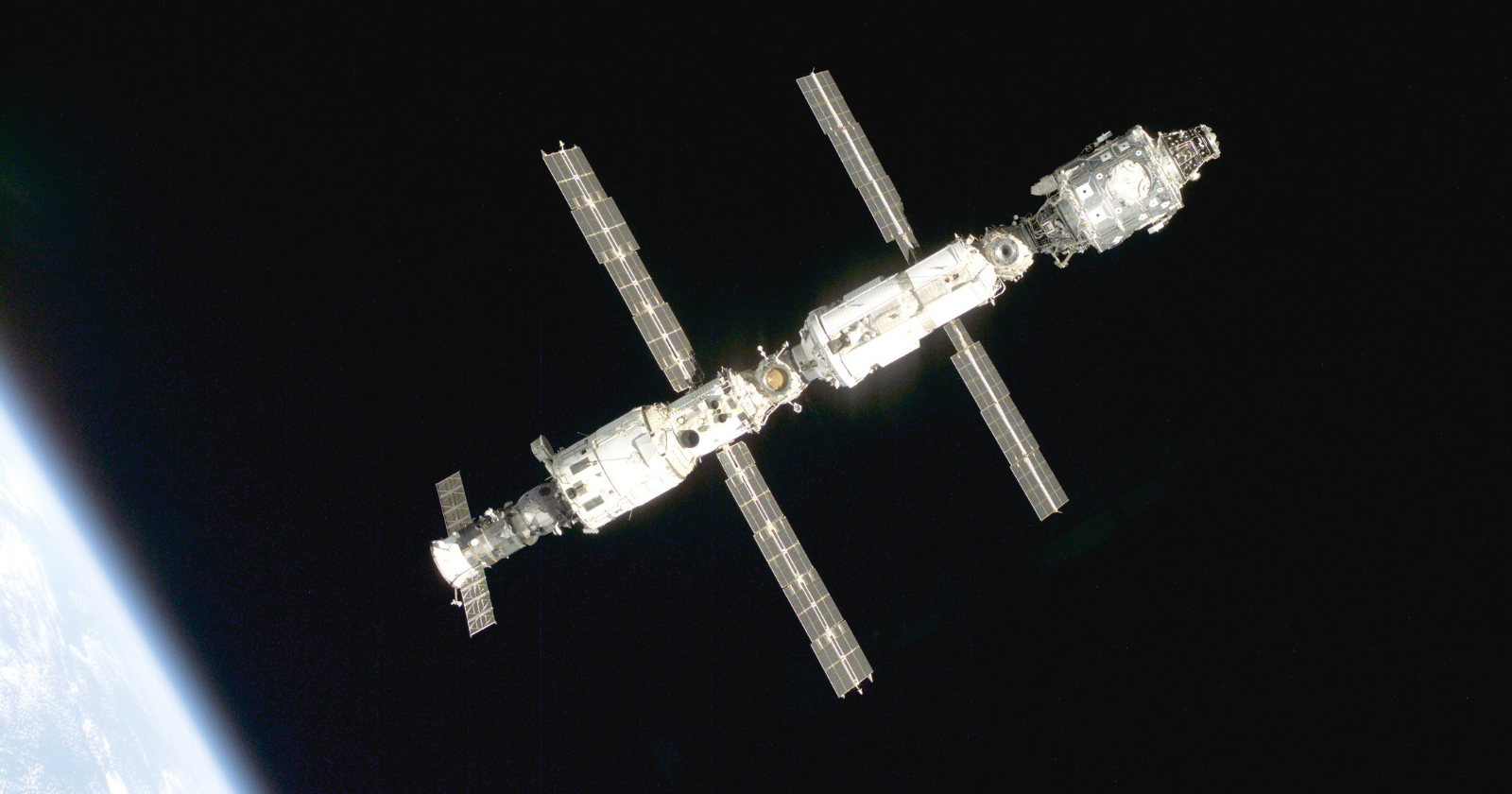
The Zvezda service module, the Russian segment that has anchored the back end of the International Space Station since July 2000, has been quietly leaking air into space for nearly seven years. The cracks are in a narrow vestibule called the PrK tunnel, which connects Zvezda to an aft docking port where Russian Progress cargo ships arrive. Roscosmos first reported the leak in September 2019, and the station has been losing breathable atmosphere ever since.
At its worst, the leak was venting roughly 1.7 kilograms of air every 24 hours. That is about the mass of a full bag of sugar, escaping silently into vacuum every day, from a pressurised volume the crew breathes.
NASA’s own safety auditors now rate the Zvezda cracks the most serious open risk on the entire station. On the agency’s risk matrix, the PrK leak sits at the top corner — the same category reserved for events that could end the mission or kill the crew.
A leak that began the year of the first Crew Dragon test
September 2019 was several months before SpaceX’s in-flight abort test in January 2020 that would clear Crew Dragon to carry astronauts. The same month, cosmonauts on the Russian side of the ISS noticed cabin pressure dropping faster than it should.
The source was traced to the PrK, a short tunnel barely wide enough for a cosmonaut in a flight suit. Russian crews spent the next several years hunting cracks with ultrasonic leak detectors, dye, and patches of Kapton tape. Each repair slowed the leak. None stopped it.
By early 2024 the daily loss had climbed to about 1.7 kg per day, prompting NASA to bring the issue to the agency’s independent safety panel. After more patching that spring, the rate fell. Then it climbed again.
What is actually cracking
The PrK is an aluminium pressure vessel welded together in the 1980s, when Zvezda was originally built as the core module of the never-completed Mir-2 station. When the Soviet Union collapsed, the hardware was repurposed for the ISS and finally launched in 2000.
The cracks are hairline, distributed along welds and stress points in the tunnel’s hull. Russian engineers believe they are the product of metal fatigue from two and a half decades of pressurisation cycles, thermal swings between sunlight and shadow every 90 minutes, and the mechanical shocks of dozens of Progress dockings.
NASA and Roscosmos do not fully agree on the cause. The two agencies have been openly at odds over the diagnosis and the fix, with the disagreement spilling into public view in technical exchanges between the partners.
The hatch that now stays closed
The operational workaround is brutally simple. When Russian cosmonauts are not actively using the PrK to receive a Progress cargo ship, they close the hatch between Zvezda and the leaking tunnel. The crack keeps venting, but only the small volume of the tunnel itself depressurises rather than the whole station.
That hatch is now opened only for cargo operations. Each time it opens, the rest of the station loses a little more air to the cracks. Each time it closes, the leak is contained again.
It is the spaceflight equivalent of living in a house with a broken window in the back porch and just keeping the porch door shut.
Why NASA flagged it the top risk on the station
The station’s overall risk register tracks hundreds of potential failures, from micrometeoroid strikes to solar array degradation. The Zvezda leak now sits above all of them.
The fear is not the current trickle. It is a catastrophic failure — a crack propagating suddenly along a weld, opening a hole faster than the crew can close the hatch. In that scenario, the four to seven people aboard would have minutes, not hours, to retreat to their docked spacecraft.
NASA has already rehearsed exactly that retreat. In one recent incident the crew was directed to prepare for evacuation and shelter inside their docked Crew Dragon while engineers on the ground assessed the leak rate.
The argument over a saw
One of the stranger sub-disputes between the two agencies has been about how aggressively to investigate the cracks. Russian engineers at one point proposed cutting into the PrK hull with a small saw to take metallurgical samples and understand the fatigue mechanism. NASA pushed back, worried that cutting into a pressurised structure with known cracks could turn a slow leak into a fast one.
That debate is emblematic of how the leak has become as much a diplomatic problem as an engineering one.
How much air the station carries
The ISS holds roughly 916 cubic metres of pressurised volume, about the interior space of a Boeing 747. The cabin is kept at sea-level pressure with a normal mix of nitrogen and oxygen.
Air is replenished from two sources: oxygen generated on board by electrolysis of recycled water, and nitrogen and oxygen flown up in pressurised tanks aboard Progress, Cygnus, and Dragon cargo ships. A loss of 1.7 kg per day is well within what the resupply chain can replace. It is not, by itself, a crisis of consumables.
The crisis is what the leak says about the hull.
Zvezda was supposed to last 15 years
When the module launched in 2000, its design life was 15 years. It is now in year 26 of continuous operation, with all the welds, seals, and feedthroughs that come with a vehicle built in the late Soviet era still holding back vacuum.
Most of those welds are doing fine. The PrK is not. And the suspicion in Houston is that whatever fatigue mechanism is cracking the tunnel may eventually appear elsewhere on Zvezda, or on the adjacent Zarya module, which is older still — launched in November 1998 as the first piece of the station.
Roscosmos has hinted at the possibility of eventually abandoning the PrK tunnel entirely, sealing the hatch permanently and giving up the aft docking port it leads to. That would cost the station one of its Progress berths but stop the bleeding for good.
The corrosion problem next door
The Zvezda cracks are not the only structural worry haunting the program. A separate manufacturing issue has surfaced on hardware being built right now for the lunar Gateway and for commercial successors to the ISS — a corrosion problem in pressure-vessel aluminium that affects the HALO module Northrop Grumman is preparing for Gateway. The defect was found before flight, but it underlines how hard it is to keep aluminium pressure shells healthy across decades.
The countdown to deorbit
NASA has committed to operating the ISS through 2030. After that, a purpose-built deorbit vehicle will push the complex into a controlled fall over the South Pacific, ending the longest continuously inhabited human outpost off Earth.
The Zvezda leak is believed to be among the factors contributing to NASA’s decision not to extend operations beyond 2030. Every additional year increases the chance that the cracks — or new ones — propagate faster than the patches can keep up.
For now, the hatch stays closed between flights. The Progress ships still dock. The air loss is still measured daily by sensors that have been counting molecules of escaping nitrogen since the Obama administration.
Somewhere in the back of the station, in a tunnel barely wider than a closet, a 25-year-old aluminium weld is still slowly letting Earth’s atmosphere out into the dark.