
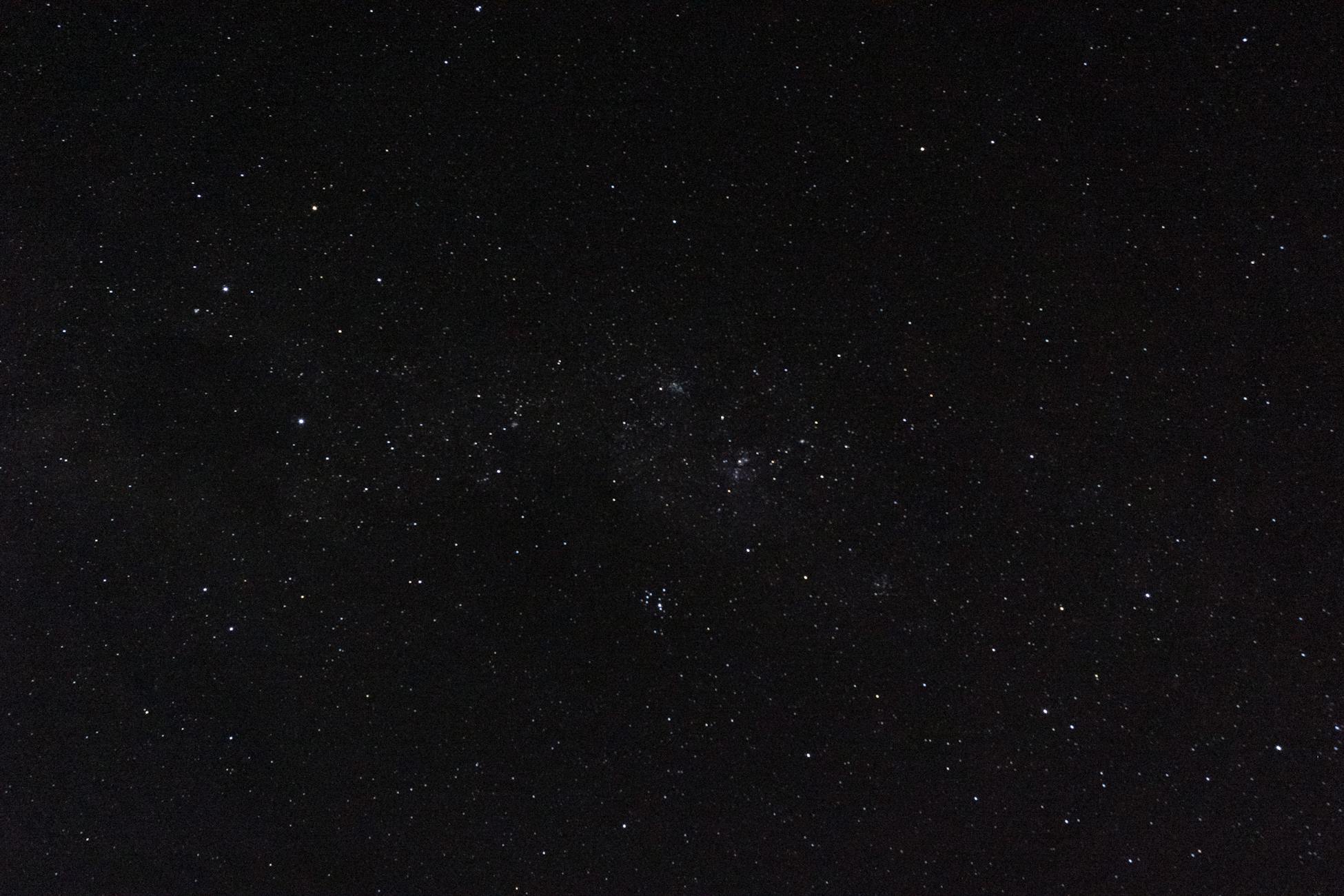
The familiar comparison runs like this: there are more stars in the observable universe than grains of sand on every beach on Earth, a fact wheeled out in planetariums and pop-science segments as the headline number that is supposed to put humans in their place. The comparison is approximately right. It is also dramatically incomplete, because the observable universe — the sphere of cosmos from which light has had time to reach Earth since the Big Bang — is almost certainly the small part. The much larger part is moving away at apparent speeds greater than the speed of light, and no signal from those regions will ever arrive at Earth. Not in a billion years. Not ever.
Most popular framings stop at the sand comparison and treat it as the punchline. That is the part of the story worth slowing down on, because the procedural reality of how cosmologists arrived at these numbers — and what they explicitly cannot see — is stranger than the headline suggests.
What the sand-grain number actually is
The standard figure cited in textbooks puts the number of stars in the observable universe at somewhere around 10^22 to 10^24 — a few hundred billion trillion. The number of sand grains on Earth’s beaches is harder to bound but is generally estimated at roughly 7.5 × 10^18. The stars win by three to six orders of magnitude depending on which estimate is trusted.
The estimate is not a count. It is a model. Nobody is sitting at a console tallying individual stars. The procedure runs through galaxy counts derived from deep-field imaging, multiplied by a typical stellar population per galaxy, with corrections for galactic mass distribution and faint dwarf galaxies that escape direct detection. Until 2016, the working number for galaxies in the observable universe was around 100 to 200 billion. Then a team led by Christopher Conselice reanalyzed Hubble deep-field data and concluded the observable universe contains roughly two trillion galaxies, ten times the previous estimate. The earlier surveys had simply missed the dim, distant ones.
That revision did not change how much light reaches Earth. It changed how astronomers accounted for what was already there. The sand comparison, in other words, was conservative for decades.
What ‘observable’ actually means
The observable universe is defined by a horizon — the comoving distance from which light emitted at the beginning of the universe could have reached an observer by now. Current measurements put that radius at about 46.5 billion light-years. The universe is roughly 13.8 billion years old, which seems to make the number nonsensical until one accounts for the fact that space itself has been expanding while the light was in transit.
This is the procedural detail that gets elided in almost every popular treatment. The photons that reach Earth from the most distant galaxies left their sources roughly 13 billion years ago, but the galaxies that emitted them are now much farther away than the photons traveled, because the space between them has stretched during the journey. The light is old. The source is no longer where it was when the light departed.
And the stretching is accelerating. Recent work cataloged in a large international measurement of the Hubble constant continues to refine — and complicate — the rate at which the universe expands. The disagreement between methods, the so-called Hubble tension, has not gone away. What is uncontested is the direction: the rate is large enough that there is a distance beyond which the recession velocity exceeds the speed of light.
The part that violates nothing
This is the point at which most readers raise an objection, and it is a fair one. Nothing can move faster than light. That is a foundational result of special relativity, and it is correct as stated.
The recession is not motion through space. It is the expansion of space itself, and special relativity places no speed limit on that. Two galaxies sitting still relative to their local spacetime can nevertheless find the distance between them growing faster than light can cross it, because new space is being added between them everywhere along the line. The effect is not a metaphor, not a thought experiment, and not a rounding error in the equations. It is a direct consequence of general relativity applied to a homogeneous expanding cosmos, and it has been the working framework of cosmology since Edwin Hubble’s redshift measurements in the late 1920s.
The practical implication: there is a sphere centered on Earth, currently about 16 billion light-years in radius, beyond which any photon emitted today will never reach this region. This is the cosmological event horizon. Galaxies outside it are not hidden temporarily. They are causally severed.
How much is out there that cannot be seen
The honest answer is that nobody knows. The observable universe is bounded. The universe itself may not be. Estimates of the total universe — based on inflationary models, on the measured flatness of spacetime, on the absence of detectable curvature out to the horizon — generally suggest the unobservable portion is at minimum several hundred times larger than what can be seen, and potentially infinite.
Some recent theoretical work pushes harder on the question. A paper highlighted by EurekAlert proposes that primordial black holes from before the Big Bang may still shape the structure of the current universe, an idea that only makes sense if one takes seriously the possibility that the observable cosmos is a small sample of a much larger and older process. Separately, a new quantum-gravity framework out of the University of Waterloo reframes the Big Bang itself as a bounce rather than a beginning. Both proposals are speculative. Both depend on accepting that the measurable cosmos is merely a slice of an unobservable whole.
A more accessible discussion of how cosmologists infer the existence of the unobservable regions beyond the horizon walks through the geometric and inflationary arguments without committing to any single number. The argument is essentially this: the universe appears statistically uniform out to the edge of the observable region, which is exactly what would be expected if the visible patch is one ordinary region inside a much larger volume. The alternative — that Earth happens to sit at the center of a finite cosmos whose boundary aligns with the observational horizon — would be an extraordinary coincidence.
What the headlines miss
The sand-grain comparison works as a hook because it makes the universe feel comprehensible. A beach. A handful of sand. A scaling factor large enough to be impressive but not so large as to break the imagination. The comparison is doing a service.
It is also doing a disservice, because the comparison treats the observable universe as if it were the entire universe. It is not. It is the part of the universe that has had time to send a signal to Earth. Beyond that boundary, galaxies are not merely far away; they are receding so fast that the light they emit today is being stretched, redshifted, and outpaced by the expansion of space. Their photons are losing the race.
Some of what is currently visible is already on the wrong side of that ledger. Galaxies whose ancient light is just now arriving have, in the time it took that light to travel, drifted into the unreachable region. These observations represent cosmic fossils. The light is real. The sources, as they exist now, are no longer in the causal future of Earth. The final messages from these regions have already been received without human awareness.
This is the same epistemological problem that runs through deep-field cosmology more generally. Previous coverage has explored how JWST is observing galaxies that shouldn’t exist under the cosmological model the telescope was designed to test. The observations keep arriving faster than the theory can absorb them. What the universe looks like depends on what can be detected, and what can be detected depends on a horizon that is itself moving.
Why the scale matters, and why it doesn’t
The numbers — 10^22 stars, two trillion galaxies, 46.5 billion light-years, a likely much larger unobservable region — invite a kind of vertigo that has its own literature. Existential and meaning-making frameworks have circled cosmic scale for decades, and clinical work in existential therapy treats encounters with vastness as legitimate triggers for the reorganization of personal meaning. Other writers on this site have looked at the empirical case that stargazing produces measurable cognitive benefits, often framed through the awe literature.
An important procedural caveat is that the vertigo is partly a category error. The observable universe is finite, knowable in principle, and steadily being mapped. The unobservable universe is not part of the same epistemic project. It is the boundary condition of the project. The sand-grain comparison flattens the distinction, which is fine for a metaphor and wrong for a model.
What deserves slowing down on is the asymmetry. The thing that can be counted is dwarfed by the thing that cannot. The portion of the cosmos that will ever causally interact with Earth is shrinking, in a comoving sense, as the expansion accelerates. The future visible universe is smaller than the present one. Eventually — on timescales of trillions of years — galaxies outside the local cluster will cross the cosmological horizon and disappear from view. Observers in that distant epoch will see a much emptier sky than contemporary observers do, and the cosmological evidence currently relied upon will be inaccessible to them.
The sand on the beach, in other words, is not just outnumbered by the stars in the observable universe. It is outnumbered by stars in a region that is itself a vanishing minority of what exists, framed by a horizon that is closing. The comparison was always more conservative than it sounded. It is becoming more conservative every second.
