
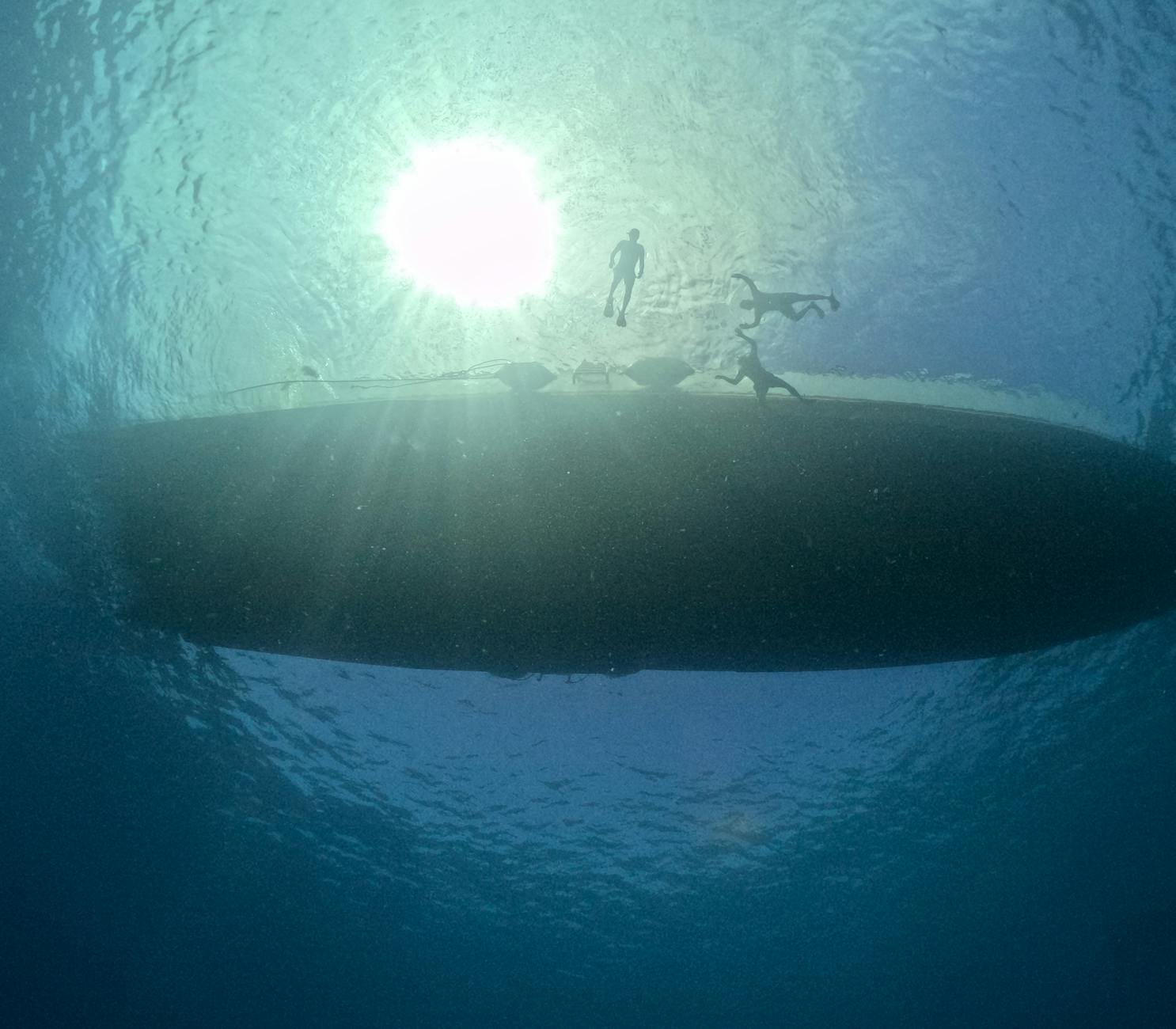
The reason the population of the planet exists in its current configuration is, on the available evidence, a vote taken by three men in a sweltering metal tube beneath the Caribbean Sea on October 27, 1962. The vote was two-to-one in favor of firing a nuclear torpedo at an American aircraft carrier leading the destroyer group that had been dropping practice depth charges on their submarine for nearly twelve hours. The dissenting vote belonged to a Soviet naval officer named Vasili Arkhipov. He was not the captain. He was not the political officer. He was the flotilla chief of staff who happened to be aboard, and Soviet protocol on that particular vessel required unanimity among the three senior officers before the special weapon could be released.

The standard Western narrative of the Cuban Missile Crisis tends to frame it as a contest of wills between two men — Kennedy in the Oval Office, Khrushchev in the Kremlin — resolved through statesmanship and back-channel diplomacy. The closer one examines the actual operational record, the more this framing distorts what happened. The crisis did not turn on the negotiation. It turned on a junior officer in international waters who had no contact with Moscow, no contact with Havana, no contact with anyone above him in the chain of command, and who refused to authorize the use of a nuclear weapon against a U.S. Navy task force.

The Submarine the Americans Did Not Know Was Nuclear

The vessel was B-59, a Foxtrot-class diesel-electric submarine, one of four Soviet boats dispatched to support the Cuban deployment. American intelligence assessed at the time, and for decades afterward, that the Soviet submarines screening the Cuban approaches carried only conventional armament. This assessment was wrong. Each of the four boats carried a single nuclear torpedo with a yield comparable to the Hiroshima device. The launch authority for that weapon, by Soviet naval regulation governing this specific class of mission, required the concurrence of the captain, the political officer, and the senior officer of the flotilla if one was aboard. On three of the four submarines, only two signatures were required. On B-59, by coincidence of staffing, three were required.

The conditions inside the submarine on October 27 were, by every available account, beyond what the vessel had been designed to tolerate. Internal temperatures had climbed past fifty degrees Celsius. Carbon dioxide levels were causing crew members to lose consciousness. The boat had been submerged and pursued for hours. The depth charges being dropped by the American destroyers were signaling charges — the U.S. Navy had communicated through diplomatic channels that this was a procedure intended to surface Soviet submarines for identification — but the diplomatic notice had not reached the captains of the submarines, who had been out of radio contact with Moscow for days. The men aboard B-59 believed, on the information available to them, that the war had already begun.

Interior view of a ship's bridge with panoramic sea view in Spain.

What the Vote Actually Was

Captain Valentin Savitsky, by the surviving Soviet accounts, ordered the nuclear torpedo prepared for launch. The political officer concurred. The recorded exchange, reconstructed from later interviews with surviving officers and Soviet naval records released through the National Security Archive in 2002, has Savitsky expressing determination to fire on the American ships. Arkhipov refused. He argued that the depth charges were not lethal — they were detonating to one side of the hull, not on it — and that the protocol for engaging without explicit Moscow authorization had not been satisfied. He demanded that the submarine surface and attempt radio contact before any weapon was released.

The dispute, by the available reconstructions, lasted somewhere between several minutes and roughly an hour. The captain eventually relented. B-59 surfaced into the middle of an American destroyer formation, identified itself, and was permitted to withdraw northeast under U.S. observation. The nuclear torpedo was never armed. The crew returned to the Soviet naval base at Sayda Bay in late December and were, by most accounts, treated as having failed in their mission for the offense of having been forced to surface. Arkhipov received no commendation. The incident did not appear in his service record in any form that identified what had actually occurred.

Why the West Did Not Know

The detail that B-59 had carried a nuclear torpedo at all was classified within the Soviet Navy and remained so through the end of the Cold War. American naval intelligence, having tracked and pursued the submarine, did not learn that they had been within minutes of a nuclear detonation against their own task force. The crisis was, in the public memory of the West, resolved on October 28 when Khrushchev agreed to withdraw the Cuban missiles in exchange for the eventual removal of American Jupiter missiles from Turkey. The submarine incident was a footnote, if it was anything.

The first substantive public disclosure came in 2002 at a conference in Havana convened to mark the fortieth anniversary of the crisis. Thomas Blanton, then director of the National Security Archive at George Washington University, presented declassified Soviet naval records and a detailed account assembled from Russian veterans of the deployment. It was at this conference that Blanton offered the formulation that has since circulated widely: that a man named Vasili Arkhipov had saved the world. Arkhipov himself had died in 1998, four years before the conference, from kidney cancer attributed to radiation exposure from an earlier incident aboard the Soviet submarine K-19 in 1961. He never lived to hear the phrase applied to him. His widow, who attended the 2002 conference, confirmed that her husband had spoken of the B-59 incident only rarely and had not regarded what he did as remarkable. He had, on her account, regarded it as the correct application of naval protocol.

Neatly arranged blue office binders labeled with dates and names for organized storage.

The Mechanics of Refusal

The question of what allows a single officer to dissent under conditions of extreme stress, isolation, and apparent imminent death is one that has occupied military psychologists and decision-theorists for the period since the disclosure. Arkhipov had been the deputy commander of K-19 in July 1961 when a reactor coolant leak required crew members to enter the reactor compartment and improvise a cooling system using bare hands and unshielded clothing. Eight men died within weeks. Fifteen more died within two years. Arkhipov watched the engineering crew die slowly of radiation poisoning, and he had, by the available accounts, formed a precise view of what nuclear release actually meant at the level of human bodies. The dynamics of moral reasoning under extreme operational pressure in military command settings remain a subject of significant interest, and the K-19 experience appears, on the available record, to be the structural reason Arkhipov was the one officer aboard B-59 who would not sign the authorization.

It is worth being precise about what the alternative would have been. A nuclear detonation against the American carrier would have destroyed the carrier and most of its escorts. The American response, on the standing nuclear war plans of October 1962, would not have been calibrated. SIOP-62, the Single Integrated Operational Plan in effect at the time, contemplated only one option for nuclear engagement with the Soviet Union, and it involved the simultaneous launch of thousands of warheads against Soviet, Chinese, and Eastern European targets. Soviet response doctrine was similarly maximalist. The estimated immediate fatalities exceeded five hundred million. The estimated subsequent fatalities from fallout, infrastructure collapse, and the climatological effects later modeled as nuclear winter exceeded one billion. The genetic bottleneck through which the surviving human population would have passed would have, on every credible model, produced a planet whose current inhabitants were not the inhabitants who exist now.

The Erasure of the Name

The phenomenon of a pivotal historical actor remaining unknown to the population he saved for four decades is, on close examination, not unusual. The mechanisms of collective memory and selective historical attention tend to organize around figures whose decisions were public, whose decisions produced visible effects, and whose decisions could be incorporated into the existing narrative architecture. Arkhipov’s decision produced an absence — the absence of a war that did not happen — and absences are not, in the cultural register, the kind of thing around which commemoration organizes. The American narrative of the crisis required American protagonists. The Soviet narrative of the crisis, particularly through the late Brezhnev period and the dissolution of the Soviet military establishment, had no incentive to publicize an episode in which a Soviet captain had ordered a nuclear launch and a Soviet officer had refused it. The relevant Soviet naval archives sat in storage. The participants aged. The history was not so much suppressed as structurally unavailable to the systems that produce public memory.

The broader pattern, examined elsewhere in historical reviews of Soviet military disclosure during the late perestroika period, holds: institutional histories of the Soviet armed forces released only what could be released without political cost, and the B-59 incident carried political cost in every direction. It implicated the captain. It implicated the chain of command that had dispatched nuclear-armed submarines without functional communications. It implicated the protocols themselves. It was easier to leave the file closed.

What the Disclosure Changed and Did Not Change

The 2002 disclosure produced a small wave of recognition. Arkhipov was awarded the Future of Life Award posthumously in 2017. A documentary was produced. His daughter Elena gave interviews. The name entered the periphery of public knowledge in the way names enter peripheries — referenced occasionally as having saved the world, deployed in discussions of nuclear risk reduction. The structural facts of the incident, however, did not produce the policy revisions that the incident would seem to require. Nuclear weapons remain deployed on submarines under launch protocols that, in some configurations, require fewer concurring officers than B-59 required. The assumption that the system depends on the judgment of individual officers in moments of communication failure remains the operational baseline of every nuclear-armed navy. The fact that this assumption held on October 27, 1962, was, on the available evidence, a function of which officer happened to be aboard which submarine on which day. The reason most people alive today exist is that the staffing assignment for the Soviet 69th Submarine Brigade in the summer of 1962 placed a particular flotilla chief on a particular boat. The system did not save itself. A man whose name was unknown for forty years did, and the disclosure has not altered the system that required him.