
Isabel Joy Bear and Richard Thomas, two researchers working at the Commonwealth Scientific and Industrial Research Organisation in Melbourne, gave the smell of first rain its name in a 1964 paper. They called it petrichor, combining Greek roots for stone and ichor, the fluid said to run in the veins of the gods. What they had isolated, after distilling rocks and clay that had been baked in the Australian sun, was a yellowish oil that plants had been quietly sweating into the soil for weeks, waiting for water to release it back into the air.
The smell is ancient. The bacteria that produce its sharpest note have been making the same molecule for a very long time.
And the human nose, it turns out, is tuned to it with astonishing precision.
The molecule you can smell at astonishingly low concentrations
The bacterial note is called geosmin. It comes mostly from Streptomyces, a genus of soil microbes that release it when they sporulate, and it is the same compound that gives beetroot its earthy taste and gives a muddy catfish its muddy flavour. Geosmin is, chemically, a bicyclic alcohol: a small, stable ring molecule that drifts easily through air and water.
Researchers led by Dietmar Krautwurst at the Leibniz Institute in Germany pinned down the human odorant receptor for geosmin in 2024, identifying OR11A1 as the protein responsible. It is unusually sensitive. In water, the threshold at which many people can detect geosmin sits around 4 to 10 nanograms per litre, an amount so small that ScienceDaily compared it with roughly a teaspoon of geosmin in the water volume of 200 Olympic swimming pools.
That is the more interesting comparison anyway. The point is not that the human nose beats some other animal in a neat contest. It is that one earthy molecule, released from soil after rain, occupies a strangely privileged place in our sensory world.
Why we are so good at smelling dirt
One explanation is that early humans may have used geosmin as a signal of water. The scent of damp soil carries downwind, and a nose sensitive to geosmin would have been useful for finding water on a dry plain. The same receptor that warns a modern shopper that the beetroot has turned would once have helped a thirsty ancestor notice a damp streambed.
Geosmin is also, paradoxically, a warning. At higher concentrations in drinking water, it can signal microbial activity, and water systems often use filtration methods to remove earthy and musty compounds before they reach the tap.
The oil the plants make
Bear and Thomas’s original contribution was not geosmin. That came later. Their work focused on the plant side of petrichor. During a long dry stretch, certain shrubs, grasses and trees secrete fatty acids and terpenes from their leaves and roots, and these compounds accumulate in the dust and porous rocks around them.
The chemistry overlaps with the molecules plants release when they are trying to hold onto water. Recent work on drought adaptation has shown that guard cells controlling leaf pores produce specific lipids and signalling compounds during water stress, part of a chemical toolkit that is hundreds of millions of years old.
Those oils sit on clay and stone like a slow varnish. When the first heavy drops finally fall, they punch the oils loose and aerosolise them in microscopic droplets.
The aerosol mechanism, filmed at high speed
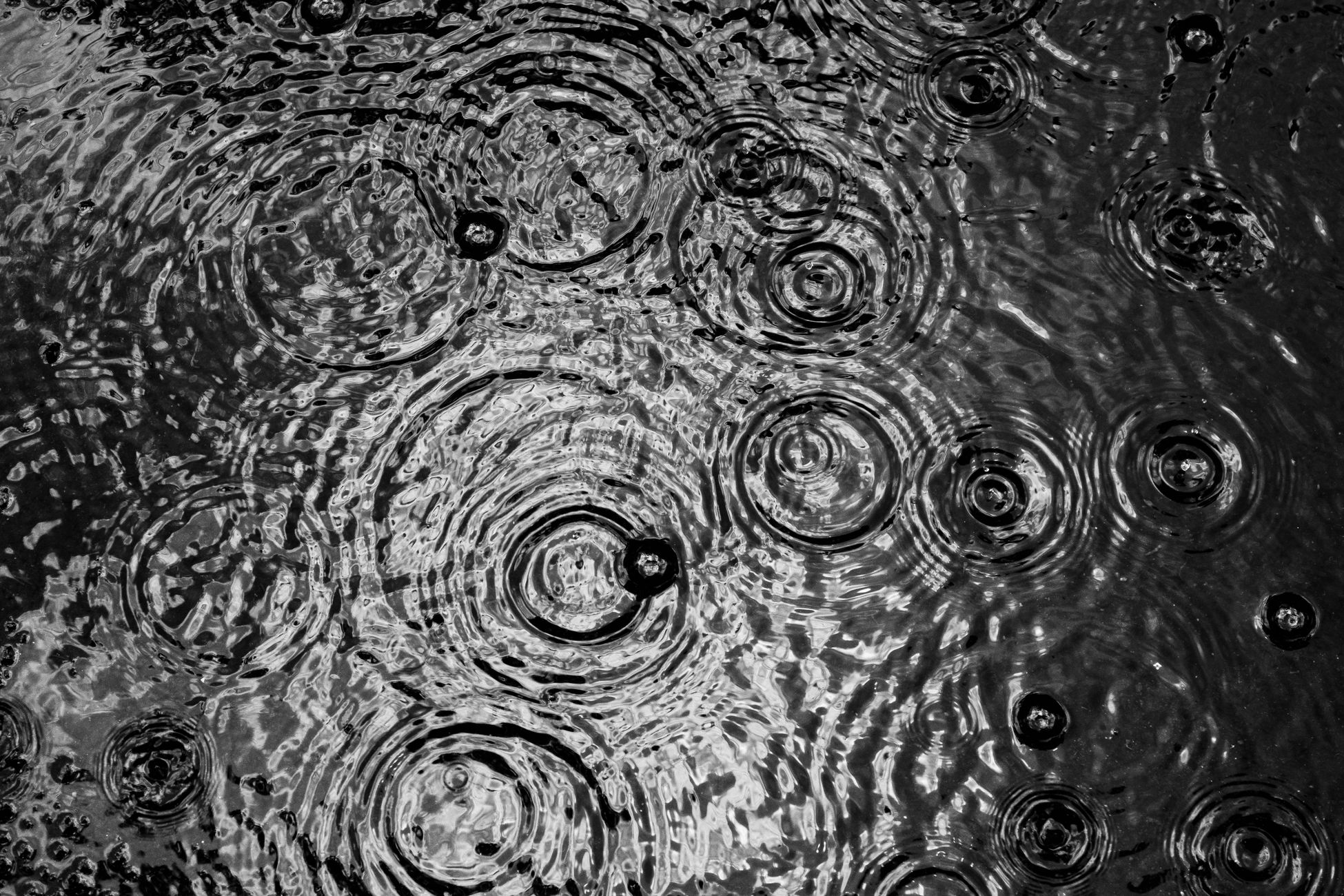
For decades, nobody had actually watched petrichor form in the air. Then in 2015, researchers at MIT used high-speed cameras over multiple surfaces, including sandy loam, silt, glass and porous brick, and dropped water on them under controlled conditions.
What the footage revealed was unexpected. A single raindrop, on hitting a porous surface, traps tiny bubbles of air against the substrate. Those bubbles rise through the drop and burst at the surface, flinging a fine mist of aerosols, sometimes hundreds of them per drop, straight up into the air.
Each aerosol carries with it whatever was sitting on the surface: plant oils, geosmin, bacterial spores, and sometimes microbes. That is how petrichor leaves the ground and reaches the nose, and it may also help explain how some soil-borne material spreads in the first minutes of a rainstorm.
The effect is strongest on light or moderate rain falling on warm, dry soil. A heavy downpour on already-wet ground produces almost no petrichor at all, because there are fewer trapped air pockets to launch the aerosols.
The third note: ozone
There is a sharper, more electric smell that often precedes rain by minutes, especially before a thunderstorm. That one is ozone, O3, generated when lightning splits ordinary oxygen molecules and they recombine in a three-atom form.
Downdrafts from the storm can carry ozone down toward ground level ahead of the rain itself. The Greek root of the word, ozein, meaning to smell, reflects the distinctive odour noticed in early chemistry experiments with electrical discharge.
So the full bouquet of an approaching summer storm is layered: ozone first, sharp and metallic; then geosmin, earthy and damp; then the plant oils, sweeter and more vegetal, as the rain works the soil.
Why the smell feels like memory
Olfactory signals take an unusually short route into the brain. The olfactory bulb feeds into brain regions closely involved in emotion and memory, including the limbic system, amygdala and hippocampus. That anatomical shortcut is why a single whiff of something can pull up a childhood afternoon with more force than a photograph.
The cognitive role of smell is still being studied, but the basic point is familiar to anyone who has been ambushed by a scent from childhood: smell is not just information. It arrives with feeling attached.
Petrichor, then, is doing a particular kind of work on the brain. It is delivering a molecule the species has been smelling for as long as it has had noses, through a pathway built for survival, in a sensory channel wired unusually close to the parts of the brain that store meaning.
The bacteria’s side of the story
Why Streptomyces bothers to make geosmin at all was a mystery for a long time. The compound costs energy to produce and serves no obvious metabolic purpose. One explanation is that geosmin functions as a recruitment signal.
Springtails are drawn to the smell, walk through Streptomyces colonies, and carry the bacteria’s spores away on their bodies, dispersing them to new patches of soil. Geosmin is, in effect, the bacterial equivalent of a flower’s scent: an advertisement to a mobile partner.
The human nose simply tapped into a chemical conversation that was already going on between bacteria and bugs.
Why first rain smells stronger than later rain
A long dry spell is what charges the system. Plant oils accumulate on rocks and soil over weeks of drought. Streptomyces populations build up in the upper millimetres of soil where moisture lingers longest. Spores sit dormant, waiting.
The first rain after weeks of dry weather releases all of that at once, in a pulse. A second rain a day later finds the reservoirs depleted, the bacteria still wet, the oils washed away. The smell is fainter, sometimes gone entirely.
That is why the petrichor of the first August thunderstorm after a July drought is something people remember for years, while the rain that comes the following Tuesday smells like nothing in particular. The molecules are spent.
The smell at near-unimaginable concentration
Hold the number in mind for a moment. A few nanograms per litre is not the language of ordinary life. It belongs to laboratories, water-quality testing and instruments designed to notice what most of us cannot measure. Yet the nose notices.
The receptor that detects geosmin is one of roughly 400 types of olfactory receptors in the human nose, and most of them are not tuned to one molecule with anything like the same narrative drama.
The nose has its blunt instruments and its scalpels. Geosmin gets the scalpel.
It is worth thinking about that the next time the sky darkens over hot pavement and the first warm drops start falling. The smell drifting up from the kerb is not a mood or a memory trick, although it produces both. It is a real, measurable cocktail of bacterial chemistry, plant chemistry and electrical chemistry, released by tiny bubbles bursting against soil, carried into a nose that may have been shaped by evolution to notice water on a dry plain.
The dinosaurs smelled it too. Their version of geosmin came from the same family of bacteria, drifting up from the same wet earth, hundreds of millions of years before anyone gave it a name from a Greek word for stone.
