
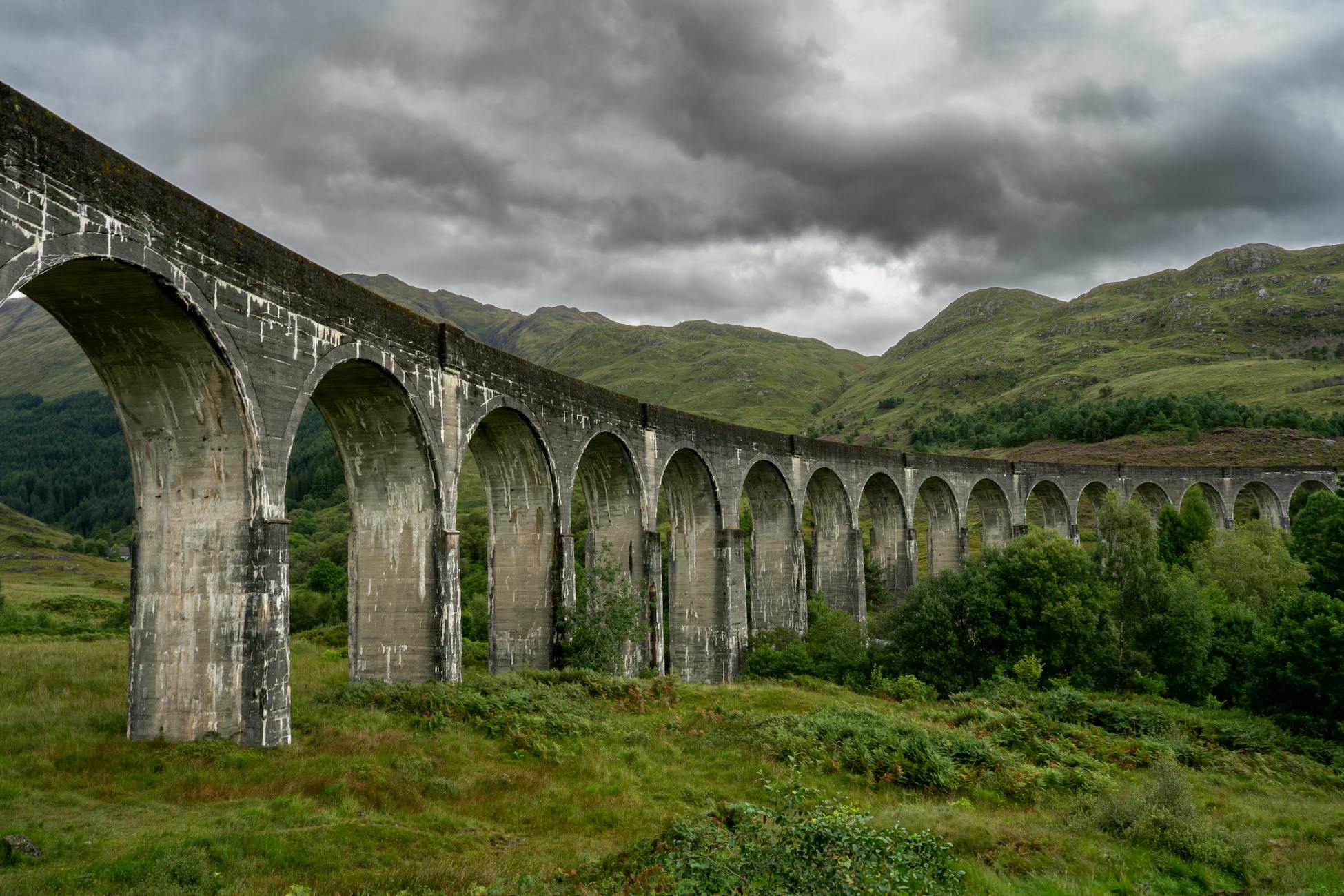
The Overtoun Bridge sits above Overtoun Burn in Milton, near Dumbarton, a Victorian arched span of red sandstone reached by a tree-lined drive that ends at a small baronial house. It is a handsome structure, built for a grand approach. It is also a place where, over several decades, hundreds of dogs have leapt from the same few feet of parapet onto the rocks below.
The leaps almost always happen on clear, dry days. Almost always from the last stones of the right-hand side as you walk away from Overtoun House. Almost always by long-nosed breeds, the collies, labradors, retrievers and spaniels whose olfactory machinery is built for following a thread of scent through a hedge.
For a long time, nobody could say why.
A bridge with a body count
The parapet is solid stone, waist-high on a person, and from the footpath a dog cannot see over it. To a dog walking across, the bridge feels like a corridor with high walls.
What the dog can do, and the human cannot, is smell what is happening below.
Local accounts of dogs jumping go back decades. The story attracted serious attention in the early 2000s when residents and the Scottish SPCA began counting incidents. Estimates vary, but the running tally repeated in Scottish press coverage and in interviews with locals includes hundreds of jumps, with dozens of fatalities, the rest surviving the fall onto the rocks and shallow water below.
Survivors sometimes climb back up and try to jump again. That detail, more than anything else, is what convinced investigators that something specific was pulling the animals over.
Enter David Sands
The Scottish SPCA commissioned David Sands, an animal behaviourist, to work out what was happening. Sands started by ruling things out. He looked at the ghost stories, the suggestion that Overtoun House and its grounds were haunted, and set them aside. He looked at the idea, popular in tabloid coverage, that the dogs were depressed or suicidal, and set that aside too. Dogs do not form the abstract intention to end their lives. The assumption that they might is a projection, the kind of humanising reflex that turns an animal’s behaviour into a human narrative.
He looked at the bridge instead. The weather on the days when jumps occurred. The breeds involved. The exact spot on the parapet. The conditions underneath.
The pattern in the data
The clustering was striking. Jumps happened on dry, clear days. They happened almost exclusively from the right side of the bridge looking away from the house, within the last two parapet stones before the end of the span. And they overwhelmingly involved long-snouted breeds with the densest olfactory hardware.
Dogs experience the world primarily through smell. They have around 300 million olfactory receptors compared with roughly six million in humans, and a dedicated vomeronasal organ for parsing the chemistry of other animals. As one recent review put it, scent is how dogs largely experience the world, the way humans rely on sight. Trained scent dogs can pick up target odours from impressive distances, in some controlled tests more than a kilometre away.
So Sands went looking for what, exactly, was being smelled.
The mink in the stones
Underneath the right-hand end of the parapet, in the dense vegetation and rock crevices that drop down toward Overtoun Burn, Sands and his team found evidence of small mammals living in the structure. Mice. Squirrels. And American mink, an introduced species that had spread across Scottish waterways.
Mink produce a strong, musky anal secretion used for territorial marking. It is one of the most pungent scents in the British mammalian fauna, instantly interesting to a predator-descended nose.
Sands ran a test with a group of dogs, presenting them with three scents: mink, squirrel and mouse. The majority went straight to the mink and showed strong investigative behaviour. The other two drew much weaker responses.
Combine that with the geometry of the bridge. A long-nosed dog walking across on a dry day catches a thread of mink scent rising up the stonework. The parapet blocks visual information. The dog cannot see that there is a drop on the other side. It can only smell that something extremely interesting is right there, just over the wall. It jumps the way it would jump a garden fence to chase a rabbit.
The breed bias fits. Brachycephalic breeds, the pugs and bulldogs with compressed snouts, have a fraction of the scent-receptor surface area of a collie or a labrador and are less likely to register a faint mammalian musk drifting up from a crevice. Across the wider animal kingdom, scent sensitivity varies enormously by anatomy, and biologists have long debated which species sits at the top of the olfactory league table. The weather bias fits the chemistry. Volatile compounds disperse in dry, still air; rain scrubs them out. On a wet Scottish afternoon, the mink scent never makes it up to nose height. On a dry one, it climbs the sandstone like smoke up a chimney.
What the jumping actually looks like
Owners who have witnessed it describe the same sequence. The dog is walking normally, often off the lead. It reaches the end of the bridge. Its body language changes, the tail goes up, the head lifts, the nose works. It moves toward the parapet with sudden intent. It does not hesitate at the wall. It scales the stones in a single motion and is gone.
The behaviour is not despair. It is the same focused, almost trance-like pursuit a dog shows when it locks onto a squirrel in a tree. Olfactory cues can trigger powerful approach behaviours in dogs, overriding caution about terrain that the animal has not actually surveyed. The bridge weaponises that override.
The other complication
Sands has been careful not to claim mink scent explains every single incident. Some of the dogs involved over the decades may have fallen rather than jumped, chasing real prey across the parapet edge. Some accounts have been retold and inflated. Counting dog jumps from a Victorian bridge is not a tidy dataset.
Researchers who work on animal behaviour have spent the last two decades trying to tighten methods against observer bias, recognising how easily a vivid hypothesis shapes the interpretation of what an animal is doing. The Overtoun investigation lives in that tension. The scent explanation is the strongest one available, supported by the breed pattern, the weather pattern, the location pattern, and the presence of mink in the structure. It is not a controlled experiment.
What still happens at the bridge
After the Sands report, signs were put up at both ends of the bridge warning owners to keep dogs on leads. The signs are still there, weathered, in plain English.
They have not closed the case. Dogs still jump from Overtoun Bridge. The incidents are less frequent than they once were, in part because owners who know the story now leash their animals before they cross. But every few years another collie or labrador goes over the same right-hand parapet on another clear, dry afternoon, and another household learns that the warning sign was meant for them. The mink are still in the stonework. The geometry of the bridge has not changed. The dogs that walk across it on a dry day are still walking into the same trap their predecessors fell into in the 1950s, and a sign in plain English, addressed to humans, is the only thing standing between them and the rocks below.
