
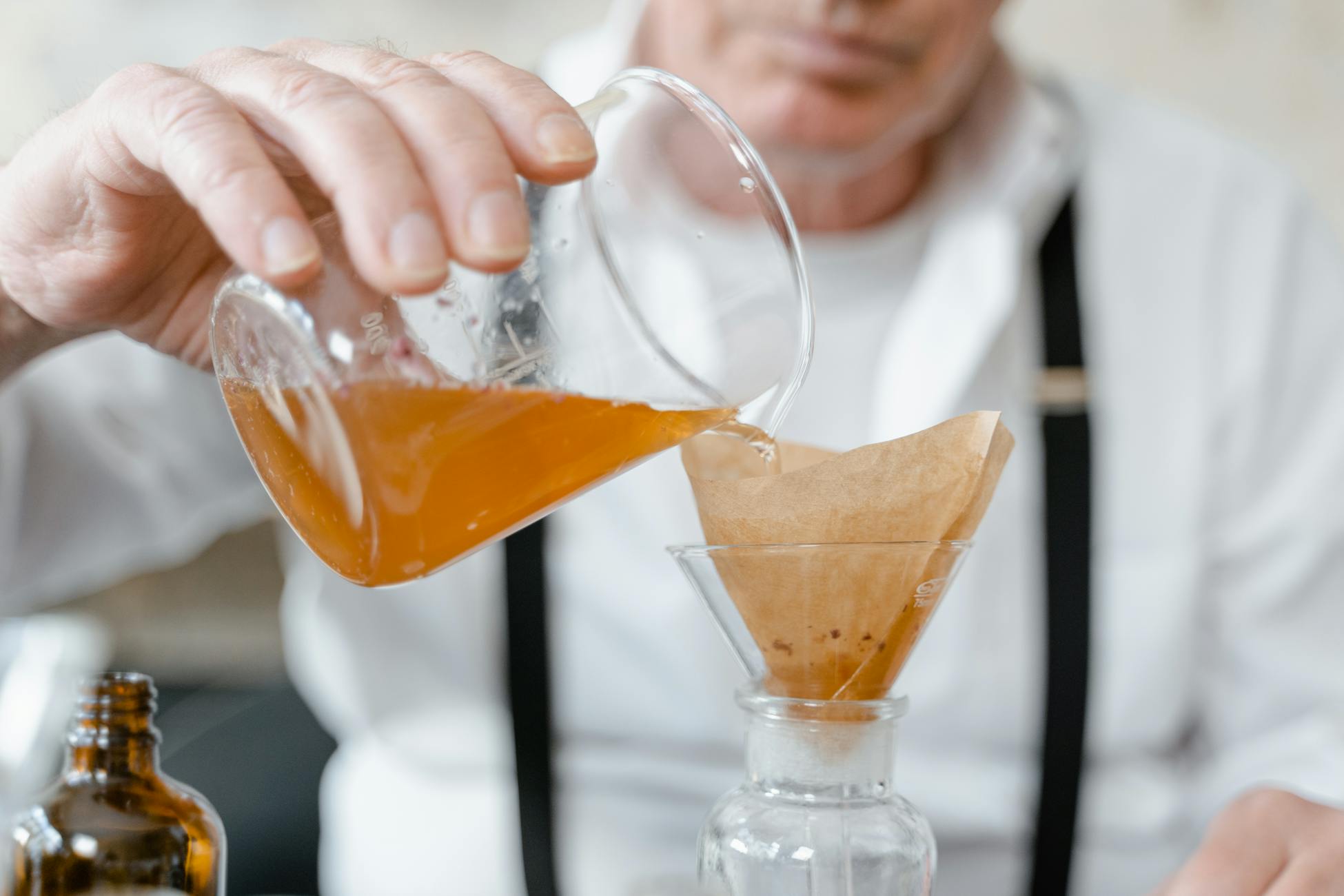
Inside a glass bell jar at the University of Queensland in Brisbane, a black blob of pitch has been slowly stretching toward the bottom of a funnel since 1927. The experiment was set up by Thomas Parnell, a professor of physics, who wanted to show his students that a substance hard enough to shatter with a hammer at room temperature is in fact a fluid, just an extraordinarily slow one. Nine drops have fallen in the 98 years since. Not a single human being has ever seen one land.
The pitch is a derivative of tar, the same material once used to waterproof wooden ships. Parnell heated a sample, poured it into a sealed glass funnel, and let it settle for three years before cutting the funnel’s stem in 1930 to let gravity begin its work. He died in 1948, having watched only two drops fall, and never witnessing either one in motion.
A funnel, a beaker, and a century of patience
The apparatus itself is almost comically humble. A glass funnel about the size of a kitchen measuring cup sits clamped above a beaker, both enclosed in a bell jar to keep dust out. The pitch, the colour of crude oil and twice as stubborn, hangs in a long thin tendril stretching from the funnel’s mouth. To the eye it looks frozen. Watch it for an hour and nothing changes. Watch it for a year and the bulge at the bottom has grown perceptibly larger.
The viscosity of the pitch has been calculated at roughly 230 billion times that of water. A drop forms, swells, narrows at the neck, and finally separates from the mass above. The interval between drops has varied across the decades, partly because of changes in air conditioning in the building. Early drops fell every eight or nine years. After climate control was installed, the wait stretched to twelve or thirteen.
The professor who took over and waited 52 years
After Parnell’s death, the experiment was inherited by John Mainstone, a physicist who became its custodian and held the role until his own death in 2013. Mainstone watched the funnel for decades. He missed the fall of the seventh drop in 1988 because he stepped out for a cup of tea. He missed the eighth drop in 2000 because a webcam set up to record it malfunctioned during the precise minutes the drop detached. He missed the moment three times in total, by minutes or hours, across half a century.
For his sustained near-miss, Mainstone was awarded the Ig Nobel Prize in physics, jointly with Parnell, the latter posthumously. The Ig Nobel honours research that first makes people laugh and then makes them think. Mainstone accepted the award with characteristic grace and continued his vigil. He died in 2013, still never having seen a drop fall in person.
The Trinity College drop that broke the curse
There is a second pitch drop experiment, set up at Trinity College Dublin in 1944 by a physicist whose name has been lost from the records. It sat largely forgotten on a shelf in the physics department for nearly seven decades. In April 2013, researchers at Trinity finally captured what generations of physicists at Queensland had failed to see. A webcam trained on the Dublin funnel recorded a drop of pitch detaching and falling into the beaker below, the first time the event had ever been observed by human or machine. The footage shows a slow, almost reluctant separation, the kind of motion that looks like a glitch in a paused video.
Mainstone, in Brisbane, watched the Dublin footage from his hospital bed. He died a few months later. The ninth Queensland drop fell in 2014, months after his death. A webcam captured it, but again no person was present in the room.
Why pitch behaves this way
Pitch is what physicists call an amorphous solid, or more precisely a supercooled liquid. Its molecules are arranged in the disordered way a liquid’s are, but they move so slowly past each other that on human timescales the substance appears solid. Glass behaves similarly, though the old story that medieval cathedral windows are thicker at the bottom because the glass has flowed downward over centuries is a myth, debunked by measurements of the actual flow rates of silica glass.
Pitch is different. It really does flow, slowly enough that a single drop takes between eight and thirteen years to form and fall. Trinity College Dublin has since sent smaller pitch-drop experiments to secondary schools across Ireland, giving students their own century-scale physics demonstrations to inherit.
The drops, dated
The Queensland record is kept in a logbook that reads like a chronicle of missed appointments. The first drop fell in 1938, eleven years after the experiment was poured. The second in 1947. The third in 1954. The fourth in 1962. The fifth in 1970. The sixth in 1979. The seventh in 1988. The eighth in 2000. The ninth in 2014. Each entry sits beside the same notation, in one form or another: no observer present.
The tenth drop is currently forming. It has been forming since 2014. The lower bulge is visible on the live webcam stream that the university maintains, and the current custodians of the experiment expect the next fall sometime in the late 2020s, though no one is willing to commit to a year.
The observer problem
The pitch drop is, in a way, a domestic-scale version of a problem that runs through physics and psychology alike. The act of watching changes what is watched, and the act of waiting changes the watcher. Mainstone described his vigil as something between a scientific duty and a private joke with the universe. He kept a chair near the funnel for years. He installed cameras. He asked colleagues to glance at the apparatus when they passed.
The drops kept falling when no one was looking. There is no malicious physics at work, only statistics. A drop forms over roughly a decade and falls in a fraction of a second. The probability that any given human eye is pointed at the funnel during that specific moment, across a building that closes at night and during holidays, is essentially zero.
The slowest piece of theatre in science
The pitch drop has outlasted regimes, world wars, the entire space age, and most of the careers it has touched. It was already a decade old when Hahn and Strassmann split uranium. It was older than the transistor when humans landed on the Moon. It was older than the internet when the eighth drop fell. It is among the longest continuously running scientific experiments on Earth, and unlike demonstrations such as the Oxford Electric Bell, which has been ringing since 1840, the pitch drop is an evolving experiment that continues to produce new observations with each fall.
The Queensland funnel produces no papers, generates no datasets beyond the dates of nine events, and has no obvious application to anything. Its value is harder to measure. It is a reminder, sitting in plain sight on a Brisbane shelf, that some processes in the physical world simply do not match the rhythms of human attention. Human perception is tuned to changes that unfold across seconds and minutes, not decades. The pitch is tuned to nothing at all.
The vigil continues
The current custodian of the experiment inherited the role after Mainstone’s death. The webcam is still running. The lower bulge is still growing. Anyone with an internet connection can watch the funnel right now, exactly as it has looked for years, with the same dark tendril hanging in the same patient stillness.
Somewhere in the next few years, probably without warning and almost certainly without an audience, the tenth drop will separate from the mass above and fall the short distance into the beaker. The webcam will record it. The logbook will be updated. The clock will reset, and the eleventh drop will begin its slow descent toward a date no one alive today will likely circle on a calendar.
The pitch does not care whether anyone is watching. It has never cared. That, more than any data point, is the lesson Thomas Parnell built into a glass funnel in 1927 and left behind for the rest of us to inherit.
