
When the Medes and Babylonians broke through the walls of Nineveh in 612 BC and set fire to the palace of King Ashurbanipal, they were trying to erase an empire. What they did instead was bake roughly 30,000 clay tablets in the royal library hot enough to harden them for the next two and a half millennia, which is why a curator at the British Museum can today pick up a small slab of mud and read a Mesopotamian poem about a king who went looking for immortality. The destruction was the preservation. The fire that ended Assyria is the reason we still have its words.
The library belonged to Ashurbanipal, who ruled Assyria from 669 to roughly 631 BC and described himself, with some accuracy, as the only Assyrian king who could read and write cuneiform. He was vain about it. He was vain about it in writing, on the tablets themselves, which is part of why we know.
A king who collected texts the way other kings collected provinces
Ashurbanipal sent scribes across Mesopotamia with what amounted to acquisition orders. Bring back the tablets from the temples of Babylon. Bring back the omen lists from Borsippa. Bring back the medical texts, the star catalogues, the hymns, the dictionaries, the spells against headache and ghosts.
The result was a working royal collection at Nineveh that the British Museum calls one of the most important archaeological finds ever made, because almost everything modern scholars know about Assyrian and Babylonian literature passes through it.
The library was not a single room. It was distributed through the palaces and temples of the citadel, organized by subject, with colophons at the end of tablets noting which series they belonged to and where they should be shelved. It was a real library, with a cataloguing system, more than two thousand years before Alexandria.
Clay is a strange medium to bet a civilization on
Cuneiform was written by pressing a cut reed into a fist-sized pad of damp clay. When the scribe was finished, the tablet was usually left to dry in the sun. Sun-dried clay is durable enough for an archive that gets used and reshelved, but it is not permanent. It can be soaked, scraped flat, and reused. Most Assyrian tablets, recent excavation work suggests, were never deliberately fired in a kiln. They were working documents, not monuments.
Fire changes that. Clay heated above roughly 600 degrees Celsius vitrifies. The water locked in its structure escapes, the silicates fuse, and the result is something close to low-grade ceramic. A sun-dried tablet exposed to a serious fire becomes, in effect, a brick. A brick with writing on it.
This is what happened to the library in 612 BC.
The night Nineveh fell
By the late seventh century BC, Assyria had spent itself. Ashurbanipal was dead. His successors quarreled. A coalition led by the Median king Cyaxares and the Babylonian king Nabopolassar marched on Nineveh in the summer of 612 BC and besieged it for roughly three months. When the city fell, the attackers looted the palaces and put them to the torch.
An Iraqi-Italian archaeological team working at the Shamash Gate has recently uncovered a thick destruction layer dated to the fall of the city, along with a stele of Ashurbanipal himself, buried under the rubble of that night and the much later rubble of the 2017 fight against ISIS for the same ground.
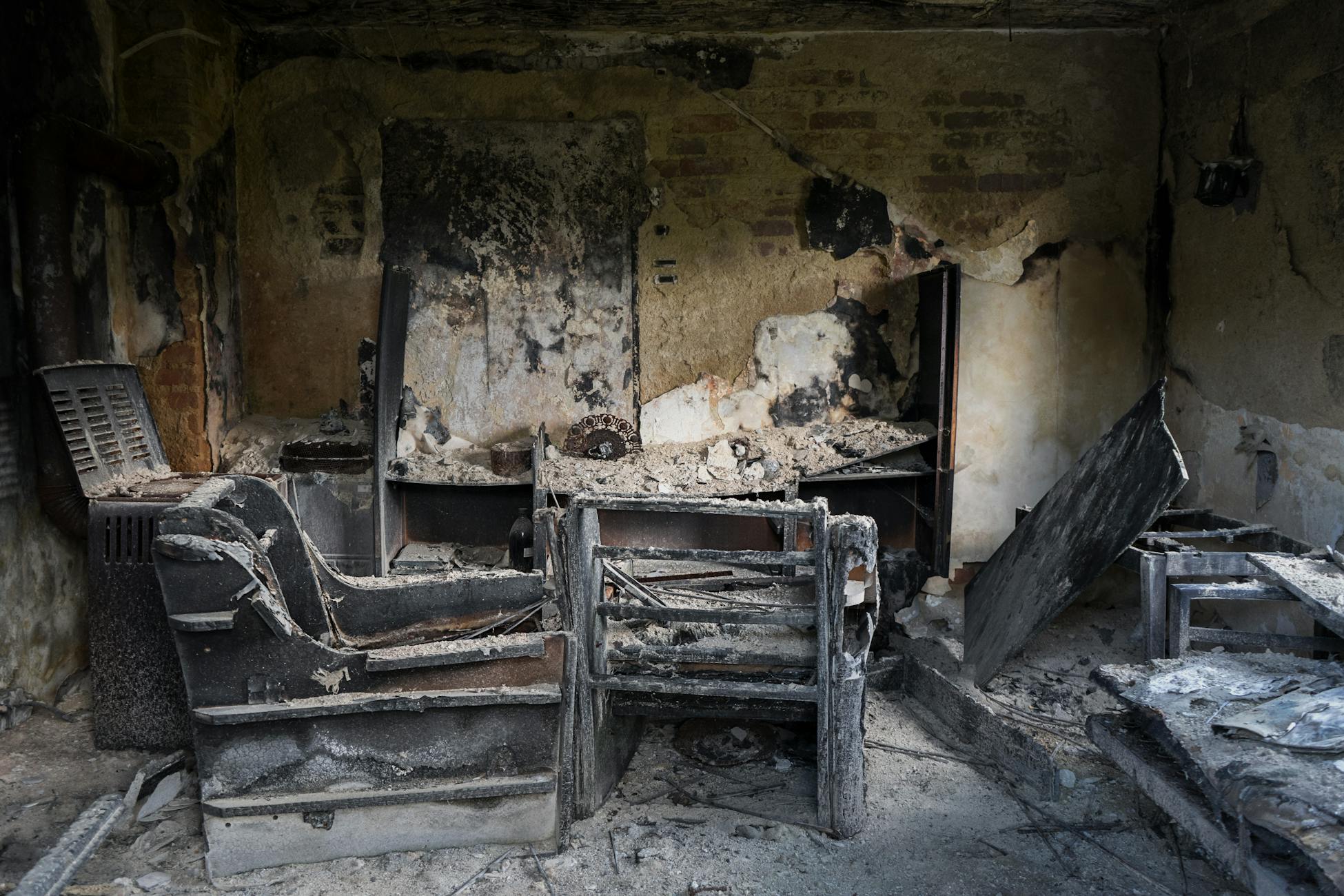
The fire in the palace was intense enough to collapse cedar roof beams onto the tablet rooms. The tablets, already stacked on wooden shelves, fell into the heat and were buried under burning timber and mudbrick. They cooked. Then they were buried.
What Austen Henry Layard found in 1849
The mound sat undisturbed for about 2,461 years. In 1849, an English traveler and diplomat named Austen Henry Layard was digging into the ruins of what he believed was ancient Nineveh, across the Tigris from modern Mosul, when he broke through into a chamber of the palace of Sennacherib (Ashurbanipal’s grandfather) and found the floor covered, almost knee-deep in places, with broken clay tablets.
Layard and his assistant Hormuzd Rassam recovered tens of thousands of fragments over the following years. They had no idea what they had. Cuneiform had not yet been deciphered. The tablets went into crates and traveled by raft down the Tigris, then by ship to London, where they entered the British Museum’s collection.
The discovery is described in detail by historians of the Assyrian record, who note that what Layard pulled out of the ground in 1849 turned out to be the single largest surviving body of Mesopotamian literature in existence.
Gilgamesh, found by accident
In 1872, a self-taught British Museum assistant named George Smith was sorting through the Nineveh fragments when he noticed a tablet describing a great flood, a man building a boat, animals brought aboard, a dove sent out to find dry land. Smith was, by several accounts, so excited that he ran around the room and began to undress.
What he had found was Tablet XI of the Epic of Gilgamesh, the Mesopotamian poem about a king of Uruk who fails to outrun death. The flood narrative on that tablet predates the Book of Genesis by more than a thousand years and shares enough plot to have reshaped the field of biblical studies overnight.
Gilgamesh survives almost entirely because of Ashurbanipal’s library. The standard version we read today, in eleven tablets plus an appended twelfth, is reconstructed primarily from the Nineveh copies, baked in 612 BC.
What 30,000 tablets actually contain
The number 30,000 is the conventional figure for the surviving fragments, though many of those fragments are pieces of larger tablets, and the original collection was probably smaller in terms of distinct works and larger in terms of total volume. National Geographic’s account of the find notes that the library held literary epics, religious hymns, divination manuals, royal correspondence, legal documents, mathematical tables, and astronomical records.
There are letters between Ashurbanipal and his governors. There are reports from spies on the Elamite frontier. There are lists of every observed lunar eclipse for centuries. There is a tablet that catalogues the sounds different animals make. There is a recipe for glass.
There are also the working materials of scribal schools, including the same texts copied out repeatedly by students learning the wedge-shaped script, which is how modern Assyriologists have been able to reconstruct lost passages: a missing line in one copy is often present in another.
The paradox of preservation by violence
If Nineveh had not burned, the tablets would almost certainly be gone. Sun-dried clay does not survive 2,600 years of damp Mesopotamian soil. It dissolves. It returns to mud. The unfired archives of cities that fell without fire, or that were simply abandoned, are mostly lost to us. The ones that survive are the ones that cooked.
The same logic applies elsewhere in the ancient Near East. The Hittite royal archives at Hattusa survived because that city also burned. The Linear B tablets of Mycenaean Greece survived because the palaces of Pylos and Knossos burned. Across the Bronze and Iron Age Mediterranean, the largest concentrations of administrative writing that have come down to us are almost always the ones that were caught in a catastrophic fire.
The pattern is grim and consistent. Civilizations that ended quietly left almost no clay record. Civilizations that ended in flames left libraries.
Reading a king’s anger 2,600 years later
One of the tablets in the Nineveh collection records Ashurbanipal’s own words about the texts he had gathered. He boasts that he can read the obscure Sumerian of the old hymns, that he understands the omen series, that he has mastered mathematics. He orders his scribes to copy and preserve. He threatens curses on anyone who removes a tablet from his library.
Roughly thirty years after he wrote that, the Medes burned his palace down.
The curse, in a sense, failed. The tablets did leave the library. They traveled to London. They sit now in climate-controlled cases in Bloomsbury, photographed in high resolution, transcribed into Unicode, fed into databases that can search across the entire corpus for a single sign.
The curse, in another sense, worked exactly as written. The texts are still being read. Ashurbanipal wanted to be remembered as the king who could read. He is. The army that came to silence him handed him the only thing that would have kept his voice audible for twenty-six centuries: heat, enough of it, applied all at once, to a roomful of damp clay.
