
In 1901, sponge divers surfaced off the rocky islet of Antikythera, in the strait between Crete and the Peloponnese, reporting corpses and horses on the seabed. They had stumbled onto a Roman-era shipwreck, and among the bronze statues and amphorae the crew hauled up over the next year was a corroded lump of metal the size of a shoebox. It sat largely ignored in the National Archaeological Museum in Athens until an archaeologist noticed a bronze gear wheel embedded in the rock-like mass. The object turned out to be a hand-cranked astronomical calculator built around 100 BC, capable of predicting solar and lunar eclipses, tracking the irregular motion of the Moon, and pinpointing the four-year cycle of the ancient Olympic Games. Nothing of comparable mechanical complexity would appear anywhere on Earth for the next 1,400 years.
The device is now known as the Antikythera mechanism, and it remains the oldest known analog computer.
A shoebox of geared bronze
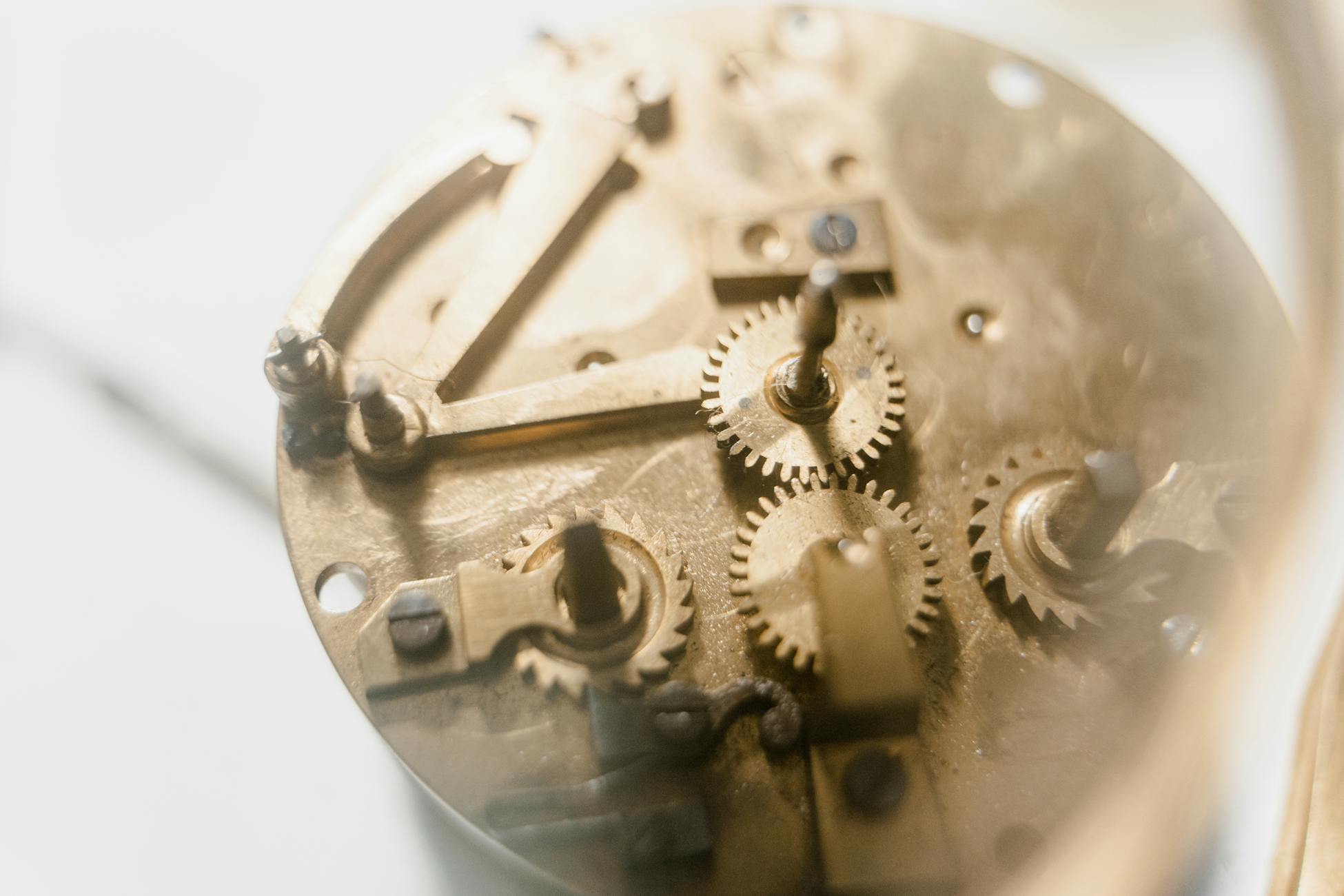
What survives is roughly a third of the original machine, broken into dozens of fragments, the largest about the size of a hand. The mechanism was originally housed in a wooden case, with bronze dial faces on the front and back and a single hand crank on the side. Turning that crank drove a train of interlocking bronze gears, each one cut by hand, with triangular teeth no more than a millimetre or two across.
The largest surviving gear has 223 teeth. That number is not arbitrary. It corresponds to the Saros cycle, the 223-lunar-month interval after which solar and lunar eclipses repeat in nearly the same pattern, a relationship known to Babylonian astronomers centuries before the mechanism was built.
What the dials actually showed
The front dial carried two concentric scales. The outer ring was a 365-day Egyptian calendar, adjustable for the quarter-day slippage we now correct with leap years. The inner ring was the Greek zodiac, divided into 12 sections of 30 degrees. A set of pointers crept around these scales as the crank turned, showing the position of the Sun, the Moon, and almost certainly the five planets visible to the naked eye, Mercury, Venus, Mars, Jupiter and Saturn.
A small rotating ball, half silver and half black, displayed the phase of the Moon. The lunar pointer itself ran on a clever pin-and-slot mechanism that sped up and slowed down to match the Moon’s elliptical orbit, the variable motion that Hipparchus had been modelling around the same period. It is the earliest known physical embodiment of that theory.
The back of the case carried two large spiral dials. The upper spiral was a 235-month Metonic calendar, the cycle after which lunar months realign with solar years. The lower spiral was the Saros eclipse predictor, with engraved glyphs marking which months would carry a solar or lunar eclipse, what time of day it would occur, and even, in some cases, the expected colour and wind direction.
The Olympic dial
Nestled inside the Metonic spiral sits a smaller subsidiary dial. When researchers deciphered its inscriptions, they found the names of Panhellenic athletic festivals including Olympia, Nemea, Isthmia, and Pythia. The pointer on this dial advances one quarter turn per year, completing a circuit every four years, the Olympiad.
The dial was not for sports fans. The Olympic cycle was the canonical way of dating events across the fractured Greek world, the equivalent of a master timestamp. A mechanism that could lock astronomical events to that civic calendar was, in effect, anchoring the heavens to human history.
How it was found, and how it was read
The wreck itself dates to the late Hellenistic period, based on amphora styles and coins recovered from the site. It was probably a merchant ship sailing from the eastern Aegean, perhaps Rhodes or Pergamon, toward Rome, loaded with luxury cargo intended for wealthy Roman buyers. Subsequent expeditions have continued to recover luxury items from the site, confirming the vessel’s role in the high-end trade of the late Hellenistic Mediterranean.
For most of the twentieth century, scholars could only guess at what the corroded gears once did. The breakthrough came when researchers used advanced X-ray CT scanning technology, hauled to the museum in Athens, to image the fragments at micron resolution. The scans revealed thousands of characters of Greek text engraved on internal surfaces, a kind of user manual, along with the precise tooth counts of gears that had been invisible for two millennia.

A calendar that followed the Moon
For decades, the front calendar ring was assumed to mark a 365-day solar year, in line with the Egyptian civil calendar. In 2024, a team analysing the spacing of holes around the broken calendar ring, originally identified using statistical techniques developed for gravitational-wave detection, concluded that the ring most likely had 354 holes, matching a lunar year of 12 synodic months. The reanalysis using methods borrowed from LIGO data processing challenged the century-old solar-calendar assumption.
The same study was independently corroborated by a separate Bayesian analysis of hole positions that placed the most probable count between 354 and 355. That makes the calendar ring a representation of the lunar year used in many Greek city-states, not the Egyptian solar one.
Who built it
No signature survives. The leading candidates trace back to the school of Hipparchus on Rhodes, the astronomer who catalogued stars and developed the lunar theory the mechanism encodes. Ancient sources describe similar bronze planetariums, including one built by Archimedes and another constructed on Rhodes around the time the Antikythera ship sank. The mechanism may be a surviving example of exactly that tradition.
Whoever cut its gears was working at the edge of what hand tools could achieve. The teeth were filed individually, and the gear trains had to mesh accurately enough to keep the Moon pointer in step with the heavens across centuries of crank turns. As the device that inspired the MacGuffin in Indiana Jones and the Dial of Destiny, the mechanism has become shorthand for ancient knowledge that seems impossibly advanced.
The 1,400-year gap
After the Antikythera ship went down, the technology vanished from the archaeological record. The Romans inherited Greek astronomy but produced no comparable surviving instrument. Geared astronomical devices reappear in the Islamic world by the eleventh century. Mechanical clocks with comparable gear trains do not show up in European cathedrals until the late thirteenth and fourteenth centuries.
That is a gap of roughly 1,400 years between a hand-cranked bronze computer aboard a Mediterranean merchant ship and the next machine of similar mechanical ambition. The Antikythera mechanism is not just old. It is anomalously old, a piece of high technology stranded in a century that otherwise leaves no trace of it.
Why the gears matter
The mechanism encodes a specific worldview. Its gear ratios are physical embodiments of astronomical theory, the Saros for eclipses, the Metonic and Callippic cycles for calendar reform, the Hipparchan lunar anomaly for the Moon’s wandering speed. Turning the crank does not just rotate pointers; it computes. The user is asking a question of the cosmos and reading off the answer.
This is the same conceptual leap that defines every later computing machine, from the orreries and clockwork planetariums of the Enlightenment to Charles Babbage’s Difference Engine to the silicon devices in modern pockets. The Antikythera mechanism makes the abstract motions of the heavens turn into the physical motion of metal, with a handle.
The fragments still sit in climate-controlled cases at the National Archaeological Museum in Athens, green with corrosion, the largest piece about 18 centimetres across. The gears are frozen. But thanks to the X-ray scans, working replicas have been built, in brass, in Lego, in CAD models running on laptops. Crank one of them and the pointers move exactly as they did when a Greek astronomer, perhaps in a workshop on Rhodes around 100 BC, fitted the last gear into place and turned the handle to test it.
The eclipse predicted for that turn of the dial would have arrived on schedule, as scheduled eclipses still do, on a Mediterranean afternoon that ended two thousand and twenty-six years ago.
