
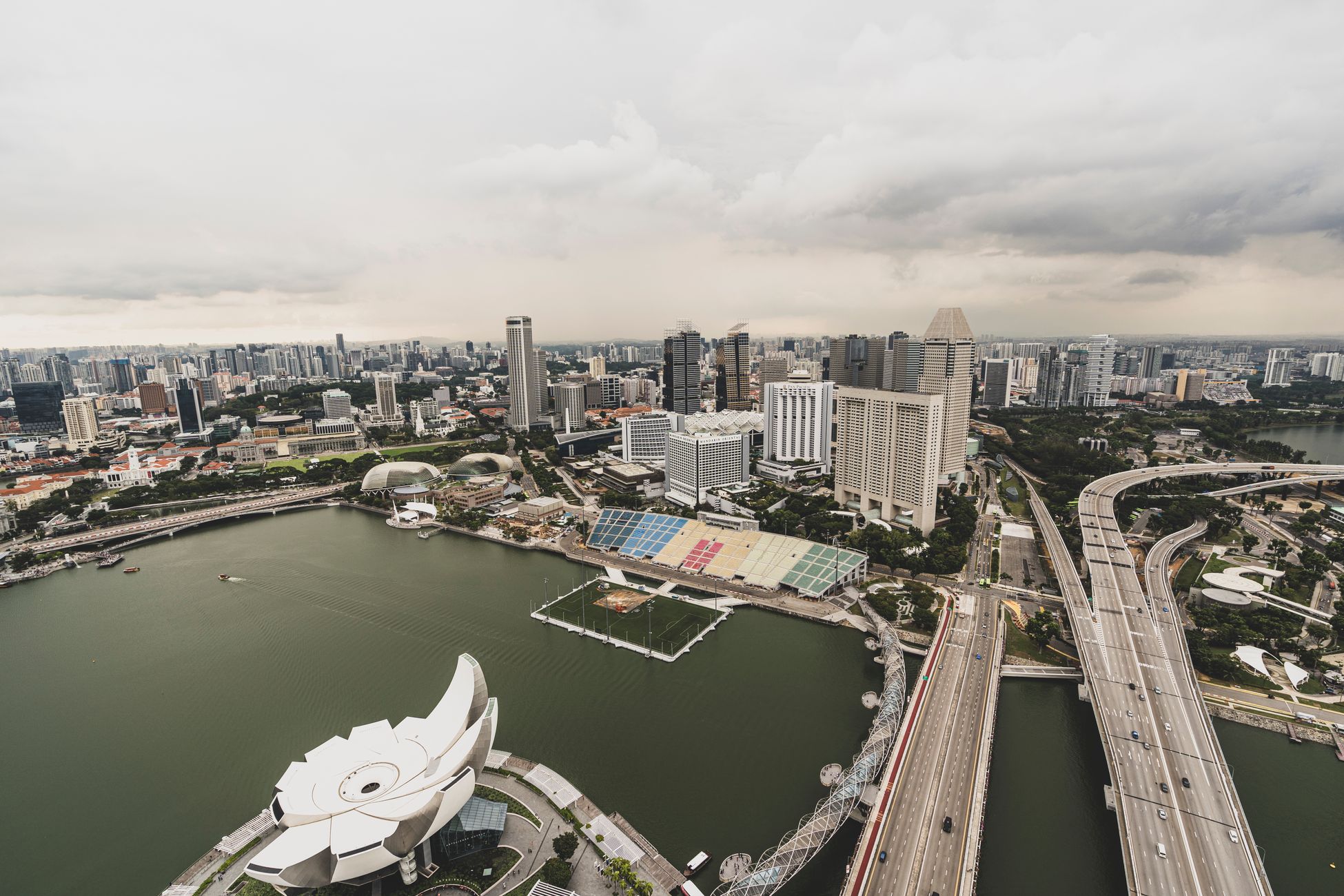
Singapore opened the Marina Barrage in 2008 and solved two problems at once that every coastal megacity now faces: too much water during storms, and not enough water to drink. Jakarta sinks while running out of groundwater. Manila floods every monsoon and rations supply in the dry months. Lagos, Dhaka, Ho Chi Minh City, Bangkok — all of them juggle the same impossible math of intensifying rainfall, rising seas, and growing demand on shrinking sources. Singapore’s answer was to stop treating flooding as a liability and start treating it as inventory. The barrage seals off a tidal channel in the middle of the financial district, captures the rain that falls on one-sixth of the country’s land area, and pipes it into household taps.
The dam holds back the sea. The downtown that used to flood when a king tide met a thunderstorm now drains, even during the monsoon, because the barrage can dump water out at low tide and pump it out at high tide. The reservoir sits a brisk walk from the Merlion. Container ships glide past the seaward wall while joggers loop the freshwater side. The water on the inland face is the same water people drink.
A river mouth that used to stink
For most of the twentieth century the Marina Channel was the bottom of the Singapore River system, and the Singapore River was a working harbour clogged with bumboats, pig farms upstream, hawker waste, and raw sewage from the squatter settlements along its banks. The government ordered a cleanup in the late 1970s. The bumboats moved out, the pig farms closed, the squatters were rehoused, and by the late 1980s the river ran clear enough that the government could start thinking about damming the river mouth and converting the estuary into a drinking-water reservoir.
How the dam actually works
The barrage runs across the Marina Channel where it opens to the sea, just east of the Central Business District. Steel crest gates lie flat along the dam’s spine. During heavy rain, if the tide outside is low, the gates tilt down and excess reservoir water spills over the top into the sea. That works for roughly half the day.
The other half, when the tide outside the dam is higher than the reservoir inside, gravity drainage is impossible. That is when the drainage pumps switch on, shifting large volumes of water straight into the sea, holding the reservoir at a steady level while torrential rain keeps falling on the catchment upstream. The pumps are among the largest in Singapore, and they run on a tropical schedule — the country sits near the equator and gets heavy rainfall throughout the year, much of it in short violent bursts.
One reservoir, three jobs
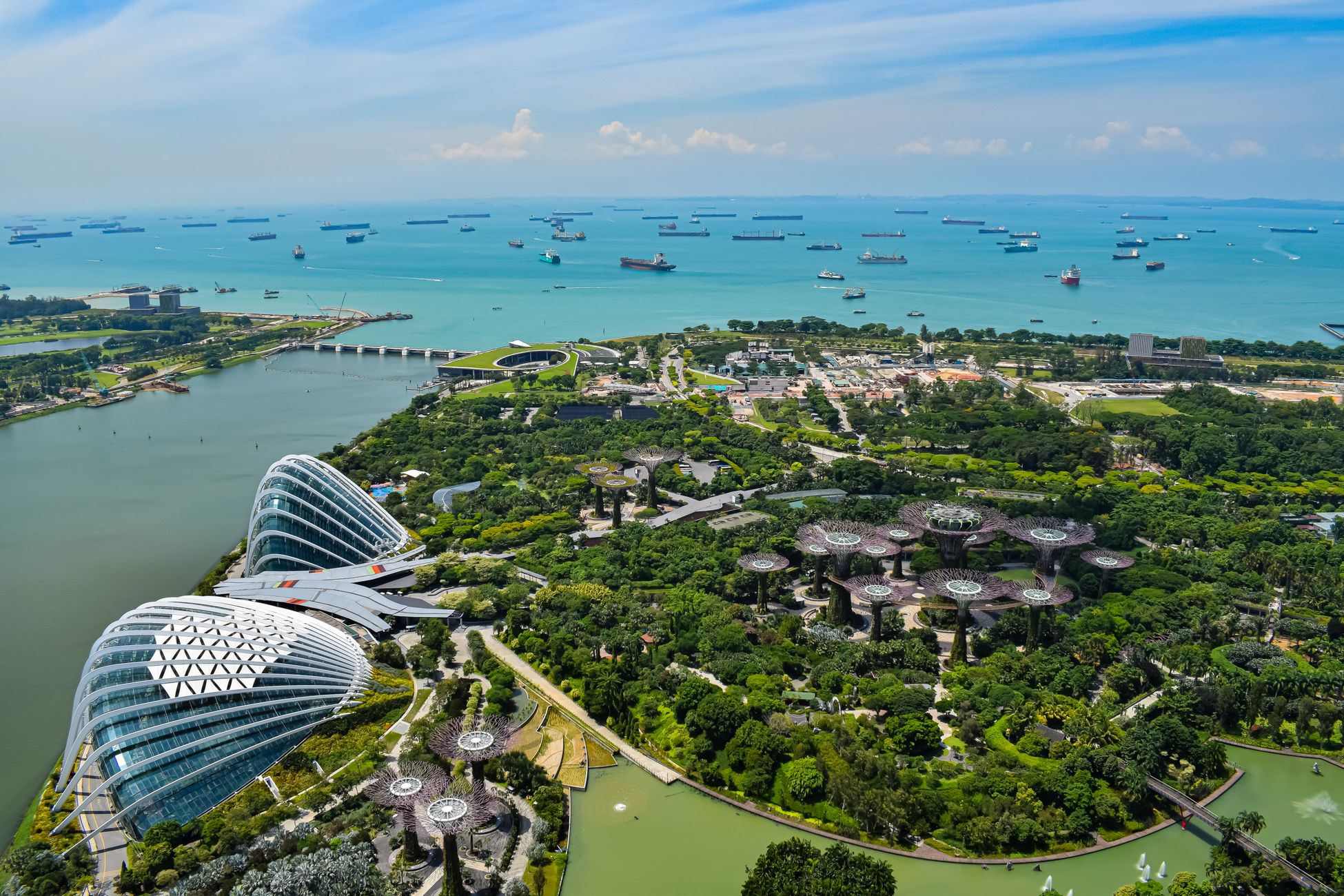
The barrage was designed to do three things at once, and PUB, Singapore’s national water agency, lists them in that order: water supply, flood control, and lifestyle attraction. Each one feeds the central trick of turning a flooding problem into a drinking-water asset.
The water-supply job is the headline. The Marina Reservoir expanded Singapore’s water catchment significantly. That matters because Singapore has almost no groundwater, no large rivers, and a long-standing dependence on imported water from Malaysia. Every additional drop captured at home is a drop the country does not have to buy or desalinate.
The flood-control job is the one residents notice. Low-lying districts in the city centre — Chinatown, Boat Quay, Jalan Besar, Geylang — used to flood during heavy rain because their storm drains emptied into a tidal estuary. When the tide was high, the drains backed up. After the barrage closed off the estuary and fixed the inland water level below mean sea level, those drains finally had somewhere to go. Urban flood management initiatives often cite the project as a working example of combining hard infrastructure with reservoir management to handle storm surge in a coastal megacity.
The lifestyle job sounds soft and is actually structural. The roof of the barrage is a green park with a solar array, the visitor centre runs school tours, and the reservoir hosts dragon-boat races and kayak schools. Putting recreation on top of utility infrastructure means the public has a daily relationship with the water they drink, which makes pollution behaviour change easier to enforce. You do not throw a cigarette butt into a reservoir where children are paddling. Urban stormwater research on similar catchments shows that pollutant loads entering a reservoir like Marina are dominated by the first flush of a storm, when streets that have been dry for days suddenly send a concentrated slug downhill — which is exactly the behaviour that public stewardship reduces upstream.
The park on the roof
The most photographed part of the barrage is the green roof. The dam’s pump house and visitor centre are buried under a sloping lawn, and on weekends it fills with families flying kites against the skyline of the financial district. The solar panels behind the lawn supplement the building’s electricity. A sustainable gallery inside explains how the gates work.
Letting people walk and picnic on top of critical drinking-water infrastructure is a choice. Most water utilities fence their reservoirs and warn visitors away. The decision to do the opposite — to make the reservoir a public park, a kayak course, and a dragon-boat racecourse — was deliberate, and the public-health logic is supported by research connecting urban greenery to mental wellbeing, which found measurably lower rates of mental-health hospitalisations in neighbourhoods with higher levels of greenness.
A template other cities are copying
The barrage has become a study object for delegations from Jakarta, Manila, Ho Chi Minh City, Bangkok, Dhaka and Lagos, and the parts they are taking home are specific. Jakarta’s Giant Sea Wall masterplan borrows the impounded-freshwater-lagoon concept directly, aiming to convert Jakarta Bay into a reservoir behind a sea dyke. Ho Chi Minh City’s tidal-sluice-gate programme on the Saigon River copies the crest-gate-plus-pump configuration for combined tidal and pluvial flooding. Bangkok’s monkey-cheek retention strategy and Manila’s Pasig River rehabilitation both cite Marina’s catchment-as-asset framing. Analysis of decentralised stormwater strategies has noted that rain barrels and green roofs alone are not enough in dense coastal cities; they need to be paired with large-scale conveyance and storage. Marina Barrage is the storage-and-conveyance end of that combination at city scale.
Singapore has not stopped there. Stamford Diversion Canal routes runoff that would otherwise flood Orchard Road directly into the Marina Reservoir through a tunnel under the city. The same agency has commissioned coastal protection studies for the eastern shoreline that anticipate sea-level rise by 2100. Climate adaptation work on coastal cities increasingly treats Singapore’s layered approach — barrage, diversion canals, raised platform levels, mangrove restoration — as a single integrated system rather than a string of separate projects.
The fact that lingers
Stand on the seaward side of the barrage at high tide on a stormy afternoon. The sea is sloshing against the concrete above the level of the reservoir behind you. Inside the pump house, large motors are pushing rainwater uphill, against the tide, back out to the sea it just fell from. Walk fifty metres inland and the same water — minus the sea salt, plus a few years of monsoons — is flat and quiet, and a school crew is launching a dragon boat across it. The drinking glass in a flat in Tiong Bahru will be filled from that surface tomorrow morning.
A tropical city built a wall against the ocean so its rain would have somewhere to stay. Half a dozen coastal megacities are now building their own versions. The wall is still holding, the rain is still falling, and the taps are still running.
