
On a chalk slope above Bulford Camp in Wiltshire, just east of Stonehenge, a 420-foot bird sits etched into the hillside, beak pointed skyward, one stubby leg cocked as if about to step. The Bulford Kiwi was cut into the turf in 1919 by New Zealand soldiers waiting, increasingly impatiently, to be shipped home after the Armistice. The men who carved it were already called Kiwis. The fruit was not. The fruit would not borrow the name for another forty years.
The bird came first. The soldiers came first. The hillside carving, raked back into bright white chalk by an RAF Chinook helicopter dropping ten tonnes of fresh material in 2026, is the oldest surviving monument to that order of things.
The nickname that predates the fruit by half a century
By the time the first New Zealand Expeditionary Force soldiers reached Egypt in 1914, the kiwi was already shorthand for the country itself. The flightless bird appeared on regimental badges, on boot polish tins, on the masthead of soldiers’ newspapers. British troops picked it up almost immediately. To a Tommy from Yorkshire or a Welshman from Cardiff, the men in the lemon-squeezer hats were Kiwis, and the name stuck through Gallipoli, the Somme, Passchendaele, and the long demobilisation that followed.
The fruit now sold in every supermarket on Earth was, at that point, called the Chinese gooseberry. It was a hairy brown oddity grown in small orchards near Whanganui from seeds brought back from the Yangtze valley in 1904. It would not be renamed kiwifruit until 1959, when an Auckland produce exporter named Turners and Growers needed a marketing name that would not trigger Cold War-era American tariffs on anything sounding Chinese or Soviet. The bird gave its name to the fruit. Not the other way around.
So when the New Zealanders at Sling Camp, on Salisbury Plain, decided in early 1919 to leave something behind, the obvious symbol was already theirs.
Why thousands of soldiers were still in Wiltshire months after the war ended
The Armistice was signed in November 1918. The New Zealanders at Sling Camp, part of the larger Bulford garrison, expected to be on troopships within weeks. They were not. Shipping was scarce, priorities shifted constantly, and by March 1919 thousands of men were still drilling, still being inspected, still eating army rations in the cold Wiltshire mud, with no clear date for departure.
On 14 March 1919, the frustration broke. Soldiers at Sling rioted, smashing the officers’ mess and the canteen, drinking the stores dry, and refusing parade for several days. The mutiny was not violent in the European sense, but it shook the command. Officers needed something to occupy the men. Hard physical labour, ideally outdoors, ideally pointless enough that it could not go wrong.
A drawing master in the ranks, Sergeant-Major Percy Cecil Blenkarne of the New Zealand Engineers, was asked to design a project. He chose the kiwi. He pulled the silhouette from a specimen at the British Museum, scaled it up, and pegged the outline onto Beacon Hill, the chalk down rising above the camp.
The dimensions of a hillside bird
The finished carving is enormous. The body stretches 420 feet from tail to beak. The beak alone is 150 feet long. The letters NZ, cut beside the bird, stand 65 feet tall. The total area of exposed chalk covers roughly 1.5 acres of hillside, angled at about 30 degrees, visible from the A303 and from trains on the West of England main line.
The work was done with picks, shovels, and chalk lines, by men who had survived Messines and Passchendaele and now spent their days digging turf off a Wiltshire hill. The topsoil was peeled back. The chalk beneath, the same Cretaceous chalk that makes the white cliffs of Dover, was exposed and raked clean. The first cuts were made in the spring of 1919. By the summer the bird was unmistakable from the valley floor.
Most of the men who carved it sailed for Wellington and Auckland within weeks of finishing. They left the bird looking after the empty camp.
How a chalk carving survives a century
Chalk hill figures do not maintain themselves. Grass returns. Soil washes down. Within a few years of being cut, the Bulford Kiwi began to fade, its edges blurring as vegetation crept back across the white. The Uffington White Horse, four counties away in Oxfordshire, has been re-chalked at intervals for around three thousand years. Without that scouring, it would have vanished long ago.
The Kiwi went through several stewards. The Kiwi Polish Company, which used the bird on its tins and had a direct commercial interest in the symbol, paid for upkeep through the 1920s and 1930s. During the Second World War the carving was deliberately covered over, camouflaged so that German bombers could not use it as a navigation landmark for the Bulford and Tidworth garrisons. It stayed hidden until 1948.
The Royal New Zealand Engineers restored it in 1981. The Ministry of Defence, which owns the land, took over routine maintenance. Volunteers from local villages weeded it by hand for decades. By the 2020s the bird had again begun to grey, the chalk thinning and the outlines softening under sixty years of weather.
Ten tonnes of chalk, dropped from a Chinook
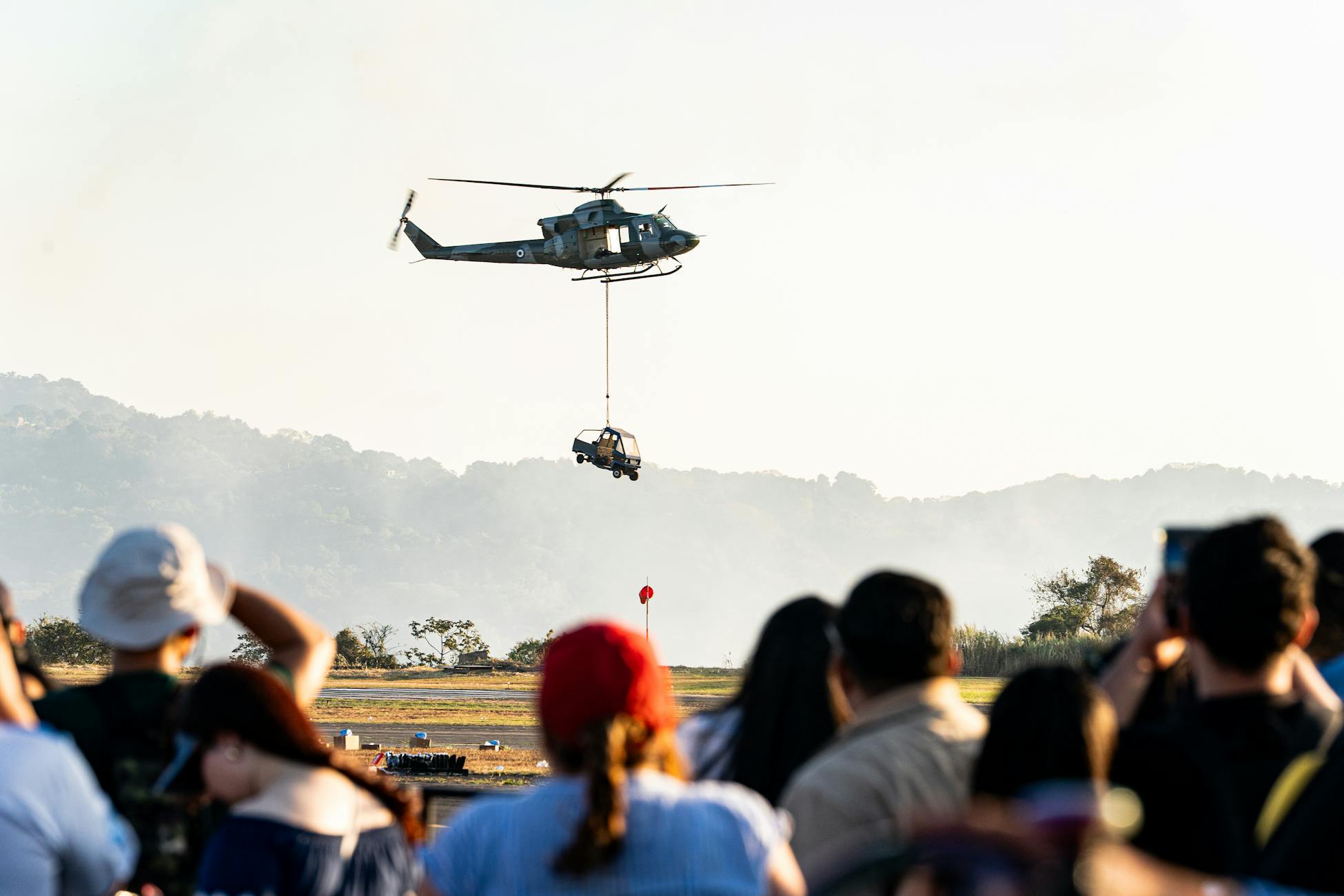
In 2026 the RAF flew in a Chinook helicopter to deliver fresh chalk to the slope. According to BBC coverage of the operation, ten tonnes of crushed chalk were dropped in bags on the carving before being raked into place by volunteers from the local kiwi restoration group and serving soldiers from the Bulford garrison. The helicopter lift saved weeks of manual hauling up the hillside.
The restoration coverage framed the lift as part of the kiwi’s ongoing annual upkeep, a ritual that keeps the bonds between Britain and New Zealand visible on the hillside. From a train passing through Grateley, the kiwi now flares white again, the NZ beside it sharp enough to read at distance.
The other carvings that did not survive
The Bulford Kiwi was not the only military hill figure on Salisbury Plain. Australian troops at nearby Hurdcott carved a 175-foot map of Australia into a chalk hillside in 1916 or 1917. Canadian soldiers at Codford cut a large maple leaf and the badges of various regiments. Most of these have faded into ghosts, visible only in low evening light or from aerial photographs as faint discolourations in the turf.
The Fovant Badges, on the south side of the Nadder valley, are the partial exception. Twenty regimental badges were cut into the chalk between 1916 and 1919 by troops staging through Fovant Camp. Eight survive, maintained by the Fovant Badges Society. The rest have grassed over.
The Kiwi survived for two reasons. The bird was big enough that partial neglect did not erase it. And it had institutional sponsors, first a polish company, then an army, then a charity, who took turns keeping the grass off.
Why a flightless bird became a national emblem in the first place
The kiwi is a strange choice for a martial symbol. It cannot fly. It is nocturnal. It is roughly the size of a domestic chicken, has hair-like feathers, and lays an egg disproportionately large for its body — sometimes 20 percent of the female’s weight. It is endemic to New Zealand and found nowhere else on Earth.
The bird’s adoption as a national emblem began with the Māori, for whom kiwi feathers were woven into ceremonial cloaks reserved for high-ranking chiefs. Colonial New Zealand picked up the symbol in the late nineteenth century, putting the bird on regimental badges from the 1880s onward and on postage stamps from 1898. By 1906 the kiwi was appearing in political cartoons as a stand-in for the country, in the same way the kangaroo stood for Australia or the bald eagle for the United States.
So when British soldiers at Gallipoli looked across at the men from Wellington and Christchurch and called them Kiwis, they were drawing on an identification that was already two decades old in New Zealand and already stamped on the men’s own uniforms.
What remains on the hill
The Bulford Kiwi is now a scheduled monument, protected under the same heritage framework that covers Stonehenge a few miles to the west. It cannot be ploughed, built on, or altered. The Ministry of Defence still owns the ground. The carving is fenced off from the cattle that graze the rest of Beacon Hill, and a small plaque at the base notes the date and the unit responsible.
From the valley, on a clear day, the bird reads at a glance. The beak points up the slope. The single visible leg suggests forward motion. The NZ beside it leaves no ambiguity about whose bird it is. Trains on the line from Waterloo to Exeter pass within a mile, and passengers who know to look can see it for about thirty seconds before the cutting closes in.
The men who cut it are all gone now. The last New Zealand veteran of the First World War, Bright Williams, died in 2003 at the age of 106. The kiwifruit, having borrowed the name in 1959, became a global commodity worth several billion dollars a year. The bird itself, the actual feathered animal on the actual islands, is now endangered, with fewer than 70,000 left in the wild.
The chalk bird on the Wiltshire hillside, raked white again by a helicopter and a crew of volunteers, will outlast all of them, provided someone keeps pulling the grass.
