
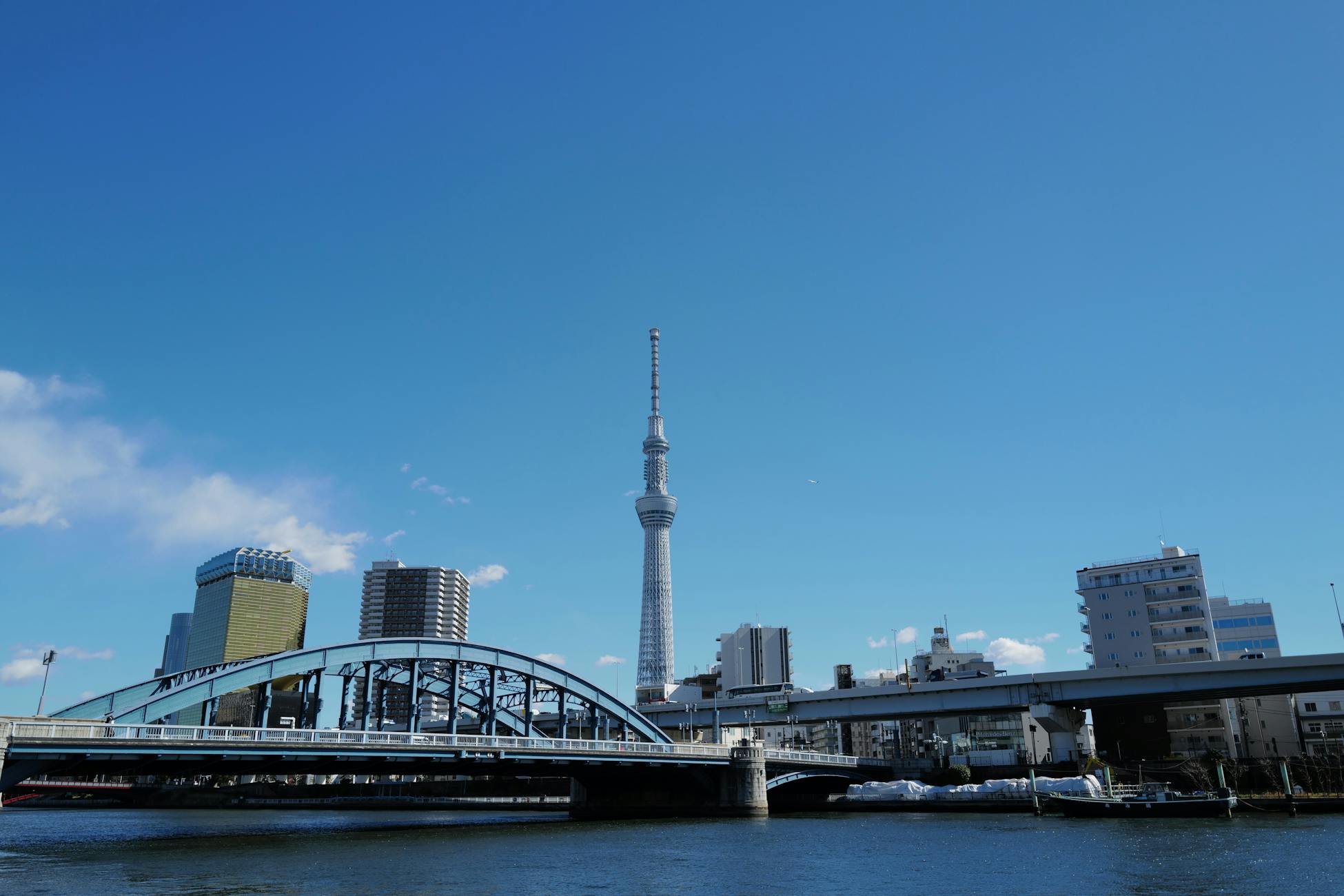
The Tokyo Skytree is designed to move during earthquakes — not resist them. The 634-meter broadcasting tower that opened in 2012 in Sumida City is, by most rankings, the second-tallest free-standing structure on Earth, and the engineering choice at its core is that during a major earthquake the building is supposed to sway: not a little, and not by accident, but as the explicit design intent.
The popular framing goes like this: Japan has among the strictest building codes in the world because Japan has the most earthquakes, and the Tokyo Skytree is a marvel of modern engineering that can withstand anything the ground throws at it. That framing is approximately right in its emotional effect and incomplete in its procedural physics. The Skytree does not withstand earthquakes in the way a fortress withstands a battering ram. It absorbs them, redistributes them, and lets the upper structure lag behind the lower structure on purpose.
The geological position that forces the problem
Japan sits at the convergence of four tectonic plates: the Pacific Plate, the Philippine Sea Plate, the North American Plate, and the Eurasian Plate. The Pacific Plate is subducting beneath the North American Plate along the Japan Trench at a geologically rapid rate. The Philippine Sea Plate is grinding under the Eurasian Plate from the south. The country lies along the western rim of the Ring of Fire, and the standard figure cited by the Japan Meteorological Agency is around 1,500 felt earthquakes per year — a figure that includes everything from imperceptible microtremors logged by seismometers to the kinds of jolts that wake a city up.
Most years pass without serious damage. Some do not. In December 2025, a 7.6-magnitude earthquake struck northeastern Japan, triggering tsunami warnings and evacuation orders for roughly 90,000 residents. Events of that scale are why the building code is what it is, and why it is one of the few national codes in the world that has been rewritten repeatedly in response to specific failures — after the 1923 Great Kantō earthquake, after the 1968 Tokachi-oki earthquake, after the 1995 Kobe earthquake, and after the 2011 Tōhoku earthquake and tsunami. Each revision tightened requirements on column strength, beam ductility, base isolation, and damping.
Tokyo specifically remains the focus of long-running seismic forecasts. Seismic researchers have published probability estimates suggesting a major quake under the capital within a measurable near-term window, and the country has spent decades modelling what an M7 or larger event in the Kantō region would do to a metropolitan area of nearly 38 million people. The Skytree was designed against those scenarios, not against the average year.
What the Skytree actually does when the ground moves
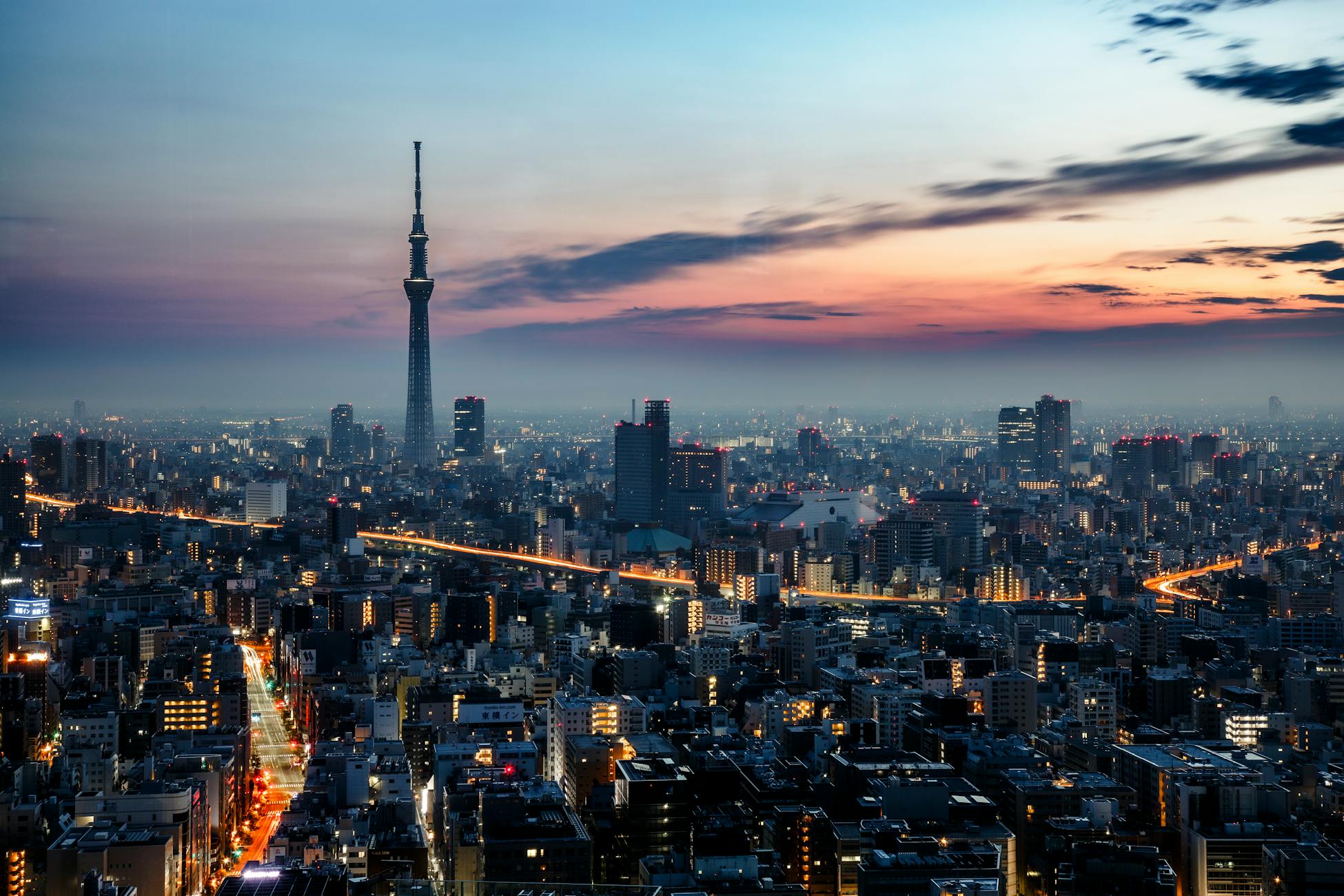
The tower’s structural system is built around two innovations, one of which is roughly twelve hundred years old. The modern part is a steel exoskeleton — a tripod of three legs at the base that transitions into a cylindrical lattice as the structure rises, distributing wind and seismic loads across a wide footprint. The older part is the shimbashira, a central reinforced concrete column running up the core of the tower, taking its name and its engineering principle from the central pillar of a traditional Japanese five-story pagoda.
Japan’s wooden pagodas, some more than a thousand years old, have survived earthquakes that flattened heavier masonry buildings around them — the Hōryū-ji pagoda near Nara has been standing since the early 8th century. The floors of a pagoda are not rigidly connected to the central post; they move independently, sliding slightly out of phase with the column at the center. When the ground shakes, the column and the floors oscillate at different frequencies, and the structure dissipates energy by disagreeing with itself. In the Skytree, the central concrete shimbashira is connected to the surrounding steel frame at the base, but for much of its upper reach it is decoupled — held in place by oil dampers that allow the column to move relative to the outer structure. During an earthquake, the steel frame and the concrete core sway at different rates, and the relative motion drives the dampers, converting kinetic energy into heat. The result is a substantial reduction in seismic response compared to a conventional rigid design.
The physics of letting a building move
The general category here is base isolation and supplementary damping, and it is one of the most active areas in structural engineering research. The principle is counterintuitive: a building that is rigidly fixed to the ground inherits all of the ground’s motion. A building that is partially decoupled — through bearings, dampers, or pendulum masses — moves more slowly than the ground, which means the forces transmitted into the structure are smaller.
A 2025 technical guidance document from the University at Buffalo’s MCEER center on seismic base isolation for advanced nuclear reactors lays out the same physics that underpins the Skytree’s design, applied to facilities where failure is not an option. The isolation system creates a long natural period for the structure, which shifts it away from the dominant frequencies of seismic ground motion. Newer work, including a multidirectional negative-stiffness isolation system developed by researchers in 2024, has extended the approach into devices that can absorb energy in horizontal and vertical directions simultaneously — closer to what actual seismic waves do.
Damping is the part of the problem that is harder than it looks. A 2023 study reported by ScienceDaily on tall building damping models found that engineers routinely overbuild multi-storey structures because the analytical models used to predict how much a building will sway are not as accurate as the field needs them to be. The conservative estimates produce safer buildings, but also heavier, more expensive ones. The Skytree benefited from decades of Japanese instrumentation data on how real tall buildings behave during real earthquakes — a dataset that few other countries possess at comparable depth.
What the code requires and what 2011 demonstrated
The Japanese Building Standard Law requires that buildings be designed for two levels of seismic performance. Under a moderate earthquake, the structure must remain undamaged. Under a severe earthquake, the structure may suffer damage but must not collapse. For tall buildings, an additional review by designated performance evaluation bodies is mandatory, and the calculations must include time-history response analysis using recorded ground motion data from actual past earthquakes.
The Skytree was under construction during the March 11, 2011 Tōhoku earthquake, which registered magnitude 9.0 and remains the most powerful earthquake ever recorded in Japan. The tower was near completion when the shaking began. It sustained no structural damage. The crane at the top was reportedly displaced, but the steel frame and the central shimbashira performed as designed. In the same event, the tsunami that followed the quake killed more than 18,000 people along the northeastern coast and triggered the Fukushima Daiichi nuclear accident — a reminder that the building code can solve some problems but not the problem of water moving inland at the speed of a car.
Liquefaction is the other failure mode that codes have to address. In the 2011 event, parts of the Tokyo Bay area built on reclaimed land — including the grounds of Tokyo Disneyland — experienced soil liquefaction, where saturated sediment temporarily loses its structural strength under cyclic loading. The Skytree’s foundation system was designed for the specific soil profile of Sumida City, with reinforced concrete walls extending deep into the ground in a configuration that resists both lateral seismic loads and the kind of differential settlement that liquefaction can produce.
What sway actually feels like at 450 meters
The Skytree has two observation decks: the Tembo Deck at 350 meters and the Tembo Galleria at 450 meters. In strong winds, the upper deck can sway considerably from the centerline. In a major earthquake, the design displacement is larger — modelled in tens of centimeters of relative motion between the core and the frame. Visitors typically do not perceive these movements as movement; the period of oscillation is slow enough that the inner ear registers it as a mild sense of imbalance rather than swaying. The building is, in a sense, performing the same trick the pagodas perform: moving in a way that the human body has to consciously look for to detect.
Smaller events happen constantly. A 7.3-magnitude offshore quake in 2022, several M6-range events most years, and the routine M3 and M4 tremors that residents of Tokyo barely register all exercise the building’s damping system. Each one produces sensor data that feeds back into the structural health monitoring that operators run continuously. The tower is, in effect, its own seismograph.
What remains genuinely unsettled
The part of the story worth slowing down on is what the code cannot yet do. Japanese seismologists have been candid that the Nankai Trough — a subduction zone running along Japan’s southern coast — is overdue for a great earthquake by the standards of its historical recurrence interval, and the probability estimates for an M8 or M9 event there in the coming decades are uncomfortably high. The country is still, in a real sense, waiting for the next great quake. Forecasting remains a probabilistic exercise. As experts have repeatedly emphasized, even clusters of regional activity do not reliably herald a coming disaster at any specific location.
The tsunami warning system, recalibrated repeatedly since 2011, still produces both false alarms and missed nuances — Japan has had to issue public apologies for overestimated alerts, which is a tradeoff the system explicitly accepts because the cost of under-warning is measured in lives. Building codes can be tightened. Tectonic plates cannot be negotiated with.
What the Tokyo Skytree represents, then, is a particular kind of engineering humility encoded as a structure. The tower does not claim to defeat earthquakes. It claims to disagree with them in a controlled way, using a principle that a Japanese carpenter working on a pagoda in the 8th century would have recognized immediately. Some of the strictest building codes on Earth converge on the same conclusion: in a country where the ground moves 1,500 times a year, rigidity is a liability and compliance is a survival trait. The lesson radiating outward from Sumida City — toward Istanbul, Los Angeles, Wellington, and every other city built on a fault — is that seismic design is not about strength alone. It is about giving a structure permission to move, and the analytical confidence to know how far. The Skytree’s quiet sway is the answer to a question the rest of the world is still learning how to ask.
