
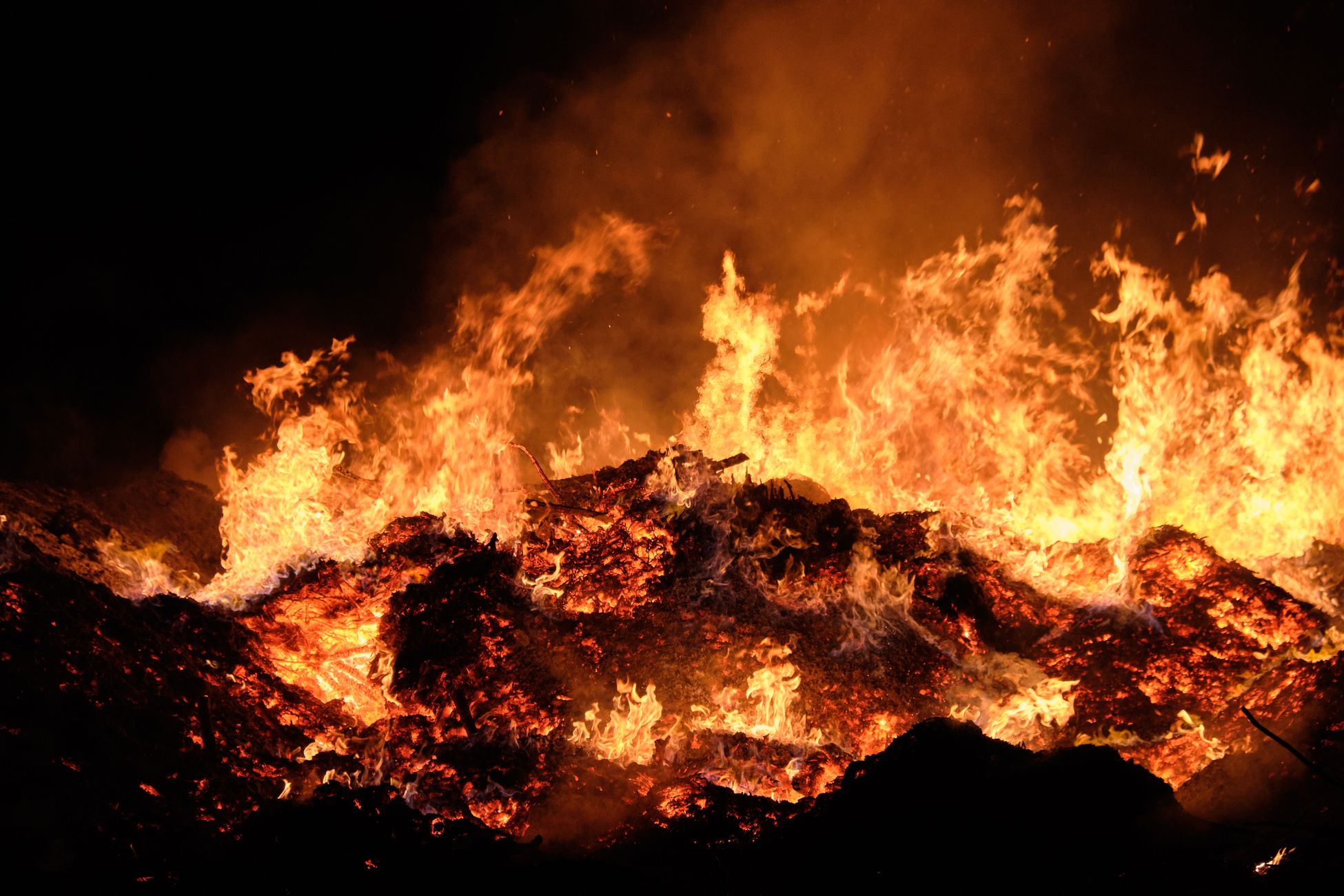
In the autumn of 1971, a team of Soviet geologists working near the village of Darvaza in Turkmenistan’s Karakum Desert watched the ground collapse beneath their drilling rig and decided the simplest fix was to set the escaping methane on fire. They expected the flames to burn off in a few weeks. The crater, now roughly 70 metres across and 20 metres deep, has been burning continuously ever since, throwing orange light across the dunes every night for more than five decades.
Today travelers call it the Gates of Hell, or the Door to Hell. The crater itself is a near-perfect circle of fire in the middle of one of the emptiest deserts on Earth, about 260 kilometres north of Ashgabat, and on a still night you can smell the gas before you can see the glow. The name Darvaza comes from a nearby settlement, from a Persian-rooted word meaning “gate”; the more lurid nickname came later, attached by visitors to the fiery pit rather than to anything the locals called it first.
A leaky basin under the sand
The Karakum is not a desert that gives up its secrets quickly. It covers roughly 70 percent of Turkmenistan, a slab of sand and clay the size of Germany, and the stretch of ground near Darvaza sits on top of one of the largest natural gas systems on the planet. Methane seeps up through fractures in the limestone cap rock and pools in low spots in the sand. The site overlies the Amu Darya Basin, and the basin is leaky. Long before any drilling rig arrived, the ground around these depressions hissed, the air smelled wrong, and the low spots were places herders learned to steer their animals away from.
The drilling rig that fell in
In 1971, Soviet geologists arrived at Darvaza with a Cold War mandate to find and quantify the gas reserves of the Turkmen SSR. They set up a drilling platform on what looked like solid ground. The ground was not solid. It was the thin roof of an underground cavern hollowed out by the same gas migration that had made the area unstable for generations.
The rig, the trucks, and a sizable bite of the desert dropped into the void. No one was killed, by most accounts, though the records from that era are thin and the Turkmen government has never released an official report. What the geologists were left with was a roughly circular pit venting methane fast enough to suffocate anything that came near it, including the camels and livestock that local herders relied on.
The decision to light it
Raw natural gas at a site like this is mostly methane, which is lighter than air, but it comes up mixed with heavier hydrocarbons and toxic traces, and in low-lying desert it can accumulate fast enough to be both an asphyxiation hazard and an explosion risk. The geologists knew venting it raw into a grazing area, even a sparsely populated one, was not a long-term plan. So they did what petroleum engineers had been doing at well sites for decades. They flared it. The reasoning, according to interviews Turkmen officials gave decades later, was that the gas pocket would burn itself out in a matter of weeks and the site could then be capped or abandoned.
That estimate turned out to be wrong by a factor of roughly 2,500 and counting. The flames are still there. The pocket, it turns out, is not a pocket at all but a connected piece of a much larger reservoir, and the methane keeps coming up through the sand and the broken rock as fast as the fire can consume it.
This kind of confident underestimation has a name in cognitive psychology. The planning fallacy describes a near-universal tendency to assume that the thing in front of you will resolve faster than comparable things have ever resolved before. Soviet field geology in the 1970s was not immune.
What is actually burning
The fuel is overwhelmingly methane, with smaller fractions of ethane, propane, and butane, and trace amounts of hydrogen sulfide that account for the rotten-egg note in the smell. The crater walls are a mix of limestone and compacted sand, and the floor is studded with smaller vents where flames lick up out of cracks in addition to the broader sheet of fire that covers most of the bottom.
The flames reach temperatures in excess of 1,000 degrees Celsius, hot enough that the few researchers who have approached the floor have done so in heat suits with breathing apparatus and steel cables. The Canadian explorer George Kourounis did exactly that in November 2013, becoming the first person known to have reached the bottom. Recording a ground temperature of around 400 degrees Celsius and working in a roughly 17-minute window, he collected soil samples that were later shown to contain extremophile bacteria living in the heated sediment, organisms that had apparently colonised an environment that did not exist before the fire began.

Turkmenistan’s on-again, off-again plan to close it
The Turkmen government has announced plans to extinguish the crater more than once. In 2010, then-president Gurbanguly Berdymukhamedov ordered local officials to find a way to seal it, citing concerns about gas being lost from a reservoir the country could otherwise export. Nothing happened. In 2022, he ordered the closure again, this time framing it as an environmental and public-health measure. Again, nothing visible has happened on the ground.
Sealing the crater is harder than it sounds. The fire is fed by a diffuse network of fractures, not a single wellbore, and capping the visible opening would simply force the methane to vent somewhere else in the surrounding desert, possibly in places harder to monitor and just as dangerous to graze near. Drilling relief wells to capture the gas at depth is technically possible but expensive, and Turkmenistan’s gas industry is structured around exporting from established fields, not chasing a leak that has become, in a strange way, a national landmark.
The crater as a destination
Darvaza sits roughly four hours north of Ashgabat by road, much of that road unpaved, and visiting it requires a Turkmen tourist visa that is famously difficult to obtain. Those who make it generally arrive at dusk. The crater is unremarkable in daylight, a brown circle in a brown landscape with a faint shimmer of heat. After sunset it becomes one of the most photographed objects in Central Asia, a perfect ring of orange light visible from kilometres away across the dunes, throwing shadows from desert grasses long enough to reach the parking area where tour vehicles cluster.
The wind off the Karakum carries the heat in unpredictable gusts. Stand on the lip with the wind at your back and you feel a furnace. Stand on the opposite side and the air is cool enough to need a jacket. Camels graze nearby, having long since learned which slopes to avoid.
A clock with no hour hand
Estimates of how long the crater will burn vary wildly because no one has been able to map the connected reservoir precisely. Some Turkmen petroleum engineers have suggested the visible flames could persist for centuries at current vent rates. Others argue the rate has slowed measurably in recent years and that the fire may dim within a few decades on its own.
Whichever turns out to be right, the crater has now been burning for longer than the Soviet Union existed after lighting it. The geologists who made the original decision are mostly dead. Their drilling rig is somewhere under the sand at the bottom of the pit, slowly oxidising in the heat. The flames they expected to last a few weeks have outlived the country that dispatched them and every confident estimate anyone has made about when, exactly, the Door to Hell will close.
