
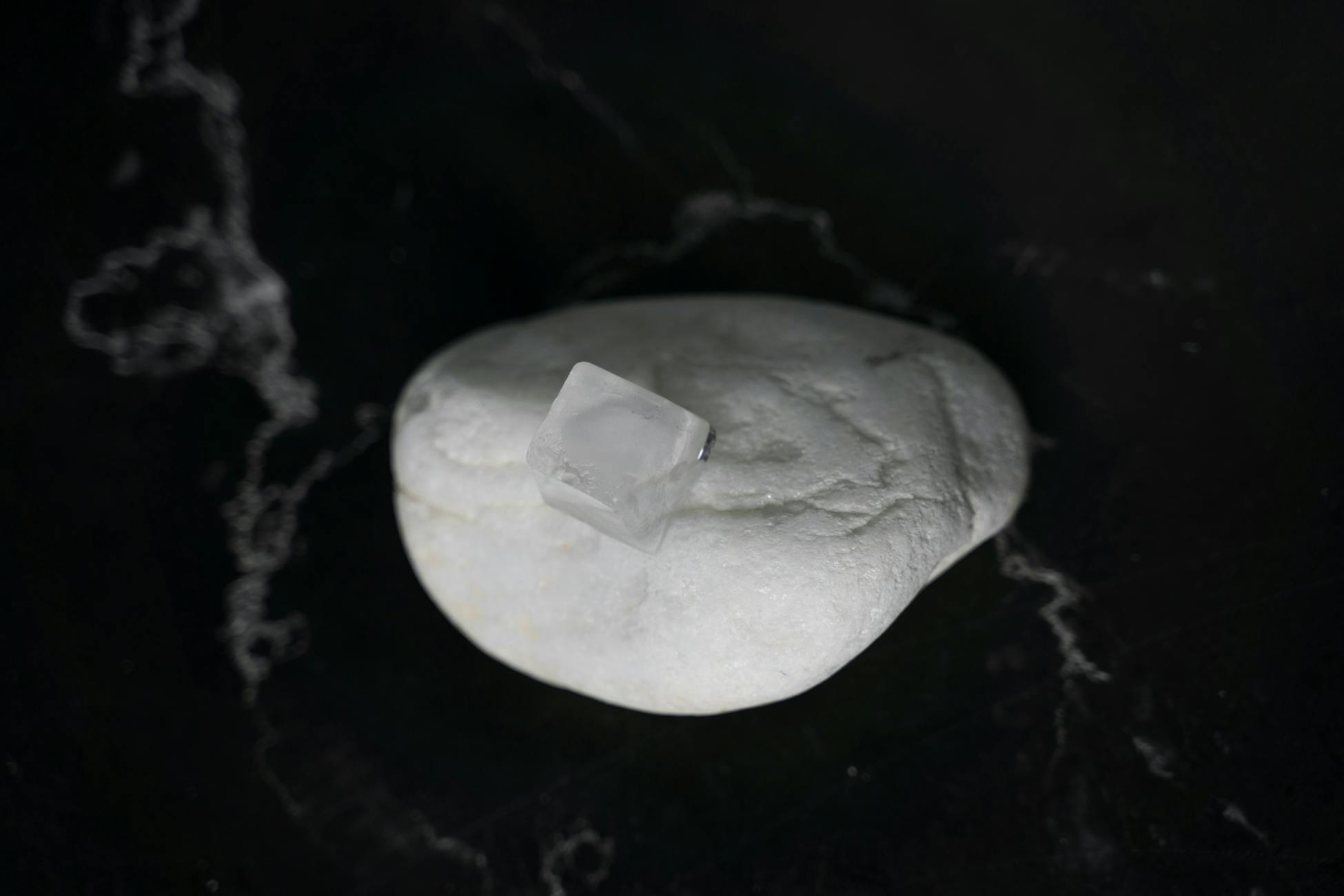
The claim is arithmetically correct, and that is the least interesting thing about it. If every atom in every human body on Earth were stripped of its electron shells and crushed until the nuclei touched, the eight billion people currently alive would occupy a volume roughly the size of a sugar cube — and that sugar cube would still weigh approximately 400 million tonnes, the combined mass of the species. The math holds. What the math hides is a procedural story about what an atom actually is, why almost all of it is nothing, and what it would take physically to perform the compression the headline describes.
The popular framing treats this as a curiosity about scale, a parlor trick of the very small. That framing is approximately right in its emotional effect and badly incomplete in its physics. The sugar-cube fact is not really about size. It is about the strange architecture of matter — the fact that the solidity of everything you have ever touched is a stable illusion maintained by quantum mechanics, and that the actual material content of the universe is far sparser than human intuition can accommodate.
What an atom actually is
A hydrogen atom is, by volume, approximately 99.9999999999996 percent empty space. The proton at its center occupies a region about 1.7 × 10⁻¹⁵ meters across. The electron cloud surrounding it extends out to roughly 5.3 × 10⁻¹¹ meters — the Bohr radius. Run the arithmetic and the nucleus accounts for something on the order of one part in 10¹⁴ of the atom’s total volume. The rest is probability distribution: a smeared region where the electron might be found if measured, governed by the Schrödinger equation rather than by anything resembling matter in the everyday sense.
A common visualization scales the proton up to the size of a marble and places it at the center of a sports stadium. The electron, in this analogy, is a flicker somewhere in the upper bleachers. Everything between marble and bleachers is empty. That emptiness is not a vacuum in the colloquial sense — it is filled with electromagnetic fields and the quantum mechanical wavefunction of the electron itself — but it contains essentially no mass. Better than 99.95 percent of an atom’s mass sits inside the nucleus, which occupies a vanishingly small fraction of its volume.
The human body contains roughly 7 × 10²⁷ atoms. Multiply by eight billion people and the count climbs to something like 5.6 × 10³⁷ atoms across the entire species. Strip the empty space — meaning, crush every atom until its nucleus touches the next nucleus with no electron cloud between them — and the resulting volume is determined entirely by nuclear density, which is a quantity physicists have measured with considerable precision.

Where the sugar cube comes from
Nuclear matter has a density of approximately 2.3 × 10¹⁷ kilograms per cubic meter. That number comes from measurements of atomic nuclei across the periodic table and from the equation of state inferred from neutron star observations — a topic explored in detail in previous Space Daily coverage of neutron stars, where the same density appears at astrophysical scales. A neutron star is, in effect, a single atomic nucleus the size of a small city, held together by gravity rather than the strong force.
The combined mass of humanity is harder to pin down than the density of nuclear matter, but a reasonable central estimate places the average human at roughly 50 kilograms when children are included in the average. Eight billion people at 50 kilograms each yields about 4 × 10¹¹ kilograms — 400 million tonnes — as the total biomass of the species. Divide that mass by nuclear density and the resulting volume comes out to approximately 1.7 cubic centimeters.
A standard sugar cube is about 1 cubic centimeter. The compressed human species would be slightly larger — closer to a small sugar lump than a standard cube — but the headline survives the math. The order of magnitude is exactly right. The entire genetic, neurological, cultural, and emotional content of humanity, reduced to its nuclear substrate, would fit comfortably in a teaspoon and weigh as much as approximately 4,000 fully loaded oil supertankers.
Why the compression is physically impossible
The part of the story worth slowing down on is the procedure. Atoms do not collapse to nuclear density on their own. They are held apart by electron degeneracy pressure — a quantum mechanical effect arising from the Pauli exclusion principle, which forbids two electrons from occupying the same quantum state. To squeeze an atom down to its nucleus, you would have to overcome that pressure entirely, then push past neutron degeneracy pressure as well, forcing electrons and protons to combine into neutrons through inverse beta decay.
In the universe as it actually exists, this happens in exactly one circumstance: the core collapse of a massive star at the end of its life. When a star above roughly eight solar masses exhausts its nuclear fuel, the iron core that has accumulated at its center collapses under its own gravity in less than a second. Electron degeneracy pressure fails. Protons and electrons fuse into neutrons. The core compresses to nuclear density, and a neutron star is born — typically with a radius of about 10 kilometers and a mass between 1.4 and 2.3 times that of the sun. Everything outside the core gets blown into space as a supernova.
To perform the same compression on eight billion humans would require, in essence, dropping the species into the collapsing core of a star. There is no laboratory technique, no engineering solution, no foreseeable technology that can replicate the conditions. The sugar cube is a thought experiment whose physical realization requires stellar death.

What solidity actually means
The deeper implication of the sugar-cube calculation is that the apparent solidity of matter is an illusion produced almost entirely by electromagnetic repulsion between electron clouds. When you press your hand against a table, no part of your hand touches any part of the table in any meaningful sense. The electrons in the outer shells of the atoms in your skin repel the electrons in the outer shells of the atoms in the wood. The repulsion is transmitted through the electromagnetic field. The actual nuclei — the parts that contain essentially all the mass — never come within any distance that would qualify as contact.
This is why the universe can simultaneously contain objects as different as a human body and a neutron star. They are made of the same fundamental particles, arranged according to the same physical laws. The difference is whether gravity is strong enough to overcome the quantum pressures that keep atoms separated. On Earth, those pressures dominate. In the core of a collapsing star, gravity wins.
The cosmological consequences are stranger still. The James Webb Space Telescope is currently observing galaxies that formed 13 billion years ago, and the same nuclear physics that governs the sugar-cube calculation governs the formation of every heavy element in those galaxies — calcium, iron, iodine — through processes covered in an earlier Space Daily analysis of stellar nucleosynthesis. The atoms in a human body were assembled inside stars that themselves underwent the kind of core collapse required to compress humanity into a sugar cube.
The psychology of incomprehensible scale
Facts of this kind tend to produce a particular cognitive response — a sense of vertigo or dissolution that psychologists have studied under the heading of awe. The humanistic-existential literature treats encounters with cosmic or atomic scale as a category of experience capable of producing measurable shifts in self-perception, prosocial behavior, and existential orientation. Kirk Schneider’s argument for an awe-based reframing of psychology rests partly on the claim that confrontation with scale of this kind reorganizes the affective architecture through which people interpret their own lives.
Whether contemplating the sugar-cube fact actually changes anything about the person doing the contemplating is a question the empirical literature treats with appropriate caution. The relationship between cosmological perspective and psychological well-being is a recurring theme in existential therapy, but causation is hard to establish. What can be said with confidence is that the fact is true, and that taking it seriously requires accepting that the matter you are made of is overwhelmingly absence, organized by forces invisible to direct perception.
What the calculation leaves uncertain
Several numbers in the calculation carry meaningful uncertainty. The average human mass varies with demographic assumptions — 50 kilograms is a reasonable global average including children, but estimates range from 45 to 62 kilograms depending on methodology. The total population of eight billion is itself a model-derived figure from UN demographic projections, with error bars on the order of tens of millions. Nuclear density is the most precise quantity in the calculation, known to within a few percent.
The resulting volume — somewhere between roughly 1.5 and 2.5 cubic centimeters depending on which inputs you choose — straddles the boundary between a sugar cube and a small marble. The headline survives any reasonable choice of inputs. What the headline does not survive is the assumption that the compression could ever actually occur outside the gravitational well of a dying star. The sugar cube is a description of what matter would be if the quantum pressures that hold atoms apart simply stopped existing. They do not stop existing. That is the only reason any of this — the table, the hand, the eight billion people — has the shape it does.
