
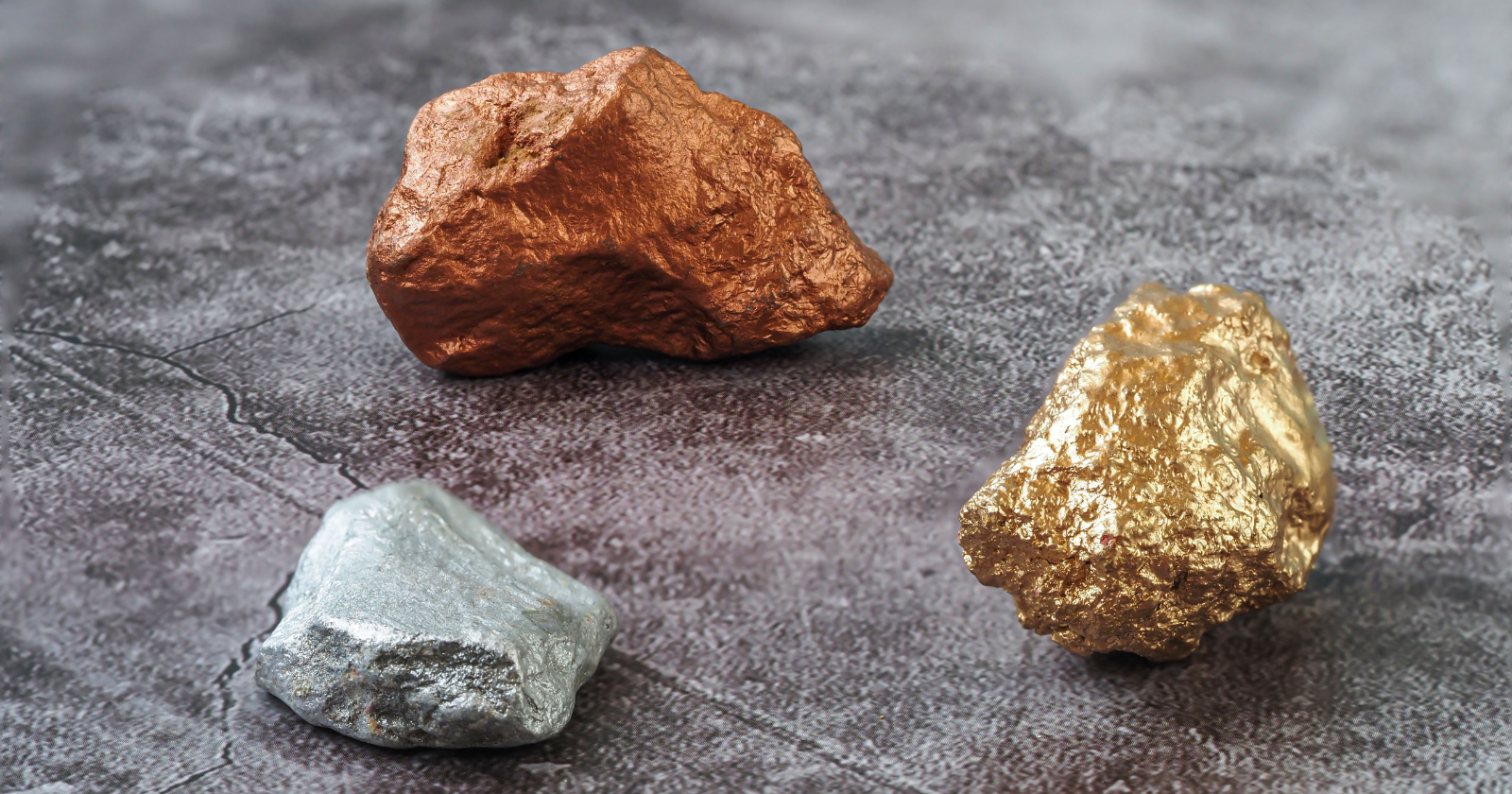
The gold in a wedding ring on a jeweller’s velvet tray in Perth was almost certainly not part of the young Earth. It arrived roughly 100 to 200 million years after the planet formed, delivered by a rain of asteroids that hammered the crust once the molten core had already swallowed the original supply. Geochemists call this the late veneer, and the evidence is written in the strange overabundance of gold, platinum, iridium and osmium in the rocks near the surface — elements that, by all rights, should have vanished into the core 4.5 billion years ago.
The young Earth was a magma ocean. Not a molten patch, not a hot crust — the entire planet, thousands of kilometres deep, glowing at temperatures that would vaporise granite.
Iron sank. It sank because iron is dense and because, in a fully molten body, gravity does exactly what you would expect it to do over a few tens of millions of years. As the iron drained toward the centre, it took its chemical friends with it.
The elements that love iron
Geochemists have a word for those friends: siderophile, from the Greek for iron-loving. Gold is siderophile. So are platinum, palladium, rhodium, iridium, osmium, ruthenium and rhenium — the entire platinum group, plus the metal that has bankrolled empires.
In a magma ocean, these elements do not dissolve into silicate rock the way calcium or aluminium do. They bond to iron. When the iron went down, the gold and platinum went with it, alloyed into the sinking droplets like flecks in a slow chemical rain.
By the time the core had finished forming, roughly 30 to 100 million years after Earth’s accretion began, the vast majority of the planet’s precious metals were locked below 2,900 kilometres of rock. Some of that primordial gold is still slowly bleeding upward through mantle plumes, but the quantities are trivial compared to what got buried.
That should have been the end of the story. A gold-poor crust, a platinum-poor mantle, and jewellery that never happened.
The problem in the numbers
The mantle contains far more gold and platinum than core-formation models predict. Not a little more. Roughly a thousand times more.
The siderophile abundances in mantle-derived rocks refused to fit the models. The ratios of the platinum-group elements to one another were also wrong — they matched the ratios found in primitive meteorites almost exactly, not the fractionated pattern you would expect from a partial hangover of core formation.
Something had added a fresh dose of meteoritic material to the mantle after the core had closed off.
The late veneer
The favoured explanation is a bombardment. Sometime between roughly 4.5 and 4.3 billion years ago, after core formation had ended but before the crust had fully solidified into anything resembling continents, a cascade of asteroids and planetesimals struck the young Earth. The impactors were chondritic — the same primitive composition as the meteorites that still fall today — and they delivered a substantial fraction of Earth’s total mass in fresh material.
This infusion of material was enormous, arriving in fragments over tens of millions of years.
Because the core was already sealed beneath thousands of kilometres of solidifying mantle, the gold and platinum in these late impactors had nowhere to sink to. They mixed into the upper mantle and stayed there. Convection, subduction and volcanism did the rest, concentrating small pockets into the ore deposits that humans would eventually find.
A gold shower in Western Australia
The evidence is not just theoretical. Research on Western Australia found evidence of meteorite impacts that may have delivered gold to the region. The same terrain hosts some of the richest gold deposits ever mined. It is possible, though not proven, that specific goldfields can be traced to specific impact events.
The Witwatersrand basin in South Africa, which has produced much of the gold ever mined by humans, sits near the edge of the Vredefort impact structure — the largest confirmed impact crater on Earth. The gold is older than the crater, but the crater helped concentrate it into workable ore.
The pattern keeps repeating. Where impacts churned the crust, gold followed.
Older than the Sun
The atoms themselves are older still. Gold nuclei cannot form in ordinary stellar fusion — the process runs out of energy long before it reaches atomic number 79. The heavy elements are forged in neutron star collisions, in the brief violent seconds when two dead stellar cores tear each other apart and spray heavy nuclei into interstellar space.
Those atoms drifted for hundreds of millions of years, mixed into the molecular cloud that would become the solar system, and were incorporated into the dust and rock of the young solar disc. Some of that dust clumped into asteroids. Some of those asteroids, billions of years later, fell on a cooling Earth.
Every gram of gold in every vault, every ring, every dental crown followed the same route: a neutron star collision, a molecular cloud, a chondritic asteroid, a late impact, a slow geological concentration, a mine shaft.
Why platinum tells the same story
Platinum’s siderophile behaviour is even more extreme than gold’s. In laboratory experiments simulating magma ocean conditions, platinum partitions strongly into iron. It should be almost undetectable in the mantle.
It is detectable because the same late veneer delivered it. The ratios of platinum, palladium, iridium and osmium in mantle rocks match chondritic meteorites so precisely that geochemists now use the pattern as a diagnostic fingerprint of the late bombardment.
Platinum prices this year have hit record highs, and analysts expect the metal to catch up with gold in 2026. The scarcity that drives those prices is not really scarcity of platinum in the planet — it is scarcity in the accessible crust, a direct consequence of how little the late veneer left behind.
How much gold did the impacts deliver?
The mantle contains gold in trace quantities. Multiplied across the mass of the mantle, that works out to an almost unimaginable amount — and still less than one percent of the gold that sank into the core.
Most of that mantle gold is unreachable. The crust holds a much smaller share, concentrated by billions of years of hydrothermal circulation, plate tectonics and volcanic activity into veins thin enough for humans to chase.
The total amount of gold ever mined in human history is relatively small compared to the late veneer’s delivery.
The rare earths that were not late
Not every valuable metal has this origin story. The rare earth elements — neodymium, dysprosium, terbium and their siblings — are lithophile, meaning they bond to silicate rock rather than iron. They stayed in the mantle and crust throughout core formation because they never had a reason to sink.
Their scarcity is a scarcity of concentration, not of quantity. That is why the current heavy rare earth crisis looks different from gold economics. The elements are present in ordinary rock; the problem is finding deposits rich enough to mine profitably. Gold’s rarity is planetary. Dysprosium’s rarity is geological.
The core is still down there
The original gold — the vast majority of it — has not gone anywhere. It sits in a liquid iron-nickel alloy roughly the size of Mars, spinning inside the Earth and generating the magnetic field that keeps the atmosphere from being stripped away by the solar wind.
The pressure at the core-mantle boundary is enormous. The temperature is around 4,000 degrees Celsius. The gold there is dissolved in molten iron, atomically dispersed, and utterly inaccessible.
It will stay there for as long as the Earth exists. When the Sun eventually swells into a red giant and consumes the inner planets, the core’s gold will finally return to space — vaporised, ionised, and scattered back into the interstellar medium it came from, ready to be swept into some future planet in some future star system, four or five billion years from now.
The ring on the jeweller’s velvet, in that sense, is a very short pause in a very long journey.
