
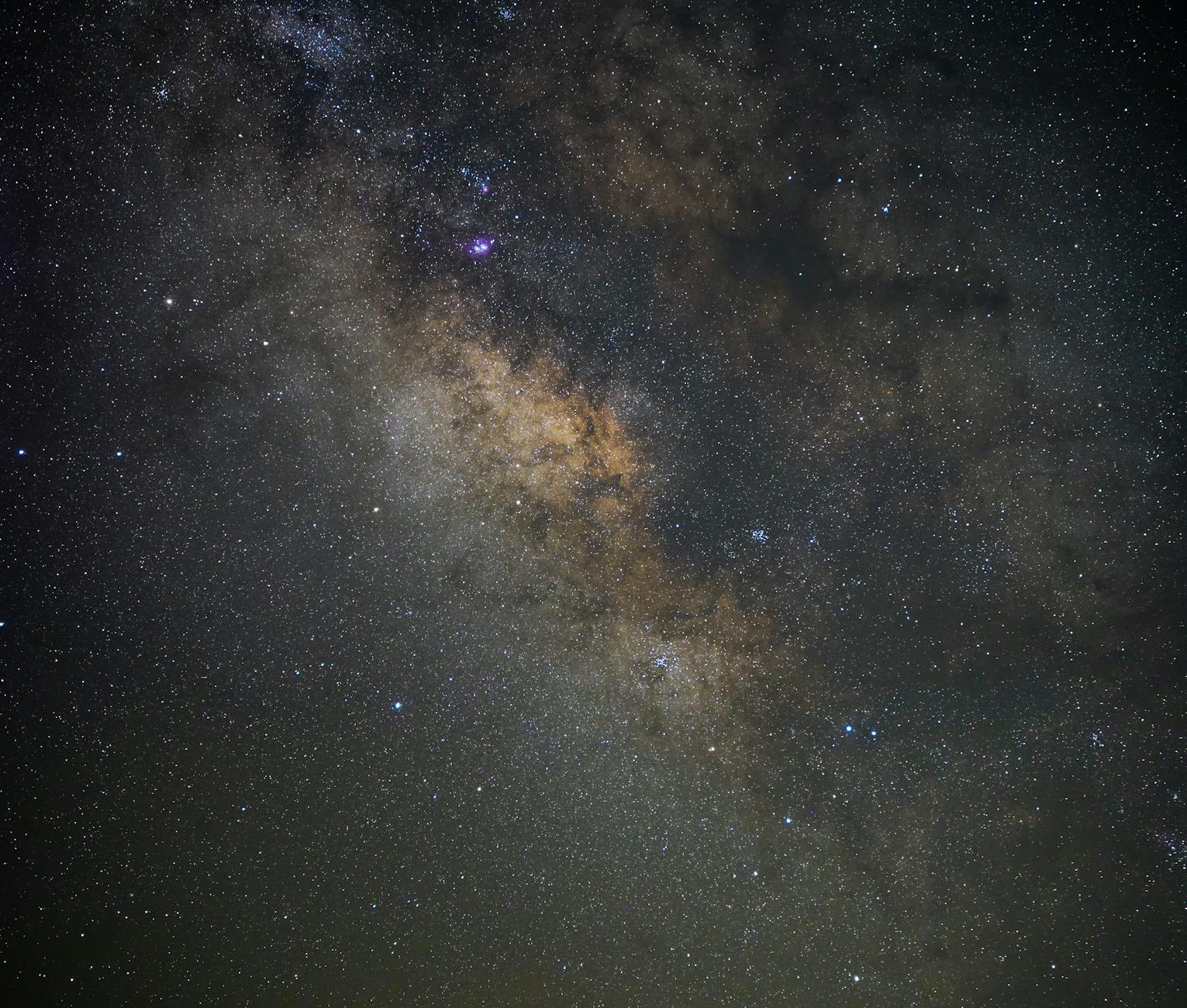
The line that you are made of stardust is true, and it is also one of the most efficiently flattened facts in popular science. Yes, the calcium locking your skeleton together, the iodine your thyroid concentrates from seawater traces, the zinc cycling through every immune cell — these atoms were not made on Earth and were not made in the Sun. They were made in stars that have already died, and in collisions of stellar corpses that are still being characterised. But the procedural detail of which stars, which explosions, and which atoms came from where is considerably less settled than the slogan implies, and the part of the story worth slowing down on is the part the slogan skips.
The popular framing goes like this: stars fuse hydrogen into helium, helium into carbon, carbon into heavier elements, and when they explode as supernovae they scatter the entire periodic table into space. That framing is approximately right in its emotional effect and partly wrong in its physics. Stellar fusion only builds elements efficiently up to iron. Beyond iron, fusion stops paying its energy bill — adding a proton or neutron costs more energy than it releases — and a different set of processes has to take over to produce everything from cobalt to uranium.
Where Fusion Stops
Iron, atomic number 26, sits at the bottom of a binding-energy curve that astrophysicists have been mapping since the 1950s. Lighter elements release energy when fused into heavier ones; heavier elements release energy when split. Iron is the floor. A massive star spends millions of years burning through hydrogen, helium, carbon, neon, oxygen and silicon in concentric shells, and when its core finishes building an iron sphere about the size of Earth, fusion can no longer hold the star up against gravity. The core collapses in roughly a second. What happens in the next several seconds is where most of the atoms in your body that matter biologically — the trace metals, the halogens, the heavier minerals — were forged.
The two processes that build elements heavier than iron are usually labelled the s-process (slow neutron capture) and the r-process (rapid neutron capture). The s-process happens inside aging stars on the asymptotic giant branch, where free neutrons drift into existing nuclei one at a time over thousands of years, slowly walking atoms up the periodic table. The r-process needs neutron densities so high that nuclei get pelted with neutrons faster than they can decay, jumping many mass numbers in a fraction of a second. The r-process needs an environment so extreme that for decades astrophysicists could only argue about where it actually happens.
The Argument Over Kilonovae
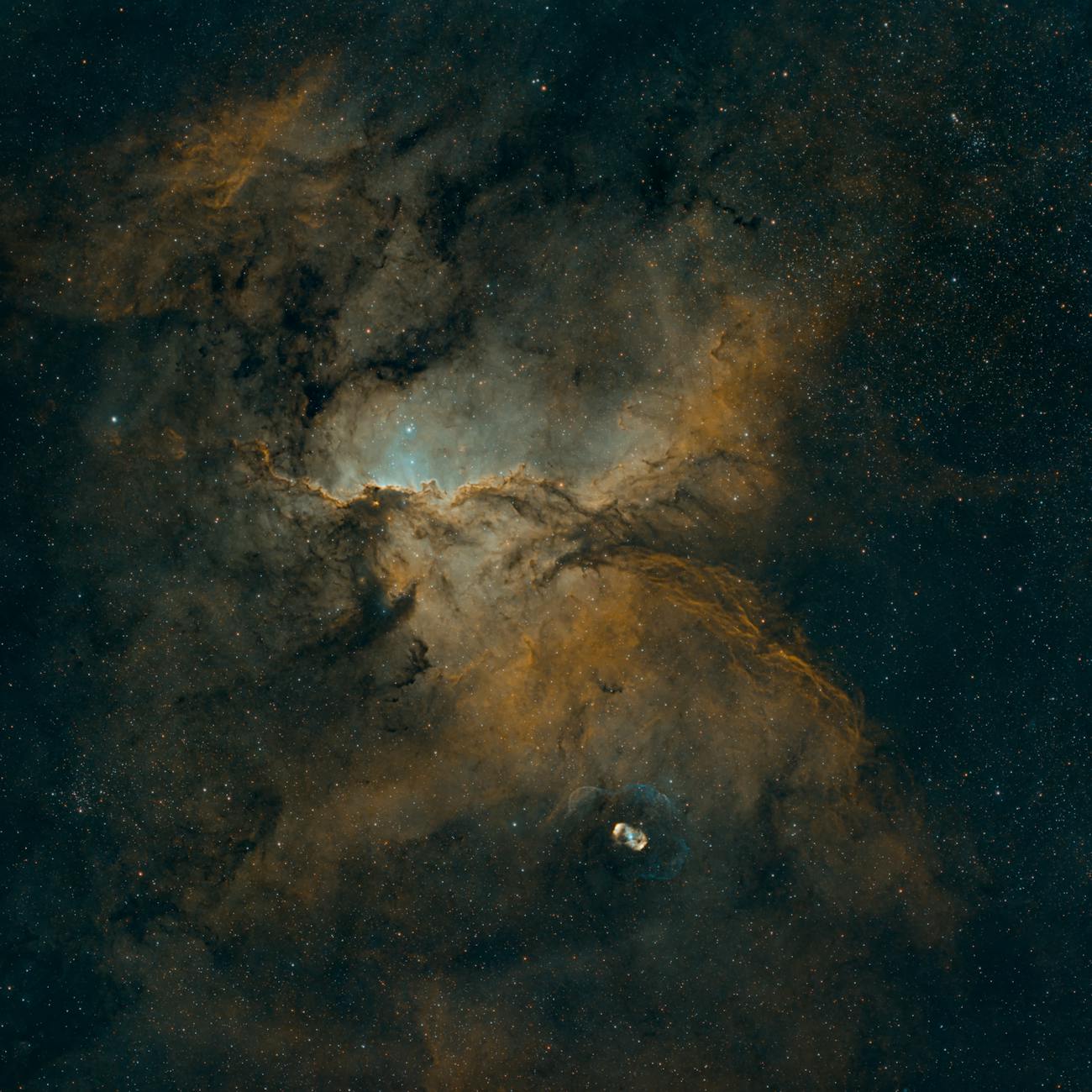
For most of the twentieth century the default assumption was that core-collapse supernovae did the heavy lifting — that the same explosions that scatter oxygen and silicon also produced the platinum, gold, iodine and the rest of the r-process inventory. The picture began to shift in 2017, when LIGO detected gravitational waves from a neutron star merger and follow-up observations caught a kilonova whose spectrum carried the fingerprints of newly minted heavy elements. That single event recalibrated the field: at least some, possibly most, of the r-process elements appeared to be made when two neutron stars spiral into each other and tear themselves apart.
The picture has since gotten more complicated rather than less. Coverage of recent cosmic events has detailed a possible superkilonova that appears to have exploded not once but twice, raising questions about how often such cataclysms occur and how much heavy-element mass they actually distribute. Other modeling work has produced the first observational hints of nuclear fission operating in the cosmos, suggesting that the very heaviest nuclei formed in mergers may be fragmenting back down and reshaping the abundance pattern astronomers observe in old stars. Inverse has reported on research suggesting some heavy elements may have “surfed” to Earth on supernova shock waves, embedded in dust grains that survived the journey through interstellar space. Recent reporting has also highlighted a first-of-its-kind supernova that raises new questions about these events, including how reliably researchers can attribute specific element abundances to specific explosion types.
What Each Atom Actually Tells You
The body contains roughly two dozen elements that are biologically essential. Most of the mass — hydrogen, carbon, nitrogen, oxygen — is light and was made either in the Big Bang (hydrogen) or in ordinary stellar fusion (carbon, nitrogen, oxygen). The calcium in bones is also from fusion, made in oxygen and silicon burning in massive stars and dispersed by core-collapse supernovae. So is the iron in hemoglobin, although iron has the distinction of being the last element fusion can build before the energy economics invert. Past iron, the provenance gets interesting.
Zinc, atomic number 30, sits in the gap where both supernovae and slow neutron capture contribute, and the relative weights are still being modeled. Selenium and bromine, both biologically essential at trace levels, are r-process products almost certainly delivered in part by neutron star mergers. Iodine, atomic number 53, is unambiguously an r-process element. Every iodine atom your thyroid uses to build thyroxine and triiodothyronine was assembled in a neutron-rich environment so violent that the nuclei could not absorb particles fast enough to keep up with the neutron flux. Whether that environment was a kilonova, a particularly exotic supernova, or some combination is the live research question.
Molybdenum in xanthine oxidase, cobalt in vitamin B12, copper in cytochrome c oxidase — every one of these has a stellar provenance that astrophysicists are still refining. The element abundances measured in the oldest, most metal-deficient stars ever found are how researchers reconstruct which processes dominated in the early universe, because those stars preserve a chemical fingerprint of whatever exploded just before they formed. Recent work using machine learning has gone further: an international team reported that artificial intelligence applied to elemental abundances suggests the first stars were not alone when they died, implying multiple supernovae contributed to enriching the gas that eventually became later stellar generations — and, eventually, planets, oceans, and people.

How the Atoms Got Here
An ejected atom from a supernova or kilonova does not arrive at Earth directly. It spends hundreds of millions to billions of years drifting through the interstellar medium, getting incorporated into molecular clouds, surviving the gravitational collapse of those clouds into new stars and protoplanetary disks. The solar system formed about 4.6 billion years ago from a cloud that had been seeded by many generations of stellar deaths. Some of the heavy isotopes in meteorites carry signatures pointing to a specific supernova that may have exploded near the protosolar nebula and possibly helped trigger its collapse. The water on Earth has its own provenance question — a NASA-led team has linked comet water to Earth’s oceans through isotopic ratios — and the heavy elements dissolved in that water carry the same kind of forensic signatures.
Once incorporated into Earth, atoms cycle. The calcium in your bones today was in someone or something else recently, and in seawater before that, and in volcanic rock before that, and in interstellar dust before that, and in a star before that. The iodine your thyroid concentrated this morning came from food, which came from soil or seawater, which got its iodine from the weathering of crustal rocks formed from the same primordial inventory.
What the Slogan Undersells
Space Daily has previously examined how procedural details get stripped out of popular science narratives — how the line that sunlight is 100,000 years old is both useful and slightly misleading, depending on whether you mean the photon or the energy. The stardust line has a similar problem. It is emotionally accurate. It is physically incomplete. The atoms in your body have at least four distinct stellar origins: Big Bang nucleosynthesis (hydrogen, helium), low-and-intermediate-mass stellar fusion plus the s-process (carbon, nitrogen, some heavier metals), core-collapse supernovae (oxygen, silicon, calcium, iron, some r-process), and neutron star mergers (much of the r-process inventory, including iodine and the rarer heavy metals). The slogan collapses all of this into “a dying star,” which is true in the same loose way that “a person made this” is true of every object in your house.
The procedural reality is more interesting than the slogan. Your body is not a souvenir from one event. It is an assembly of atoms from at least three different classes of cosmic catastrophe, mixed and recycled through gas clouds, planetary differentiation, biogeochemical cycling, and metabolism, and the specific question of which kilonova made which of your iodine atoms is, at present, unanswerable — not because the physics is mysterious but because the mixing is too thorough to invert.
What remains uncertain is not whether heavy elements come from stellar death — that is established — but the relative budgets. How much of the r-process inventory comes from neutron star mergers versus rare classes of supernova? How much fission cycling happens in the immediate aftermath of a merger? How much of the chemical enrichment of the early universe came from a population of first stars whose properties are still being inferred from abundance patterns in surviving low-metallicity stars? Each of these questions is being actively worked, and each answer shifts the percentages assigned to the atoms in your blood.
The honest version of the line is longer and less quotable. Every atom heavier than iron in your body was made in a violent stellar event, and astrophysicists are still arguing about which kind of event made which fraction of which element. That is a worse slogan and a better description of what is actually known.
