
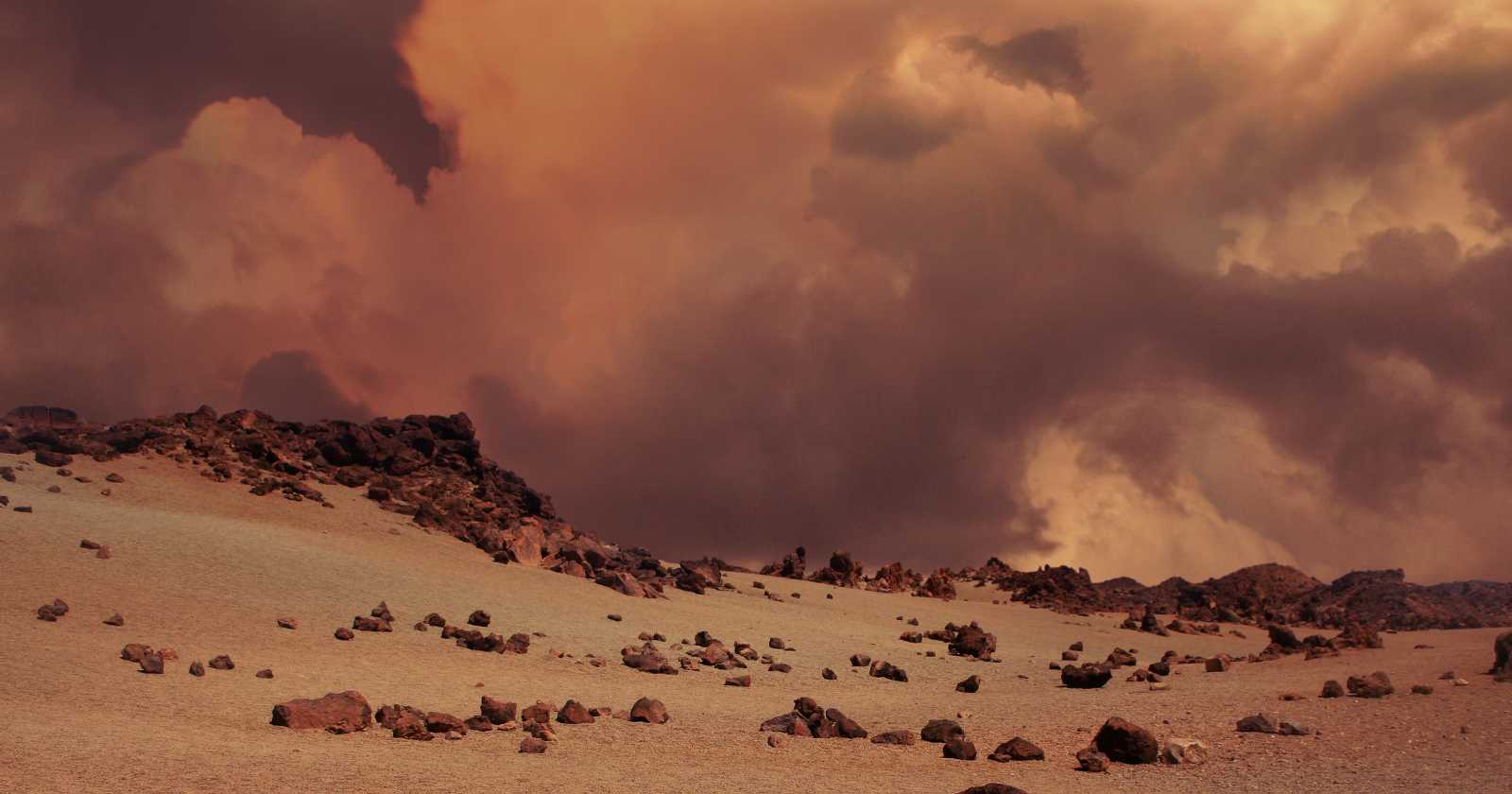
Carl Sagan, Richard Turco, Owen Toon, Thomas Ackerman, and James Pollack published a paper in Science in 1983 that ran the climate of a hypothetical nuclear war through a one-dimensional radiative-convective model that Pollack and Toon had spent the previous decade building at NASA Ames to study something very different: the great dust storms that periodically shroud Mars.
The paper, known forever after by the acronym TTAPS, drawn from the authors’ surnames, gave the English language the phrase “nuclear winter” and produced a single chilling prediction. A war involving a few thousand warheads could loft enough soot from burning cities into the stratosphere to drop average Northern Hemisphere land temperatures dramatically and hold them there for months. The model that produced that number had been written to explain why Mariner 9, arriving at Mars in 1971, had found the entire planet hidden under a planet-wide dust shroud instead of the cratered surface its cameras were built to photograph.
The lineage is not a footnote. It is the entire reason the paper exists.
A spacecraft that arrived to find a planet erased
When Mariner 9 entered Mars orbit, James Pollack was a young planetary scientist at NASA Ames Research Center in California. The mission’s cameras returned images of a featureless ochre haze. Mars was in the grip of the largest dust storm ever observed from Earth, and the spacecraft had to wait weeks for it to settle before mapping could begin. Pollack, working with colleagues including Brian Toon, Richard Turco, and Tom Ackerman, set out to understand how a thin atmosphere could hold so much suspended dust for so long, and what that dust did to the temperature of the planet underneath.
The answer they built was a one-dimensional radiative-convective model. It tracked, layer by layer through the atmosphere, how sunlight was absorbed by suspended particles, how heat radiated back up from the surface, and how convection redistributed energy. The Martian version showed something striking. Dust high in the atmosphere warmed the upper layers by tens of degrees while plunging the surface into cold and darkness, sometimes for months at a time. The same code, with different inputs, could be pointed at any dusty atmosphere. Venus. The early Earth. The aftermath of an asteroid impact, which is exactly what the team used it for in the early 1980s to model the Cretaceous extinction.
From asteroid impacts to mushroom clouds
By the early 1980s the same group was looking at a different kind of injection. Earlier work had pointed out that the fires set by nuclear weapons would loft enormous quantities of smoke into the atmosphere, and that nobody had bothered to calculate what that smoke would do to sunlight. Sagan, who had worked with Pollack on Venus and Mars atmospheres for twenty years, saw immediately that the Mars dust code was the right tool for the job. Soot from burning cities is darker and more absorbing than Martian dust. The optical depth numbers from a few thousand warheads detonated over urban targets were not subtle. They were catastrophic.
The team ran scenarios. A 100-megaton attack purely on cities. A 5,000-megaton counterforce exchange. A 10,000-megaton spasm war. In every plausible case above a few hundred megatons aimed at flammable targets, the model returned the same family of curves. Sunlight at the surface dropped to a few percent of normal for weeks. Temperatures over continental interiors plunged below freezing even in summer. Agriculture in the Northern Hemisphere ended for a growing season, possibly more.
The paper that named the thing
TTAPS appeared in Science in 1983. The phrase “nuclear winter” was new. Sagan, who had a gift for the line that travels, had insisted on it. The paper was deliberately conservative in places and deliberately stark in others. The one-dimensional model could not capture ocean heat transport, could not resolve the patchiness of smoke clouds, could not simulate the washout of soot by rain. The authors flagged all of this. They also pointed out that the qualitative result, a sun-blocking pall over the Northern Hemisphere lasting months, was robust across every set of assumptions they tried.
Within weeks the paper was on the desk of every serious arms control thinker in Washington and Moscow. A companion biology paper spelling out what happens to ecosystems and food supplies when the sun goes out for a season appeared alongside it. Sagan went on television. He wrote a long essay for Parade magazine that reached tens of millions of Sunday readers. He testified before Congress.
What Reagan read, what Gorbachev read
The political afterlife of TTAPS is the part most often misremembered, and it is the part that matters. The nuclear winter findings became part of the arms control conversation during the mid-1980s. At the Reykjavik summit in 1986, Reagan and Gorbachev briefly agreed in principle to eliminate all nuclear weapons within a decade. The deal collapsed over Strategic Defense Initiative testing, but the trajectory that led to the Intermediate-Range Nuclear Forces Treaty signed in 1987, and eventually to the START agreements, ran in part through the climate calculation the TTAPS team had performed on a model built for Mars.
The arms control architecture that followed shaped the world for forty years. The INF Treaty held until the United States withdrew in 2019, and New START, the last treaty placing numerical caps on deployed strategic warheads, expired in February 2026 with no successor in place. The current debate over what replaces it, including proposals to abandon arms control altogether, is being conducted in a world where the climate physics Sagan’s group laid out has not gone away, even if the political memory of it has faded.
The scientific fight that followed
TTAPS was attacked from the day it was published. Critics dismissed it. Other scientists ran more detailed three-dimensional general circulation models and came back with somewhat moderated predictions sometimes called “nuclear autumn.” Surface temperature drops in these models were still substantial, though in some cases smaller than the original TTAPS predictions, and the duration varied. The 1980s debate over which number was right was bitter, public, and unresolved when the Cold War ended.
What happened next is the part nobody predicted. Climate models improved by orders of magnitude. Soot lofting was studied empirically using satellite observations of large wildfires, including the Australian Black Summer fires and the boreal fires that have grown more frequent each decade. Modern nuclear winter modeling in the 2000s and 2010s using coupled atmosphere-ocean models produced results that were comparable to or worse than TTAPS, not better. Even a regional nuclear war involving roughly 100 Hiroshima-sized weapons would loft enough soot to cut global agricultural output for years and cause widespread famine.
A model that keeps coming home to Mars
The Mars connection has not gone stale either. Perseverance, which landed in Jezero Crater in 2021, has been measuring Martian dust storms with instruments the TTAPS-era scientists could only have dreamed of. The SuperCam microphone has recorded crackling electrical discharges inside dust devils, and follow-up work has shown the storms are actively rewriting the planet’s surface chemistry. The radiative-convective frameworks Pollack and Toon built in the 1970s are still the bones of how planetary scientists think about any dusty, hazy atmosphere, from Titan’s hydrocarbon smog to the photochemistry of Saturn’s largest moon to the early Earth’s hazy Archean sky.
A piece of code written to explain why a spacecraft could not see Mars in 1971 became, twelve years later, the calculation that helped inform arms control discussions between two men with 60,000 warheads between them. The same code, refined and re-refined, is now being used to study planets we may one day visit and a future we are once again on the edge of having to imagine.
The plutonium pits that sit in storage from the Cold War arsenals the TTAPS paper helped shrink are now being eyed for civilian reactor fuel, a peaceful end to weapons that were almost used. Whether the next generation of leaders considers the nuclear winter calculations the way previous leaders did is the open question. The physics, written first to describe a red planet in a dust storm, has not changed.
