
The most successful packaging material in modern commerce was a failed home furnishing product before it was a failed agricultural product before it was rescued, almost by accident, by a mainframe computer that needed to survive a cross-country freight journey. The sheet of bubble wrap sitting in a drawer somewhere in every office on earth is not a packaging invention. It is a wallpaper invention that became a greenhouse invention that became a packaging invention only because two engineers ran out of other ideas.
The popular framing of bubble wrap goes like this: someone clever realised that trapping air between two sheets of plastic would protect fragile objects, patented it, and got rich. That framing is approximately right in its emotional effect and almost entirely wrong in its procedural detail. The product existed for nearly three years before anyone involved understood what it was for. Its inventors spent that time trying to convince people to glue it to their living room walls.
Two engineers, a garage in Hawthorne, and a wallpaper idea
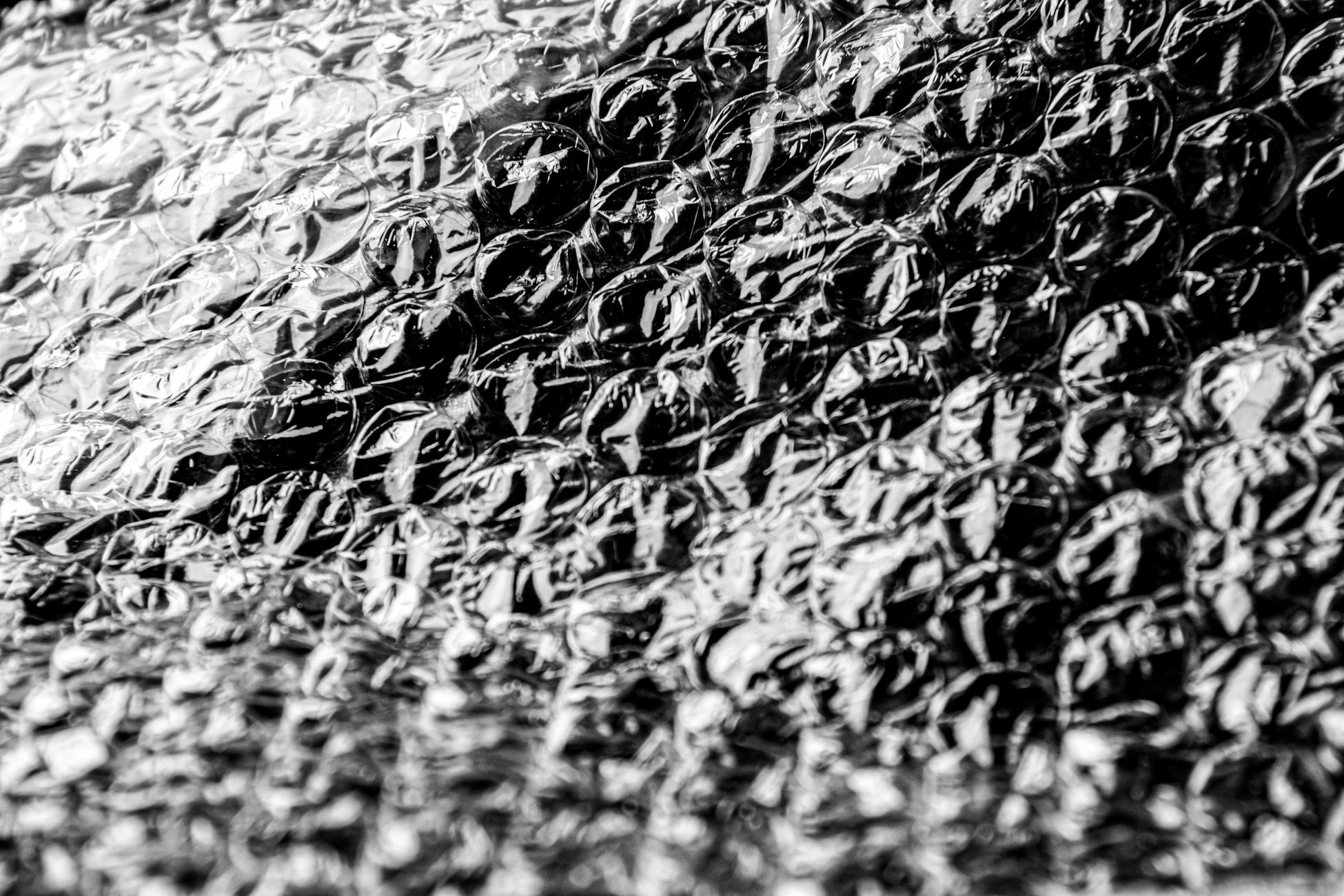
In 1957, Alfred Fielding and Marc Chavannes were working to produce a textured plastic wallpaper with a paper backing. The technique they developed sealed two plastic sheets together in a way that trapped pockets of air between the layers. The intended aesthetic was something modern, something three-dimensional, something a homeowner in the late Eisenhower years might glue to a feature wall for a futuristic effect.
That sentence sounds like folklore. It is, in fact, the documented origin story of the material that now ships almost every fragile object in global commerce. Fielding and Chavannes were not packaging engineers. They were not thinking about cushioning. They were thinking about interior design.
The wallpaper failed completely. Homeowners did not want plastic bubbles on their walls. The product offered no real advantage over paper wallpaper, cost more, and looked, by most contemporary accounts, slightly strange. There was no market. There were no orders. The two inventors were left with a manufacturing process and a product no one wanted to buy.
The greenhouse pivot that nobody asked for
The second attempt at finding a use for the material targeted agriculture. Fielding and Chavannes pitched the bubble sheet as greenhouse insulation, arguing that the trapped air layer would help retain heat in commercial growing operations. On paper, the physics is reasonable. Air is a poor conductor of heat, which is why double-glazed windows work, which is why down jackets work, which is why any insulating material in the world traps air rather than blocking heat directly.
Run the arithmetic and a sheet of small sealed air pockets should, in principle, perform some insulating function. The problem was not the physics. The problem was that commercial greenhouse operators in 1958 had established methods, established suppliers, and no particular reason to retrofit their operations with an untested plastic film from two men in New Jersey. The greenhouse market also failed to materialise.

At this point the invention had been on the market, in one form or another, for nearly three years with essentially no commercial success. Two failed product categories. No customer base. A manufacturing line producing a material that nobody seemed to need. By any reasonable startup metric, the project should have been wound down. The pattern is one that appears repeatedly in the literature of product launches that struggle to find their market — a real technical innovation looking for a problem it can actually solve.
The IBM 1401 and the shipping problem
The rescue came from an unexpected direction. In 1960, IBM was preparing to ship the IBM 1401, a transistorised business computer that would go on to become one of the defining mainframes of its era. The 1401 was a delicate, expensive machine. IBM had a problem that every computer manufacturer of the period faced: how to get the thing from the factory to the customer without damaging it in transit.
The packaging materials available at the time were limited. Wood shavings, shredded paper, crumpled newsprint, and various foam products were the standard options. None of them performed especially well for an object as sensitive and as heavy as an early mainframe. Wood shavings absorbed moisture. Paper compressed under load. Foam was expensive and not yet widely manufactured in the forms needed.
Someone at the company that would later become Sealed Air saw the IBM problem and the unsold wallpaper sitting in the warehouse and made the connection that the inventors themselves had missed for three years. The trapped air pockets that had failed as a decorative texture and failed as a greenhouse film would absorb impact extraordinarily well. The material was pitched to IBM as protective packaging for the 1401.
IBM accepted. The product that nobody had wanted on their walls or in their greenhouses turned out to be precisely what a computer manufacturer needed to ship fragile electronics across a continent. The company that became Sealed Air Corporation has now built its entire brand legacy around the material’s third act.
What the failures actually were
The part of the story worth slowing down on is what the two earlier failures actually represented. They were not failures of the product. They were failures of category. The physical properties of the material — air trapped between thin polyethylene films, deformable under impact, recovering most of its shape afterward — were the same in 1957 as they were in 1960. What changed was the framing.
As wallpaper, the bubbles were a visual feature, and the visual feature was unappealing. As greenhouse insulation, the bubbles were a thermal feature, and the thermal feature was marginal compared to incumbent solutions. As packaging, the bubbles became a mechanical feature — the ability to absorb and dissipate kinetic energy from a sudden impact — and that mechanical feature happened to be revolutionary. Nothing about the material changed between failure and success. The application changed.
This pattern — a technology searching for the application that reveals its actual value — is well documented in innovation research. The relationship between a product’s physical properties and its commercial value is mediated entirely by which problem it is being asked to solve. The same molecule, the same manufacturing process, the same sheet of plastic can be worthless in one market and indispensable in another. Cross-domain problem-solving in engineering describes this kind of lateral transfer as one of the most reliable sources of genuine innovation, and one of the hardest to plan for.
The serendipity that wasn’t quite serendipity
It is tempting to file the bubble wrap story under serendipity — the lucky accident, the right product meeting the right problem at the right moment. The category is real. Psychology Today’s working definition distinguishes serendipity from synchronicity by emphasising that serendipity involves an unexpectedly helpful discovery that the discoverer is positioned to recognise and act on. Someone was positioned. They understood IBM’s shipping problem, they understood the warehouse full of unsold air-bubble sheet, and they made the connection that the inventors had not.
What the bubble wrap story illustrates is that serendipity in product development is almost never pure accident. It is the meeting of a real physical capability with a real unsolved problem, mediated by someone who can see both at once. Fielding and Chavannes could see the capability. They could not see the problem, because the problem they were imagining — bare walls, cold greenhouses — was not the problem the capability solved. IBM had brought the packaging problem to the company. The third launch worked because, for the first time, the question being asked of the material matched the material’s actual properties.
What the modern brand inherits
The material is now sold under the Bubble Wrap brand name by Sealed Air, which has spent decades building out the product line and protecting the trademark. There is a National Bubble Wrap Appreciation Day. There are popping toys, stress-relief variants, and biodegradable versions. The IBM 1401, the computer that justified the third launch, was discontinued in 1971. The packaging material that was invented to protect it is still in production, still using essentially the same trapped-air principle, still solving essentially the same problem.
The numbers behind modern packaging are striking. Bubble wrap and related cushioning materials now ship a meaningful percentage of all e-commerce parcels globally. The market that did not exist in 1957, that two inventors failed to find in their wallpaper pitch, that they failed to find again in their greenhouse pitch, turned out to be one of the largest packaging categories in the world. It just was not the market they were looking for.
The lesson nobody quite learns
The instructive part of the story is not that Fielding and Chavannes were wrong twice. The instructive part is how long they remained wrong, and how committed they were to the wrong applications, before the right application arrived from outside. Three years is a long time to manufacture a product that no one is buying. Most modern startups would not survive that pattern. The high failure rate in enterprise technology adoption tracks a similar dynamic — capability and application are easier to invent in isolation than to match together, and most of the matching is done after the inventing, by people other than the inventors.
The reflective pattern behind this — the slow, often misdirected search for what a thing is actually for — is a phenomenon often visible in adjacent technology sectors, such as how SpaceX’s long-term commercial value shifted toward satellite internet infrastructure rather than just rocket launches. The headline product and the actual business are often different products.
The sheet of bubbles on the desk is a small monument to that gap. It was supposed to be a wall. Then it was supposed to be a roof. It became a shipping container for a computer, and then a shipping container for everything else, and the inventors had to be wrong twice in order to be right once. The material did not change. The question changed. The answer had been sitting in the warehouse the entire time.
