
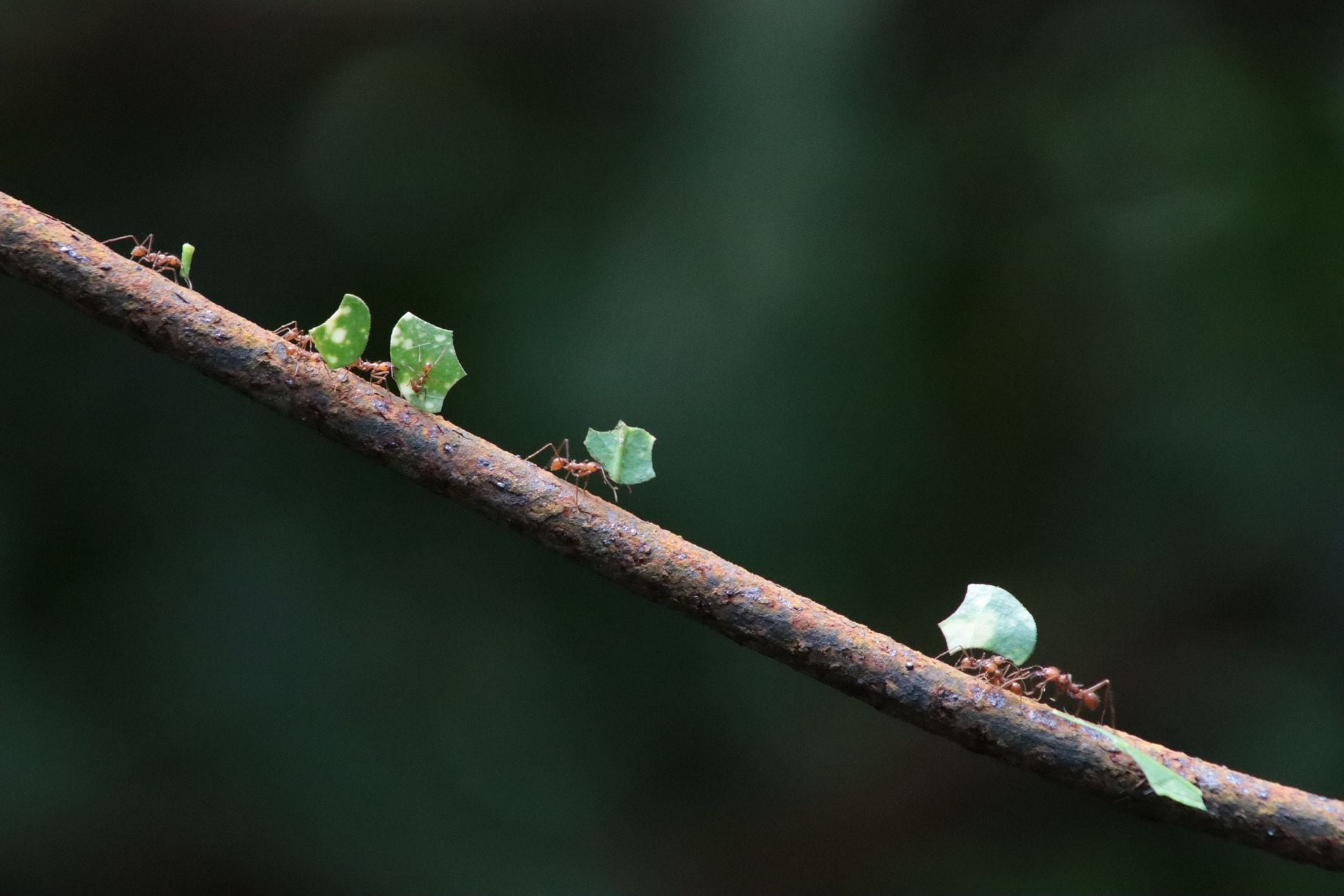
The leafcutter ants of the genus Atta, marching in dark columns through Central and South American rainforests, routinely hoist fragments of leaf and flower petal that outweigh their own bodies many times over, ferrying the cargo back to underground fungus gardens that can stretch the size of a small living room. A single worker can haul a load roughly 50 times her body mass across the forest floor, the rough equivalent of an average adult human sprinting home with a small hatchback strapped to their back.
The ant does not slow down. It does not stagger. It moves at close to its normal walking speed, mandibles clamped, six legs pistoning in a gait so steady you could set a metronome to it.
The crumb, and what it really means
Watch an ant on a kitchen tile long enough and something odd happens to the scale of the room. The crumb of toast it is dragging is bigger than its head. Sometimes bigger than its whole body. And it is not being pushed or rolled — it is being lifted, held clear of the floor, and carried.
For a common black garden ant, Lasius niger, that crumb might weigh several milligrams. The ant itself weighs only a few milligrams. The math is quiet and absurd.
Scaled up, a 70-kilogram adult would be walking down the street with roughly 3,500 kilograms in their arms. A Toyota Corolla weighs about 1,300 kilograms. A Ford F-150 pickup, around 2,000. The ant, in effect, is carrying the truck.
Why the physics lets them do it
The answer sits in a piece of geometry that biologists call the square-cube law. When you shrink an animal, its volume — and therefore its weight — falls off much faster than the cross-sectional area of its muscles and its skeleton.
Muscle strength scales roughly with cross-sectional area. Body weight scales with volume. Halve an animal’s linear dimensions and you cut its weight by eight, but its muscle cross-section only by four. The little creature ends up, pound for pound, twice as strong.
An ant is not stronger than a human in absolute terms. A human bicep could tear an ant in half without noticing. What the ant has is a body so small that gravity barely bothers it, and a musculature that, at its scale, is functionally overbuilt.
The neck that does the lifting
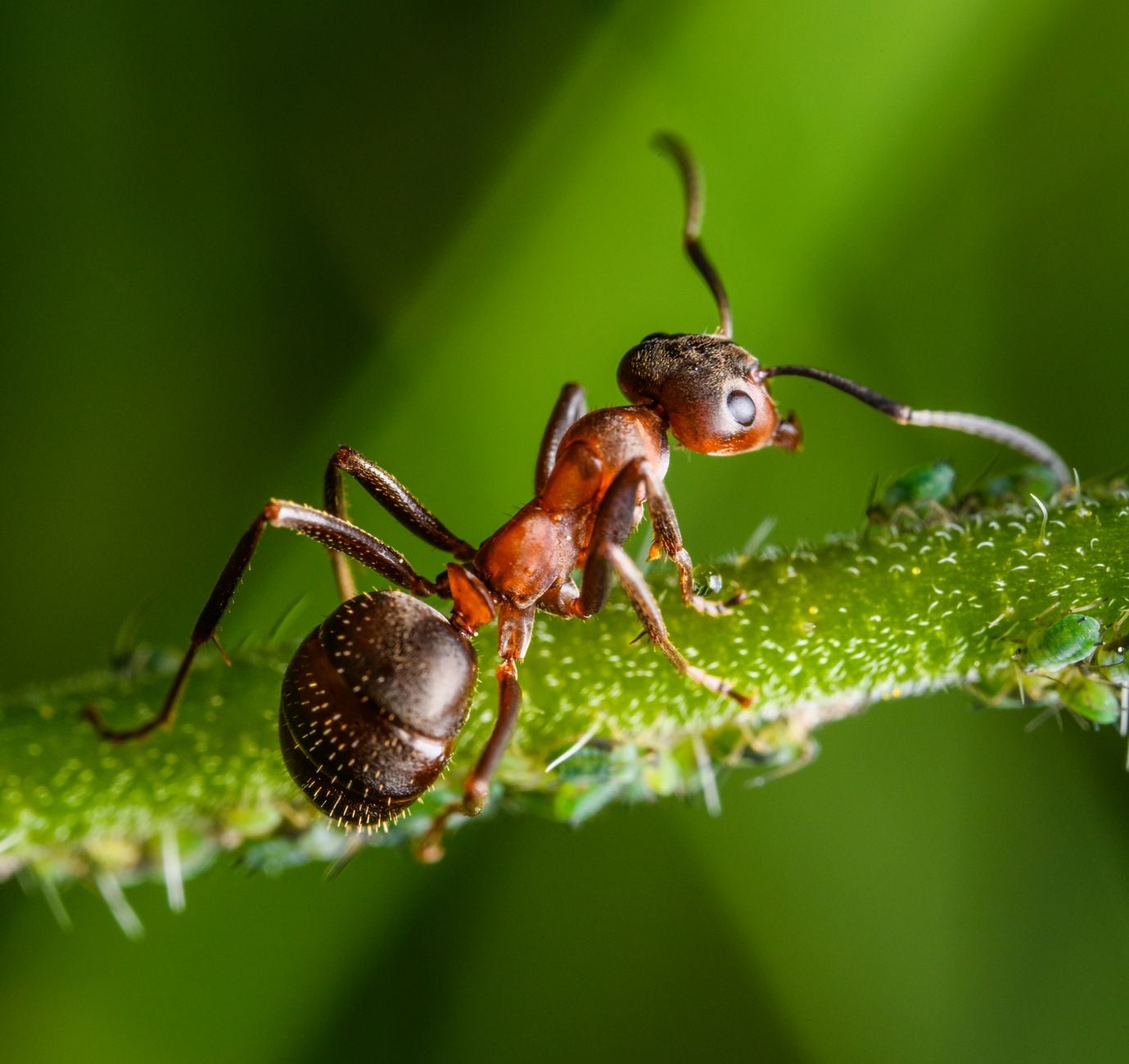
The neck joint of a field ant can withstand forces thousands of times the ant’s body weight before catastrophic failure. The soft neck membrane, ridged and folded like a bellows, interlocks with the harder exoskeleton of the head in a way that spreads the load across a surprisingly wide contact area.
The 50-times number people quote is not the ceiling. It is the routine working load. The ant is nowhere near its structural limit when it picks up your breadcrumb.
Leafcutters and the 5,000-strong supply chain
The most extreme haulers on the planet are the leafcutter ants of Central and South America. A mature colony of Atta cephalotes can contain millions of workers and clear an area of forest of its foliage in a single night, moving the equivalent of a family car’s worth of leaf material into an underground nest that can descend several metres below the surface.
Each worker snips a semicircle of leaf, hoists it above her head like a green sail, and joins a highway of thousands of others marching back to the nest. The columns are so heavily used that the ants wear grooves into the forest floor, visible trails that persist for years.
The leaves are not food. The ants feed them to a fungus, which they cultivate in chambers underground and eat in return. The whole arrangement is tens of millions of years old, older than the Andes.
What 50 times your body weight actually feels like
The strongest human deadlifters can pull roughly 2 to 2.5 times their own body weight off the floor, held for a couple of seconds before dropping it.
An ant does 50 times its body weight and then walks with it. For minutes. Over rough terrain. Up vertical surfaces. If a human could match an ant on a per-kilogram basis, an average person could pick up a Volkswagen Beetle and jog with it down the block.
The comparison breaks down at the edges — human muscles have to fight gravity in ways ant muscles largely do not — but the intuition holds. At the ant’s scale, physics has taken a thumb off the scale.
The Asian weaver ant, tested in a lab
Asian weaver ants, Oecophylla smaragdina, have been observed hanging upside down from glass surfaces while carrying loads many times their own body mass. When the load grows heavy, the ants deploy more of their footpad surface area, effectively pressing harder against the glass. They are not just strong. They are actively adjusting their grip in real time based on the weight they are carrying.
Coordination beats brute force
When a load is genuinely too big for one ant — a whole cricket, a chunk of fruit — the colony sends more workers. Groups of ants transporting a large object make coordinated navigation decisions.
A single ant briefly joins the team, sets a new direction based on cues the group can’t easily see, then leaves. The load moves. Another scout arrives. The direction shifts. The colony carries objects far larger than any individual could manage, and the process looks eerily like a distributed algorithm.
The group’s steering can be more efficient than any single ant’s would be, but only up to a certain group size — beyond about 10 to 15 ants, the coordination benefit appears to level off.

Ants have been doing this for 100 million years
The oldest known ant fossils have been found preserved in amber dated to around 90 million years ago. They were already recognisable ants — social, wingless workers, elbowed antennae, the whole plan.
By the time Tyrannosaurus rex was walking around the Cretaceous, ants were already hauling things bigger than themselves through the leaf litter beneath its feet. The load-bearing trick predates flowering plants in their modern form. It predates most mammals.
Today there are more than 14,000 described ant species with a combined global biomass that rivals or exceeds that of all wild birds and wild mammals put together.
Every one of them, on a per-body-weight basis, could out-lift you.
The kitchen floor, one more time
The ant on the tile is not a curiosity. She is a piece of engineering that has been refined for longer than the Rocky Mountains have existed. Her neck can bear thousands of times her weight before it fails. Her feet can grip glass upside down. Her colony can move a bird carcass across a garden in a night.
The crumb she is carrying weighs more than she does. She does not know this and would not care if she did. She has an address to get to, a chemical trail to follow, sisters waiting at the other end.
Whether an ant would ever slow down for a car on a staircase is not really the question. The question is why, at her scale, the staircase and the car barely matter at all.