

Entomologists who have spent careers studying the American cockroach Periplaneta americana will tell you the same thing: cut the head off a healthy adult and it will keep standing for the better part of a week. The body walks. It responds to touch. It rights itself if flipped. It dies, eventually, not of the wound but of dehydration, because without a mouth it cannot drink.
The head, meanwhile, can also survive for hours on its own, antennae twitching, if you keep it cool and moist.
This is not a party trick. It is a direct consequence of how insect bodies are engineered, and it explains why the cockroach lineage has walked, unbothered, through mass extinctions, nuclear tests, and the flooded basements of every city on Earth.
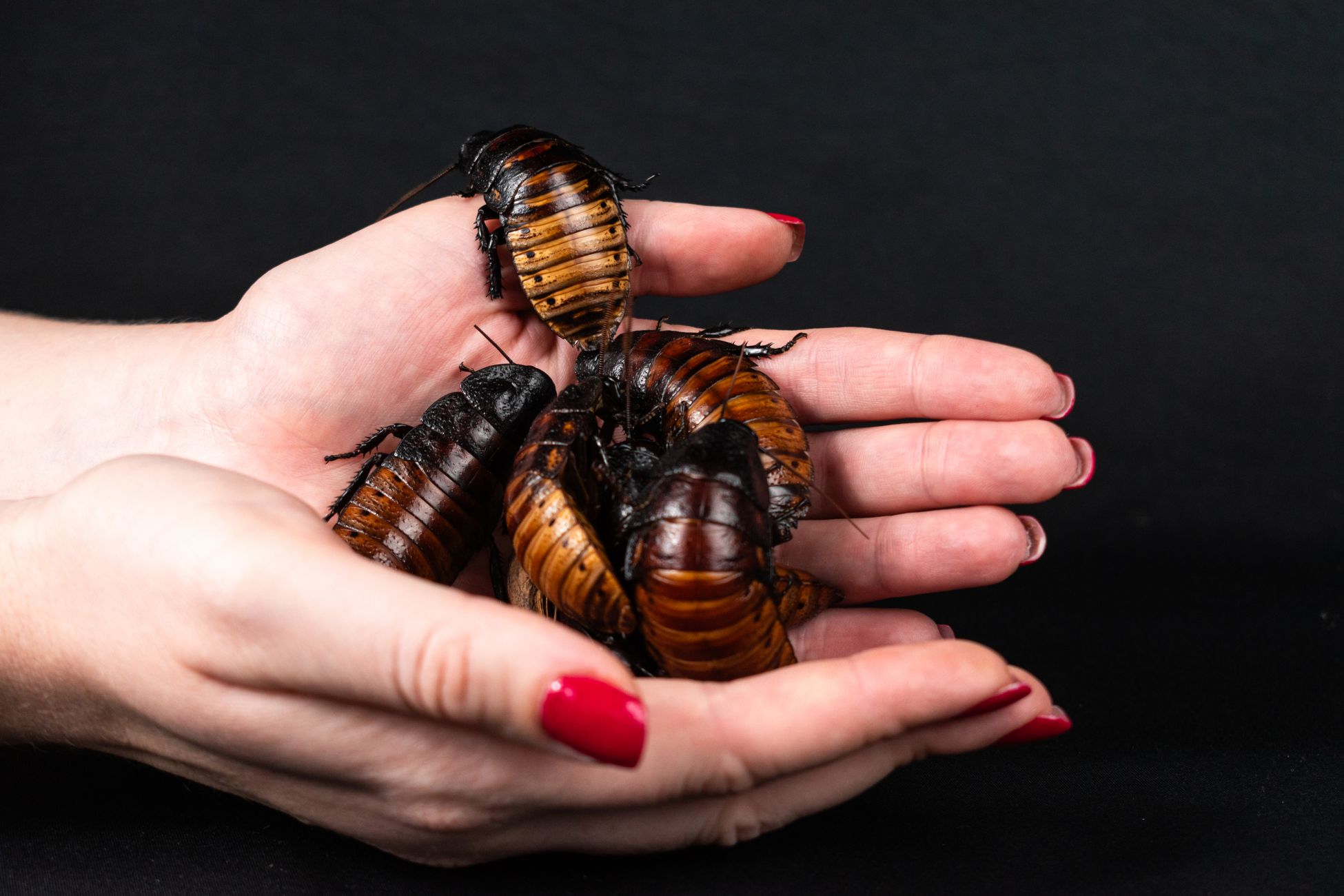
The mammal problem the cockroach doesn’t have
Decapitation kills a human in seconds for two linked reasons. Blood pressure collapses instantly because the heart pumps through a closed, high-pressure loop that depends on an intact head-and-neck circuit. And breathing stops because the diaphragm takes its marching orders from the brainstem, which is now on the floor.
A cockroach has neither of those vulnerabilities.
Its circulatory system is open. A long dorsal vessel, the insect equivalent of a heart, pushes a fluid called hemolymph into the body cavity, where it simply sloshes around bathing the organs. There is no arterial pressure to lose. Cut the head off and the wound clots at the neck within minutes, and the rest of the body carries on at roughly the same internal pressure it had before.
The breathing system is even stranger. Cockroaches don’t inhale through their heads at all.
Breathing without a mouth, or a brain
Air enters an insect through a series of small valved openings called spiracles, arranged in pairs along the sides of the thorax and abdomen. A cockroach has ten pairs. Each spiracle opens into a branching network of tubes, the tracheae, that thread directly into every tissue and deliver oxygen at the cellular level.
There is no central pump. There are no lungs. The cockroach’s own muscular movements, plus passive diffusion and a rhythmic opening and closing of the spiracle valves, are enough to keep oxygen flowing to muscle and nerve. Insects even use discontinuous gas exchange patterns that let them fine-tune oxygen intake without any brain input at all.
Which means the head is, respiratorily speaking, optional.
The brain isn’t where you think it is
A cockroach carries what a neurobiologist would call a distributed nervous system. There is a brain in the head, yes, but there is also a chain of nerve ganglia running the length of the body, one cluster per segment, each capable of running the local machinery on its own.
Walking is coordinated by ganglia in the thorax. Standing upright, reacting to a puff of air, cleaning a leg — all of that is handled below the neck. The head brain mostly deals with vision, the antennae, and feeding. Remove it and the body loses its senses of sight, smell, and taste, but the six legs still know how to walk and the abdomen still knows how to breathe.
This is why, as Forbes biology columnist Scott Travers has explained, a headless cockroach can right itself, walk, and respond to touch for days after the operation. What kills it, eventually, is thirst.
Death by dehydration, on a stopwatch
Cockroaches are cold-blooded. Their metabolism runs slowly compared to a mammal’s, and they don’t need to eat for weeks at a time. What they cannot do without is water. In a warm dry room, a decapitated cockroach loses moisture through its cuticle and its open spiracles at a steady rate, and after roughly a week the tissues have dried enough that the nerve ganglia stop firing. In humid conditions the body can persist longer. In cool, damp conditions, longer still.
Keep the severed head cold and wet on a slide, and it can survive several hours. Feed it sugar water through a capillary and researchers have kept isolated cockroach heads responsive for considerably longer.
None of this is theoretical. Entomology labs have run the experiment repeatedly for the better part of a century, because Periplaneta americana is one of the workhorse study species of insect physiology.
Why this lineage keeps winning
The same anatomical package that makes decapitation survivable makes cockroaches almost absurdly hard to kill by any other means. A closed circulatory system is fragile — one puncture and pressure collapses. An open one shrugs off punctures. A centralised lung is a single point of failure. Ten spiracles feeding a tracheal mesh is not.
Cockroaches can hold their breath by clamping their spiracles shut, a trick they use to conserve water. They can survive submerged for extended periods. They can withstand radiation doses that would sterilise a mammal several times over, because their cells divide slowly and mostly during the moult cycle. And they have been walking the planet, in essentially their modern form, since long before the dinosaurs — which is part of why they strolled through the Chicxulub impact that ended the Cretaceous.
The cockroach lineage extends back hundreds of millions of years. The design has barely changed.
The scuba-suit experiment
The robustness of that design is now being exploited. Researchers at Nanyang Technological University in Singapore unveiled what they called a diving suit for cyborg cockroaches — a 3D-printed flexible pack that fits over a cockroach and lets it breathe underwater. The suit carries a small chemical oxygen generator that releases O₂ near the spiracles as the roach walks along a submerged surface.
The bugs are steered by tiny electrodes, which is why they get the “cyborg” label. The team envisions swarms of them crawling through the mud and debris of flooded buildings after a hurricane, carrying sensors, sniffing for survivors, threading places no drone can fit.
None of it would work with a mammal. You cannot mount a chemical oxygen generator over a mouse’s face and send it walking into a flooded basement. But an insect that already breathes through valved holes in its sides, and whose nervous system is happy to take instructions from an electrode instead of a brain, is essentially pre-adapted for the job. The engineers at NTU are building on 300 million years of evolutionary R&D.
What the headless week actually looks like
In a laboratory, a decapitated Periplaneta spends the first hour looking, to the naked eye, almost normal. It stands. The legs shift weight the way a resting cockroach’s legs shift weight. Touch the abdomen and it walks, in a direction it chooses, until it runs into something.
By day two the movements are slower and the responses less crisp. By day four the legs fold underneath and the animal mostly sits, twitching when disturbed. By day six or seven, in room-temperature air, it stops responding. Dissection shows tissues that have simply dried out.
The head, meanwhile, if it was kept alive, has been moving its antennae the entire time, sampling an air it cannot walk through.
An architecture built for a different planet
The cockroach body is a reminder that vertebrate biology — centralised brain, closed circulation, lungs — is one solution to being alive, not the solution. Insects went a different way in the Carboniferous, and that architecture has proved so durable that engineers now bolt oxygen tanks to it and send it into disaster zones. The cyborg diving-roach project is only the latest instance of a pattern that has been running for decades: when humans want a machine that can survive the impossible, they keep ending up copying, or literally borrowing, the cockroach.
Which is why the headless-cockroach fact, half urban legend and half undergraduate lab demonstration, matters. It is not a curiosity about how gross cockroaches are. It is the clearest single window into why this animal is still here, and why it will still be here, long after the flooding gets worse and the power goes out and the last mouse in the basement has given up.
A week without a head. Killed, finally, by a glass of water it cannot reach.
