
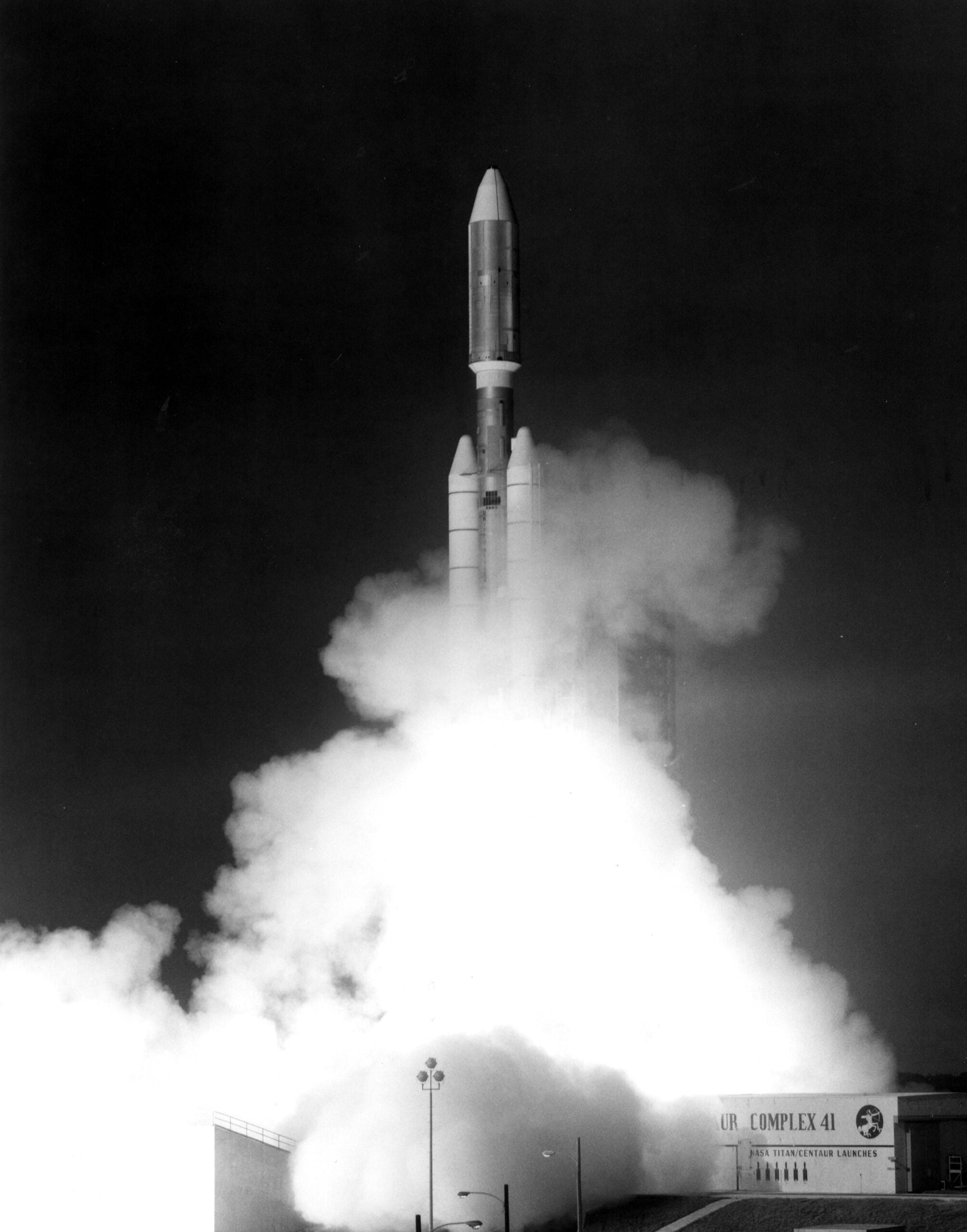
A spacecraft weighing 721.9 kilograms — 1,592 pounds, about the mass of a small car — lifted off from Launch Complex 41 at Cape Canaveral, Florida, on 5 September 1977 at 12:56:01 UT, riding a Titan IIIE-Centaur designated TC-6. Thirty-five years later, on 25 August 2012, that same machine became the first human-made object to leave the heliosphere and enter interstellar space. And as of 21 August 2024, NASA’s tally put Voyager 1 at 164.7 astronomical units from Earth, still talking to the Deep Space Network, still returning data.
That is the whole arc in three dates, and the arithmetic inside it is the story. One AU is the average Earth-Sun distance. At the 21 August 2024 stamp, Voyager 1 sat more than 164 times farther from us than the Sun — a number generated by hardware designed, built, and launched in the mid-1970s for a mission originally scoped around the outer planets.
A four-year plan that became a planetary tour
Voyager 1 was designed and is managed by NASA’s Jet Propulsion Laboratory, and it launched second. Voyager 2 went first, on a slower trajectory; Voyager 1 followed on a faster route and overtook its twin on 15 December 1977, barely three months into flight. The ordering has confused people ever since, but the naming reflects arrival sequence at Jupiter rather than departure.
Closest approach to Jupiter came on 5 March 1979. Among the findings credited to the encounter: a thin ring around the planet, invisible from Earth, and two new moons — Thebe and Metis — added to the Jovian roster. Then on 12 November 1980, Voyager 1 made its closest pass by Saturn, where it found five more new moons and another ring, the faint G-ring.
That Saturn encounter also set the rest of the mission. The flight plan sent Voyager 1 close to Titan, Saturn’s haze-wrapped moon, and the geometry of that pass bent the spacecraft’s path north, up out of the plane of the ecliptic in which the planets orbit. The cost was steep and known in advance: Voyager 1 would not continue to Uranus or Neptune. Those worlds were left to Voyager 2. The gain was a trajectory climbing away from the solar system at a steep angle, aimed at nothing in particular and everything beyond.
Power came — and comes — from three Multi-Hundred Watt radioisotope thermoelectric generators, converting heat from decaying plutonium into electricity. There are no solar panels out there to catch anything. The RTGs are the reason a 1977 spacecraft is still a functioning spacecraft, and the reason it will one day stop being one.
Bolted to the side of the craft is a 30-centimeter gold-plated copper disc, the Golden Record, carrying greetings, sounds, music, and images assembled as a message from Earth. It was never the point of the mission. It is, increasingly, the part people remember first.
Crossing out
The Voyager Interstellar Mission officially began on 1 January 1990, after the planetary work was finished. By then Voyager 1 had a single remaining job description: keep going, keep measuring, keep reporting.
The milestones arrived on their own schedule. On 17 February 1998, at 69.4 AU from the Sun, Voyager 1 overtook Pioneer 10 to become the most distant human-made object — a title it has held without interruption since, and will hold permanently, given its speed advantage.
Then 25 August 2012. On that date Voyager 1 crossed out of the heliosphere, the bubble of charged particles and magnetic field blown outward by the Sun, and entered interstellar space. It was the first spacecraft to do so. No fanfare was possible at the moment of crossing; confirmation came from the data, from changes in the particle and field environment that the instruments recorded and the spacecraft dutifully radioed home at light speed, hours in transit.
The Voyager fact sheet keeps the record tidy: launch date, launch pad, launch vehicle, mass, encounter dates, the crossing. What it does not do is dramatize. The numbers carry it.
164.7 AU, stamped and dated
Here is where precision matters more than momentum. NASA’s figure of 164.7 AU from Earth is timestamped to 21 August 2024. It is not a live reading, and it should not be read as one. The spacecraft is receding at roughly 38,027 mph relative to the Sun — NASA’s precise figure is 38,026.79 mph, about 17.0 kilometers per second — so the distance grows continuously, but the honest statement is the stamped one: 164.7 AU on that date, still sending data.
The “still sending data” part is now an actively managed condition. The RTGs produce less power every year as their fuel decays, and JPL has been switching off science instruments to stretch what remains. In February 2025 the Cosmic Ray Subsystem on Voyager 1 was turned off. On 17 April 2026 the Low-energy Charged Particles experiment was shut down, with the mission page noting two science instruments still operating after that step. Each shutdown is a trade: one fewer measurement, more months of spacecraft.
There is no announced end date, and inventing one would be its own kind of error. What exists is the record: a 721.9-kilogram machine that left LC-41 on 5 September 1977, passed Jupiter in 1979 and Saturn in 1980, became the farthest human object in 1998 at 69.4 AU, crossed into interstellar space on 25 August 2012, and stood 164.7 AU from Earth on 21 August 2024 with its transmitter still finding the Deep Space Network.
Everything in that sentence was built with 1970s components, launched on a rocket that no longer exists, from a pad on a Florida coastline, by people who planned for four years of operation. The spacecraft outlived the plan by decades, and it is still, carefully and with diminishing power, filing reports.