
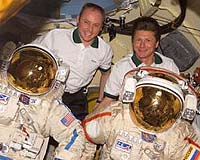
Expedition 9 crewmembers conducted their second session with an experiment that looks at the accuracy of ultrasounds for bone scans, abdominal scans and other medical contingencies.
Gennady Padalka and Mike Fincke took turns performing the scans on each other to better understand the ability to quickly and remotely transmit medical data to the ground.
NASA’s payload operations team at the Marshall Center monitored the activity and coordinated the video transmission from the Space Station.
The Expedition 9 crew recently served as test subjects for the Advanced Diagnostic Ultrasound in Micro-G (ADUM) experiment. NASA ISS Science Officer Mike Fincke set up the equipment, after which he and Commander Gennady Padalka performed the ultrasound bone scans on each other by taking turns as operator and subject.
The bone scans were taken of the subject’s shoulder, elbow, knee and ankle. Scans were also taken of the abdominal area. All of the activities were monitored remotely from the ground, and videotaped and photographed for downlink.
This research will be used to better understand the ability to quickly transmit data to the ground remotely. It will also be used to determine the accuracy of ultrasound in novel clinical conditions including:
orthopedic, thoracic, and ophthalmic injury and dental/sinus infections; and to assess the ultrasound as a feasible option for monitoring in-flight bone alterations.
NASA’s payload operations team at the Marshall Center coordinates science activities on Space Station.
