
ISRO Proposes INSAT 4E Multimedia Mobile SBand Satellite Mission
The Union Cabinet Thursday gave its approval to undertake design, develop & launch GSAT-6 / INSAT-4E, a multi-media mobile satellite system, at a total estimated cost of Rs.
The Union Cabinet Thursday gave its approval to undertake design, develop & launch GSAT-6 / INSAT-4E, a multi-media mobile satellite system, at a total estimated cost of Rs. 269 crores with a foreign exchange component of Rs. 102 crores.
Indian Space Research Organisation (ISRO)) proposes to build a state-of-the-art National Satellite System (GSAT-6) / INSAT-4E) that will offer a Satellite Digital Multimedia Broadcasting (S-DMB) service, via mobile phones and mobile video/audio receivers for vehicles.
The satellite capability can also be utilized for strategic and social applications. This satellite will also provide a platform for developing techniques and technologies which will be useful in future satellite based mobile communication applications such as demonstration of large unfurlable antenna in spacecraft, handheld ground terminals and network management techniques.
GSAT 6/INSAT-4E will have five C x S transponders each of 9 MHz bandwidth and five S x C transponders each of 2.7 MHz bandwidth which will together cover the entire country.
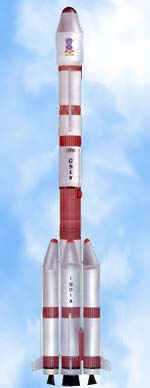
GSAT-6 / INSAT ¿4E is a part of GSAT/INSAT system planned for initiation in 10th Five Year Plan and the funds have been already provided in the approved 10th Plan. The GSAT-6 / INSAT-4E will be launched in early 2008 by the GSLV with a lift-off capability of 2100 kg. The life of the satellite will be 12 years.
The National Satellite System will provide the following benefits :
A state-of-the art National Satellite System with coverage exclusively devoted to entire population of India.
Utilization of India’s S-band spectrum allocation for satellite broadcasting as per International Telecommunications Union (ITU) and National Frequency Allocation Plan (NFAP) allocations.
Capacity to deliver over ten video channels and over ten audio channels in each beam (which will grow over time through better digital transmission, encoding and compression technologies) through downlink component of the system, including interactive services such as text messaging, weather information, disaster warning, etc.
Capacity to customize programme content in a variety of regional and local Indian languages for better consumer adoption through five (5) satellite spot beams.
Adoption of open technology standards for transmission, encoding, compression, reception, and decoding that enable the greatest degree of interoperability with existing systems.
Impetus to technology and business development of Satellite Multimedia Services and related products & services including lease of space segment capacity by domestic private sector companies in India in the electronics services and satellite sectors, and reduction of reliance on foreign entities.
Satellite Digital Multimedia Broadcasting (S-DMB) services would also complement and provide hub interconnectivity to 2.5G/3G networks.
The successful accomplishment of the Project would also enable ISRO/DOS to become a leader in this growing worldwide satellite digital multimedia broadcasting (S-DMB) services to mobile vehicles and cellular phones and thus provide India access to these markets globally.
Written by
Space Daily Editorial Team
The Space Daily Editorial Team produces content across our two editorial pillars: space industry news and Mind & Meaning. We cover launches, missions, satellites, defense, and the technology of getting humans to space, alongside the psychology of ambition, isolation, and meaning under extremes. Articles reflect our team's collective editorial process, source verification, drafting, technical review, and editing, rather than a single writer's work. Space Daily takes editorial responsibility for content under this byline. For more on how we work, see our editorial policy.