
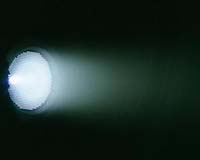
The Japanese built spacecraft MUSES-C that will attempt the first asteroid sample return mission is currently scheduled for launch in May 2003. To power this breakthrough mission the spacecraft will use a microwave ion engine for most of its deep space operation.
As part of the verification process for this engine, the Institute for Space Astronautical Science (ISAS) has had a prototype model of this engine operating for over 18000 hours of autonomous endurance running following its start up on March 30, 2000.
It successfully achieved the original goal of 18000 hours at 2:00AM on October 25, 2002, and remains operational to this day. The engine used for the endurance test is a prototype model of MUSES-C and has been produced in complete accordance with the design, material and manufacturing of the flight model.
Over this time there has been some down time in the sequence of cumulative time. However all these downtimes have been due to operational requirements and do not indicate in any way a malfunctioning of the engine: For example the engine has been shutdown for flight model testing and adjusting; legally scheduled power cuts to the ISAS plant, and regular maintenance and inspection of the engine.
Moreover, through the entire test period, the engine has successfully maintained the required thrust performance level, which clearly proves its high potential as a reliable engine in the future.
In this ion engine Xenon is being used as the propellant, and electrons are emitted from the luminescent point, neutralizer, in front. While some wear due to Xenon sputtering is visible around the ion beam acceleration and outlet areas ISAS says these are well within expectations and has had no impact on the performance of the engine.
