
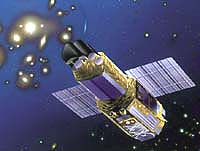
Japan’s Institute of Space and Astronautical Science has released initial details on its failed MV-4 launch last Thursday that saw a $100 million X-ray observation satellite placed in an unsustainable orbit.
The MV-4 was launched at 10:30am JST, February 10. Weather conditions at the time of launch were fine, and the surface wind was 1 meter per second NW. The local ground temperature was 8 degrees centigrade.
The MV-4 flew along the planned trajectory during the initial stage of flight until 41 seconds after liftoff, the when the inner pressure of the first stage motor abruptly dropped.
The burning and control of the second and the third stage motors were normal, and strived to restore the velocity deficiency but in vain.
As a result, MV-4 was unable to boost the ASTRO-E satellite into the planned orbit. A detailed description on the malfunction is now under preparation by ISAS.
