
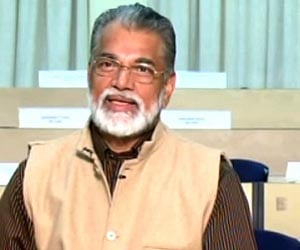
India’s space programme is inching closer to the realisation of its plans for inter-planetary missions, a senior official said Monday.
‘A mission to Mars, for several reasons, has become a priority for us. We are trying to actualise the ideas as soon as possible. Deep space missions have their own challenges. Gravitational forces from different planets, x-rays from sun and various other hazards have to be carefully monitored before the mission, besides a study of Martian surface,’ Indian Space Research Organisation (ISRO) chairman K. Radhakrishnan said.
Speaking at the silver jubilee celebrations of Indira Gandhi National Open University ( IGNOU), Radhakrishnan touched on future missions of ISRO, including ASTROSAT – India’s first dedicated multi-wavelength astronomy satellite, Chandrayan 2, the sequel to lunar mission Chandrayan 1, and a possible human-spaceflight.
‘Chandrayaan 1 was cornerstone of deep space exploration in India. Chandrayan 2 will mainly consist of a lander, which is being developed by Russia, and a rover, which is currently being fabricated in Indian laboratories,’ he said.
Since its inception around five decades ago, ISRO has accomplished 31 launch vehicle missions, built 55 Indian satellites and fabricated 2 satellites for foreign customers, said Radhakrishnan.
earlier related report
NASA Administrator Statement On China Visit
Washington DC (SPX) Oct 28 – On October 16-21, NASA Administrator Charles Bolden led a small delegation to China. The following is a statement from the Administrator regarding his visit:
“On behalf of the NASA delegation that traveled to China, I want to express my appreciation to the China Manned Space Engineering Office, our hosts for my visit. Our delegation conducted a very comprehensive visit to Chinese human spaceflight related facilities including the Jiuquan Satellite Launch Center and conducted meetings with relevant senior officials in the Chinese government.
“I am pleased that NASA was able to meet its objectives for the visit, which included becoming acquainted with relevant Chinese space officials and institutions, better understanding Chinese human spaceflight programs and plans, and reaching a common understanding of the importance of transparency, reciprocity and mutual benefit as the underlying principles of any future interaction between our two nations in the area of human spaceflight.
“I also had an opportunity to meet with my counterpart at the China National Space Administration to review the ongoing efforts of Space and Earth Science working groups, established in 2007, to explore areas of mutual interest.
“Although my visit did not include consideration of any specific proposals for future cooperation, I believe that my delegation’s visit to China increased mutual understanding on the issue of human spaceflight and space exploration, which can form the basis for further dialogue and cooperation in a manner that is consistent with the national interests of both of our countries.”
