
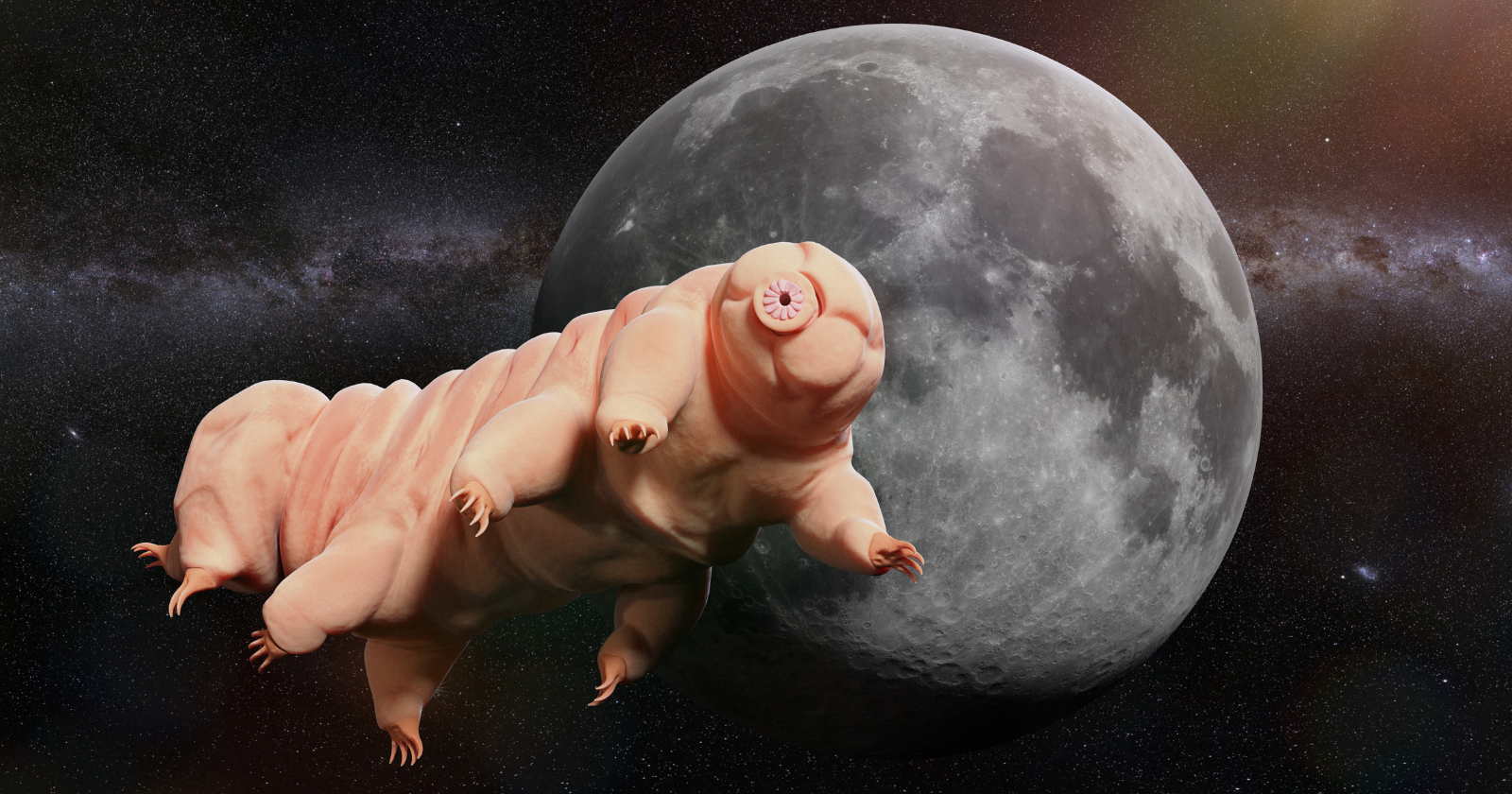
In April 2019, the Israeli spacecraft Beresheet crashed into the lunar surface carrying thousands of dehydrated tardigrades inside a “lunar library”. Later impact tests put the survival cutoff for tardigrades at around 0.9 kilometres per second and 1.14 gigapascals of shock pressure, almost exactly where Beresheet’s final reported speed appears to have been. Whether any Earth life is now lying dormant on the Moon, with no water to revive it, remains an open question.
At 22:25 UTC on 11 April 2019, the Israeli lunar lander Beresheet failed its braking burn during final descent and impacted Mare Serenitatis at high speed. It was the first privately funded mission to attempt a Moon landing, built by SpaceIL and Israel Aerospace Industries, and it had reached lunar orbit successfully before its main engine cut out around 10 kilometres above the surface.
Among the lost payload was a small object that has since become disproportionately famous: a DVD-sized disc archive called the Lunar Library, fabricated by the Arch Mission Foundation, and seeded with thousands of dehydrated tardigrades.
What was in the library
The Lunar Library was a stack of nickel sheets, each etched at microscopic resolution and laminated together with epoxy resin. According to the Davidson Institute’s reconstruction of the mission, it carried roughly 30 million pages of text, keys to 5,000 languages, DNA samples from 25 people, and the entire English Wikipedia. The premise, articulated by Arch Mission’s founder Nova Spivack, was a “backup of planet Earth” that could survive geological time on a body that does not weather.
The tardigrades were a late addition. Several thousand of them, in their desiccated tun state, were placed on a layer of tape embedded between the nickel sheets, and the whole stack was wrapped in further epoxy. None of this was disclosed publicly until after the crash. The species and dose were not formally documented, though Arch Mission has said the animals were in cryptobiosis and intended to demonstrate that biology could be preserved alongside text.
The lander itself disintegrated on impact. The library, according to Spivack’s reading of imagery from NASA’s Lunar Reconnaissance Orbiter, may have been ejected from the spacecraft before peak shock.
The 2021 impact tests
In May 2021, a team led by Mark Burchell at the University of Kent published a study in the journal Astrobiology testing exactly what tardigrades can survive in the way of impact velocities and shock pressures. The motivation was partly the panspermia question, namely whether organisms could plausibly travel between worlds on impact ejecta, and partly the more immediate question of what had just happened to the tardigrades on Beresheet.
The method was straightforward. The researchers froze samples of the species Hypsibius dujardini into the tun state, loaded them into hollow nylon projectiles, and fired them from a two-stage light gas gun at sand targets at velocities up to about 1 kilometre per second. The shock pressures generated at impact were calculated from the projectile material and velocity, and survival was assessed by rehydrating the recovered samples and counting how many revived.
The result was a clean threshold. Tardigrades survived impacts at speeds up to roughly 0.9 km/s, corresponding to shock pressures up to 1.14 gigapascals. Above that, the team recovered only fragments. The survivors that came through the highest survivable shots took longer than usual to revive, suggesting internal damage even where they had not physically come apart.
That number is much lower than the threshold for tardigrade survival under static pressure, which sits in the hundreds of megapascals. Shock pressure, applied over microseconds, is harder for biology to absorb than gradual compression.
Whether the tardigrades on Beresheet survived
Here the picture gets messy.
Beresheet’s final reported telemetry, captured at 19:23 UTC on 11 April 2019 from an altitude of 149 metres, gave a horizontal velocity of 946.7 metres per second and a vertical velocity of 134.3 metres per second. The combined speed at impact, around 956 metres per second, sits slightly above the 0.9 km/s tardigrade survival threshold rather than comfortably below it. On velocity alone, survival was uncertain at best.
The shock pressure picture is worse. Velocity alone does not determine biological damage; shock pressure on impact depends on the mass and rigidity of the impacting body, not just its speed. Beresheet was a metal-framed lander hitting basalt-derived regolith at a low approach angle of around 8 degrees. Alejandra Traspas, one of the Burchell paper’s coauthors, told Science magazine on the record that the shock pressure Beresheet’s metal frame would have generated on impact was “well above” 1.14 GPa, which is to say, well above the survival threshold their experiment had identified.
If the library was ejected from the spacecraft before peak shock, as Spivack has argued from LRO imagery, then the tardigrades inside it may have experienced lower pressures than the spacecraft body itself did. If the library stayed within the lander structure through impact, they almost certainly did not.
This is not a question that current observations can resolve.
If they did survive
Survival of the impact is only the first hurdle. The second is the lunar surface itself.
Tardigrades emerge from tun state through rehydration. They need liquid water to reactivate metabolic activity. The Moon has no atmosphere, no liquid water, and surface temperatures that swing from roughly −170 to +120 degrees Celsius across the lunar day-night cycle. Surface deposits of water ice exist in permanently shadowed polar craters, but Beresheet crashed in Mare Serenitatis, at lower mid-latitudes, where no such ice is accessible.
A dehydrated tardigrade in tun state on the surface of Mare Serenitatis can persist for an extremely long time, but it cannot revive. Cryptobiosis is a pause button, not an indefinite life support system, and without water to restart the metabolism the animal simply remains paused.
This is the part of the story that often gets lost in the panspermia framing. The Beresheet incident did not seed the Moon with a viable Earth population. At most, it scattered a few thousand suspended animals across a few square metres of lunar dust, where they will remain, intact or not, until something brings water to them or something brings them to water.
What it actually changes
The Beresheet case mostly matters as a planetary-protection precedent. NASA, ESA, and the COSPAR space agencies maintain a set of planetary protection guidelines that govern what can be sent to which kinds of bodies, on the principle that contaminating another world with Earth biology compromises the search for indigenous life and constitutes an irreversible environmental change. The Moon, classified as a Category II body where contamination is unlikely to interfere with future science, is treated relatively permissively, but the Arch Mission payload had not been declared as containing biological material in the way the guidelines anticipate.
The episode prompted a quiet revision of attitudes within the community about what private payloads should and should not be permitted to carry to other bodies without disclosure. It also produced the impact-testing work, which has direct astrobiological value beyond the Beresheet question. The same numbers constrain how plausibly tardigrade-like life could survive being launched into space by an impact on Mars and arriving on Phobos, or being collected by a spacecraft transiting the plumes venting off Enceladus.
For now, the Beresheet tardigrades sit on the Moon, almost certainly damaged by shock, possibly partially intact, with no path to revival. It is the closest thing humanity has yet produced to an answer to the question of whether Earth life can survive being delivered to another body by accident. The answer, somewhat unsatisfyingly, is: probably not, but we cannot yet rule it out.
