
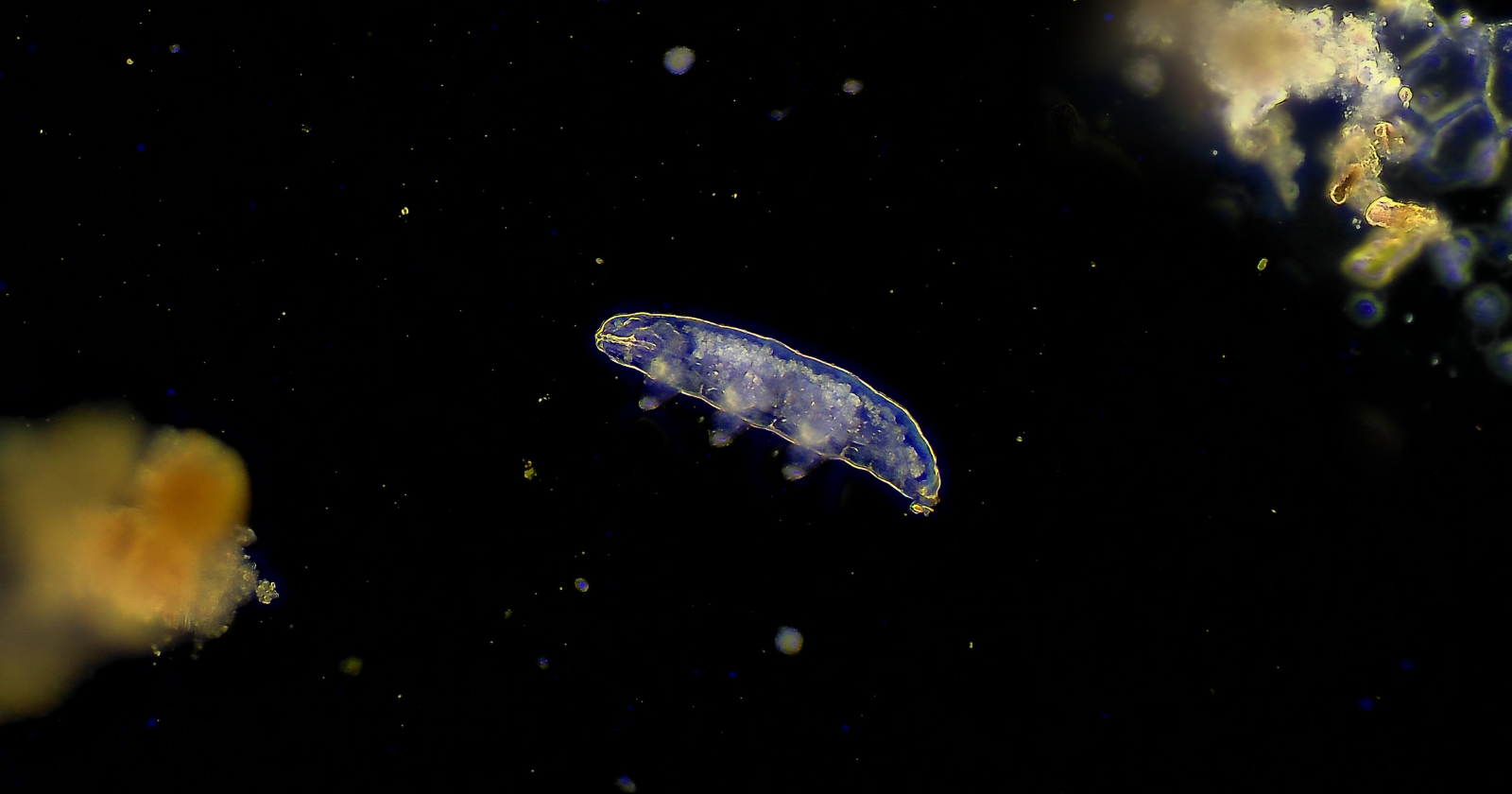
In September 2007, the European Space Agency exposed dried tardigrades to the open vacuum of space for 10 days aboard the FOTON-M3 mission. Most survived the combination of vacuum and cosmic radiation. Some survived the addition of direct solar UV. Once back on Earth, they were rehydrated, revived, and produced viable offspring.
The experiment that produced this result was called TARDIS, for Tardigrades In Space, and the result was published in Current Biology in September 2008. It was the first time any animal had been shown to survive simultaneous exposure to space vacuum, cosmic radiation, and direct solar ultraviolet light. Until then, open-space exposure experiments had mainly involved bacterial spores, seeds, and lichens.
A water-dwelling micro-animal that looks like an eight-legged gummy bear was not on the list.
What the experiment actually did
The TARDIS payload rode on ESA’s Biopan-6 platform, a sealed cassette mounted on the outside of the FOTON-M3 capsule that could be opened in orbit to expose its contents to the space environment, and closed again before re-entry. The capsule flew between 258 and 281 kilometres altitude in low Earth orbit, well above the protective bulk of the atmosphere though still within Earth’s magnetic field.
Two tardigrade species were used: Richtersius coronifer and Milnesium tardigradum. Both were dried into a metabolically inactive state called a tun, in which the animal expels most of its body water, curls into a barrel shape, and reduces its biological activity to undetectable levels. In this state, tardigrades can be revived by rehydration after years of storage.
The animals were divided across three exposure conditions. One group experienced only space vacuum and cosmic radiation. A second group experienced vacuum plus filtered ultraviolet light, restricted to the UV-A and UV-B bands familiar from terrestrial sunburn. A third group was exposed to the full solar UV spectrum, from vacuum-UV at 116.5 nm up to UV-A at 400 nm, which is the unfiltered radiation Earth’s atmosphere absorbs before it reaches the ground.
The cassette opened in orbit and remained open for 10 days.
What survived, and what did not
When the samples came back to Earth, the differences across conditions were stark.
Tardigrades exposed only to vacuum and cosmic radiation came through almost unscathed. The vacuum, which causes immediate dehydration and would rupture most organisms within minutes, did not harm them, because they were already dry. The cosmic radiation flux at low Earth orbit altitudes, while higher than at the surface, was not enough to damage them at survivable doses.
The UV-A and UV-B group fared less well. Survival fell substantially compared to the vacuum-only condition, but a meaningful fraction of the test group recovered after rehydration. The animals that did wake up went on to reproduce, and their offspring developed normally.
The full-spectrum solar UV condition was where the limits showed up. Survival in the UV-B and combined-UV groups dropped to between 10 and 15 percent of the original sample for short-term recovery, and approached zero in the longest exposures. Of the most heavily irradiated Milnesium tardigradum subjects, only three individuals survived. Those three reproduced, and their descendants showed no detectable damage.
A 2016 follow-up paper by the same group, tracking the descendants of the space-exposed survivors across multiple generations, found no reduced performance in later generations compared to unexposed lineages. The authors suggested this is consistent with a make-or-break interpretation: tardigrades that survive may do so by repairing their damage in full rather than by partial repair that leaves mutations to pass on. The data don’t establish that as a general rule, but they show no inherited impairment in the surviving FOTON-M3 lineages under the conditions tested.
How they do it
The mechanism is not a single trick, it is a stack of them.
The starting point is cryptobiosis. When their environment dries out, tardigrades shut down water-dependent biology and enter the tun state, in which metabolic activity is essentially zero and the cell contents are stabilised by a family of tardigrade-specific intrinsically disordered proteins, with sugars such as trehalose playing a supporting role in some species. The cell does not so much survive desiccation as suspend itself in a state where there is no active biochemistry to be disrupted in the first place.
On top of that, tardigrades have evolved active radiation-handling mechanisms. The best-studied example is Dsup, short for damage suppressor, a DNA-associated protein identified in 2016 in the species Ramazzottius varieornatus and shown to reduce radiation-induced DNA damage in cultured cells. Dsup is one component of a broader toolkit, and the TARDIS experiment predates its discovery. Other proteins, the so-called CAHS family, gel during desiccation to maintain cellular structure. Pigments such as betalains neutralise free radicals.
None of this is a complete explanation. The mechanism behind UV resistance in particular remains an open question, since UV radiation damages DNA in a different way to ionising radiation, and not all of the protective tricks that work for one are expected to work for the other.
What it actually proves, and what it doesn’t
The headline takeaway from TARDIS, often repeated in shorthand as “tardigrades can survive in space”, needs a small amount of unpacking.
What the experiment showed is that desiccated tardigrades can survive 10 days of open exposure to space vacuum and cosmic radiation in low Earth orbit, and that a fraction can survive the addition of solar UV at orbital levels. It did not show that tardigrades could survive indefinitely in space, that they could survive deeper-space radiation at higher fluxes, or that they could complete a journey across interplanetary distances. The radiation environment in low Earth orbit is still partially shielded by Earth’s magnetic field, and 10 days is a short cosmic ride.
What it did do, fairly conclusively, was eliminate the assumption that animal-grade biology cannot persist outside a pressure vessel.
The implications for astrobiology are not that tardigrades obviously hitched here on a meteorite. The implications are that the range of conditions under which complex life can survive, even in a suspended state, is wider than the prior literature suggested, and that the panspermia hypothesis, the idea that life can travel between worlds embedded in rock, is not constrained by a flat impossibility at the animal level.
What came after
Tardigrades have flown several times since. In 2011, they were carried to the International Space Station aboard STS-134 in the TARDIKISS experiment. In 2019, an Israeli lunar lander called Beresheet crashed on the Moon carrying thousands of tardigrades in tun state in its payload, and the question of whether any survived the impact remains open, though the lunar surface offers no rehydration prospects.
NASA’s Cell Science-04 experiment, run on the ISS in 2021, studied how microgravity affects tardigrade gene expression in real time, with a focus on which genes the animal turns on under spaceflight stress and how its antioxidant response scales.
For now, the FOTON-M3 result remains the foundational data point. A small dehydrated invertebrate, sealed into a barrel by its own biology and clipped to the outside of a Russian capsule, can take 10 days of vacuum, cosmic radiation, and a portion of unfiltered sunlight, and come home well enough to have children.
