

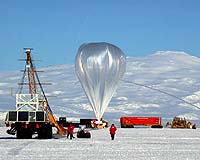
Montana student experiments that were flying on a high-altitude balloon over Antarctica had to be brought down to prevent them from drifting out to sea, Michelle Larson, Deputy Director of the Montana Space Grant Consortium at Montana State University-Bozeman, said Wednesday.
Afraid that the predicted route of the balloon would take the experiments off the coast of Antarctica, scientists on the TIGER balloon project sent up a radio command to cut the balloon from the payload container holding vials for the experiments, Larson said. The container then landed Jan. 4 near Mawson, an Australian base in Antarctica.
The balloon came down after a successful 18-day flight, but it is not yet known when the vials will be recovered, Larson said. Mawson is located across the continent from the McMurdo Station where the balloon was launched on Dec. 16. The experiments were originally expected to land at McMurdo.
Aria-9 project leader Keith Bennett from Washington University in St. Louis, said “I still do not know if the Aria 9 payload will be able to be recovered soon or whether it will have to wait until next year.”
Students from 10 schools around Montana had experiments flying above Antarctica. Billings, Bozeman, Great Falls, Havre, Joliet, Manhattan, St. Ignatius and Sidney students had prepared their experiments during the fall.
After the December launch, the experiments were floating more than 130,000 feet above the ground, above 99 percent of the Earth’s atmosphere. The purpose was to see what happens to ordinary materials when they’re exposed to high altitudes, extreme thermal conditions, space radiation and ultraviolet rays.
Each experiment involved three small identical samples, Larson said. One sample stayed in Montana. The second was placed on the ground outside the McMurdo Station. The third flew on the high-altitude balloon.
The experiments that stayed on the ground near McMurdo should return to Montana by April, Larson said.
The Aria Project is a National Aeronautics and Space Administration (NASA) program. This year’s project involves approximately 950 K-12 students in four states, Washington, D.C. and Australia. It is being directed through Washington University in St. Louis, Mo. TIGER refers to the Trans-Iron Galactic Element Recorder that attaches to the high-altitude balloon.
