
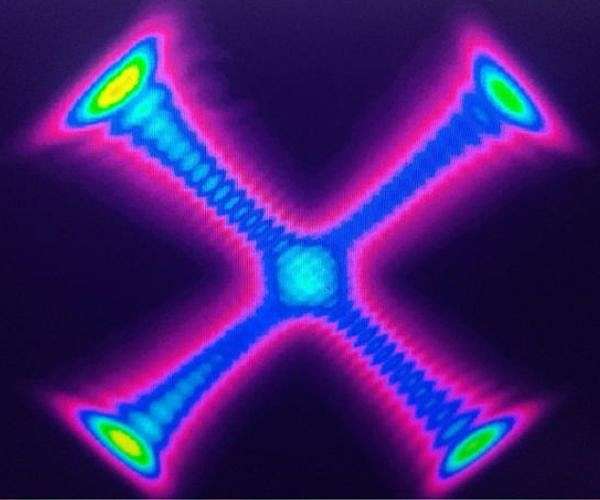
Tampere University has launched a pan-European doctoral network dedicated to the development of high-power optical vortex beams, securing 4.4 million euros in funding from the European Union’s Marie Sklodowska-Curie Actions program. The consortium’s High-Power Optical Vortices (HiPOVor) initiative will recruit and train 15 doctoral researchers focused on the amplification, generation, and application of these beams for advanced research in light-matter interaction.
Optical vortex beams, which transport orbital angular momentum, hold potential for material processing, particle acceleration, communications, and emerging photonic technology. Their technical deployment has previously encountered obstacle due to unreliable generation methods and difficulties preserving beam properties during matter interaction.
The HiPOVor network will address these challenges by driving research in component design, light-matter interaction studies, and high-power amplification methods. Doctoral researchers will work across a range of topics from device engineering to practical applications.
“Our Doctoral Network is about shaping the next generation of scientists and innovators in photonics,” said Dr. Regina Gumenyuk, Project Coordinator at Tampere University.
Dr. Gumenyuk also stated that the project will further the creation of new products and processes, such as optical components and nanofabrication, aiming for environmental improvements by advancing circular economy practices. The team intends to minimize use of hazardous chemicals and reduce the hardware size and energy needs with predictive technologies for high-power vortices.
Professor Goery Genty of Tampere University said, “High-power optical vortices are not only fascinating from a fundamental perspective but also hold the potential to transform applications from precision manufacturing to high-resolution imaging.”
The HiPOVor consortium brings together eight leading academic institutions specializing in structured light and high-power lasers, the Extreme Light Infrastructure-Nuclear Physics (ELI-NP) facility, and nine industry partners. The official project launch is scheduled for January 1, 2026.
