
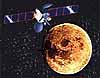
The HGS-1 satellite is on its way toward a second rendezvous with the moon on Saturday, following thruster firings early this week.
HGS-1 is the satellite that was launched last Christmas Day and,
because of a malfunctioning launch vehicle, was left in an unusable,
highly elliptical orbit. Hughes Global Services Inc. (HGS) has
obtained title to the fully functional satellite, an HS 601HP model
built by Hughes Space and Communications Co.
Hughes made spaceflight history last month by sending HGS-1
around the moon, using lunar gravity to improve the resulting orbit
once the satellite returned to Earth. It was the first commercial
mission to the moon. Hughes is sending the satellite around the moon
again this month to further improve the orbit. No further lunar trips
are planned.
At 7:40 p.m. PDT Monday, small thrusters on the satellite were
fired for half an hour, giving the satellite a small change in
velocity. The gentle boost went perfectly, and was sufficient to send
HGS-1 on a 15-day loop around Earth and out to the moon.
HGS-1 is expected to pass near the moon again around 9:30 a.m.
PDT Saturday. Lunar gravity will give the satellite’s trajectory, or
flight path, another twist and send it back to Earth. On June 11,
Hughes controllers will reposition the satellite for its final orbit.
A retro burn June 14 will slow it down and allow it to enter
near-Earth orbit. A series of maneuvers over the next few days will
settle it into circular geosynchronous orbit, 22,300 miles (36,000 km)
above the equator. HGS-1’s final position will be determined after
Hughes finds customers for its services.
When HGS obtained title to the satellite, it agreed to try to
find revenue-producing uses for the satellite and to share profits
with the insurers. A consortium of 27 insurers had owned the satellite
after the original mission was declared a total loss.
HGS’ primary business is packaging satellite communications
services for governmental entities, although it is actively seeking
commercial interest in the entire satellite as well.
“With the orbital improvements obtained by this second lunar
rendezvous, I expect a great deal of interest in this brand-new,
high-power satellite,” said Mark Schwene, HGS vice president. “I’m
looking forward to talking to potential customers for the satellite.”
HGS-1 made its first swing around the moon May 13. It was a
first-of-its-kind mission, and the flyby went almost exactly as
predicted by Hughes orbital analysts.
On May 16, as the satellite approached Earth, Hughes mission
controllers slowed it down by firing the on-board rocket motor, which
exerts a thrust of 110 pounds. This put the satellite into a looping
15-day orbit around Earth with an apogee — the farthest distance from
the Earth — of about 303,000 miles (488,000 km). The moon is about
250,000 miles away (402,000 km).
The maneuver Monday used the satellite’s small thrusters, which
exert only 5 pounds of force, to nudge the satellite into position for
its second lunar flyby. On Saturday, the spacecraft will pass the
moon’s surface from a distance of nearly 21,300 miles (34,300 km),
which is about 5 1/2 times farther than the initial lunar encounter.
An additional firing of the rocket motor is planned for the
morning of June 11, to further position the satellite for its final
orbit. Rocket motor burns on June 14, 16 and 17 are planned to settle
HGS-1 into geosynchronous orbit over the Pacific Ocean, where it will
be “parked” until customers and a final orbital location are
determined.
Hughes Global Services is a subsidiary of Hughes Space and
Communications Co. (HSC), the world’s leading manufacturer of
geostationary commercial communications satellites. Scientists and
engineers from both HGS and HSC are taking part in the mission. Both
companies are units of Hughes Electronics Corp.
PanAmSat Corp., of which Hughes Electronics is the majority
owner, has been providing critical command and tracking support for
the mission through its ground station in Fillmore, Calif.
