
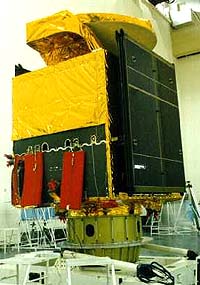
Last Saturday (May 20) China’s domestic communications satellite Dongfanghong-3 (DFH-3, Dongfanghong means “East Is Red”) celebrated the third anniversary of on-orbit operation, Xinhua News Agency reported.
The satellite has been operating reliably with stable performance. Xinhua says that the trouble-free operation of DFH-3 demonstrates the high quality of the satellite, which is a product of the Chinese Academy of Space Technology.
On May 11, 1997 DFH-3, also known as Zhongxing-8 (ZX-8, Zhongxing means “China Star”), was lofted into orbit aboard a Changzheng-3A (CZ-3A) rocket from the Xichang Satellite Launch Centre in the Sichuan Province in southwestern China. DFH-3 eventually settled in its geostationary orbital slot at 125 deg. E longitude.
Just a month ago a panel of academics from the two Chinese academies of sciences and engineering selected the launch of DFH-3 as one of the top ten space events in the thirty years of Chinese space program.
During the three years of successful operation, ground controllers have performed station-keeping maneuvers 65 times in the east-west orientation and 7 times in the north-south orientation.
DFH-3 carries 24 C-band transponders. The transponders and the three solid-state amplifiers, which are all built domestically, are functioning nominally.
China Communications and Broadcasting Satellite Company uses 22 transponders for domestic communications and television transmission service.
Of the two remaining transponders, one is used by Pingan Insurance Company for its dedicated communications network, while the other transponder is reserved for occasional transmission such as broadcasting Division A soccer matches.
The DFH-3 design forms a standard platform for future Chinese comsats. The newly-launched Zhongxing-22 (ZX-22) comsat in January this year is based on the same design but incorporated with improvements to enhance its reliability. After three months of commissioning, ZX-22 was declared operational on April 26.
DFH-3 has a design lifetime of eight years.
