
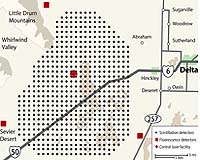
A groundbreaking ceremony will be held 9 am MDT Saturday Aug. 28 in the desert southwest of Delta, Utah, for the Telescope Array ¿ a Japanese and American cosmic ray observatory designed to find the source of the most energetic particles in the universe.
“This is the first step towards implementation of an $18 million cosmic ray project to resolve the puzzling mysteries of the highest-energy cosmic rays,” says Kai Martens, an assistant professor of physics at the University of Utah.
Pierre Sokolsky, the university’s physics chairman, says previous research in Japan and the United States – including the university¿s High-Resolution Fly¿s Eye observatory at Dugway Proving Ground – “uncovered a mystery with regard to the highest-energy cosmic ray particles.”
“We don¿t know where they are coming from,” Sokolsky says. “We don¿t know why they are here. This groundbreaking is a guarantee there will be tremendous new data to shed light on this mystery.”
The groundbreaking ceremony atop Black Rock Mesa in Millard County is for the first of three “fluorescence detectors” to be built on hilltops. The other two will be built later on Long Ridge and between the Drum and Little Drum Mountains.
Each of the three fluorescence detectors will consist of a building with garage-type doors that open to reveal 12 sets of mirrors, each consisting of 16 segments. The mirrors will detect faint blue flashes in the night sky caused when cosmic rays hit atmospheric gas molecules.
In addition to the three hilltop fluorescence detectors, the Telescope Array also will include a “ground array” of 576 scintillation detectors sitting on 2-foot-tall steel tables that will be scattered in a vast grid on a roughly 18-by-22-mile area west of Delta, Hinckley and Deseret.
The scintillation detectors will measure “air showers” of subatomic particles that reach the ground after cosmic rays hit gas molecules in the atmosphere.
The Japanese government last year approved $12 million to build the three fluorescence detectors and 576 scintillation detectors.
The University of Utah and other US universities are seeking $6 million in federal funds to either enhance the three fluorescence detectors built with Japanese funds or, if necessary, add a new one.
Construction to Take Two Years
The University of Utah is leasing the first three fluorescence detector sites, including Black Rock Mesa, from Utah¿s School and Institutional Trust Lands Administration (SITLA), which has approved the project, Sokolsky says.
The gravel road to the site was recently improved, and a contractor started pouring the foundation for the Black Rock Mesa fluorescence detector on Wednesday Aug. 25.
Sokolsky said the building should be done by the end of November, and construction of the second and third fluorescence detectors will begin in spring 2005.
The Japanese and American research team is now in the process of seeking U.S. Bureau of Land Management approval for most of the ground array of scintillation detectors, and SITLA approval for 18 of the detectors located on state land, Martens says.
Scientists hope to start installing those 18 detectors for test purposes this winter.
Sokolsky says cash flow will determine how quickly the sprawling observatory is completed, but he expects it will be finished in two years, and “in three years, data will start coming out of this experiment.”
