
NASA Administrator Michael Griffin said last week that, in effect, reports of the demise of the Terrestrial Planet Finder – and perhaps other major space-exploration projects for the future – have been exaggerated.
He also made a strong statement of support for sending a space shuttle mission to the Hubble Space Telescope for repair and upgrades within two years.
Speaking at a luncheon sponsored by the National Space Club, Griffin acknowledged that his agency’s proposed budget for fiscal year 2007 contained no funding for the giant telescope, which has been planned for some time as a possible means of imaging Earth-like planets orbiting distant stars. NASA’s budget proposal, released last week, said essentially that funding constraints had forced the TPF’s postponement indefinitely.
The James Webb Space Telescope, a near-infrared instrument intended to replace the aging Hubble, also would be deferred, the NASA document said, with an eye on a “launch date of no earlier than 2013.”
Likewise, NASA’s plans now call for deferring SIM PlanetQuest – formerly called the Space Interferometry Mission – a precursor to the TPF.
“I recognize that no one is getting everything they want from this budget for NASA,” Griffin said. “We simply will not be able to do everything, right now, that many in the space community may want us to do. I do not relish the fact that we cannot afford the costs and complexity of starting new space science missions, like a mission to Jupiter’s moon Europa, or the next generation space astronomy missions beyond the James Webb Space Telescope. We must make difficult choices in setting resource priorities.”
Despite the decisions, Griffin said, “it is important to note that we are delaying missions, not simply abandoning them. We will still do the Space Interferometry Mission, the Terrestrial Planet Finder, and the Global Precipitation Monitoring mission. We will not do them right now.”
Griffin explained that he made the decisions to delay the projects because doing so “would be less harmful to the space program overall than would further delays to the (Crew Exploration Vehicle) program. I simply believe that further delays to CEV are strategically more damaging to this nation than are delays to other missions. I stand by this view.”
The CEV is NASA’s centerpiece for rejuvenating the agency’s human spaceflight program by aiming to send astronauts back to the Moon by 2018, using updated versions of the capsule spacecraft developed during the Mercury, Gemini and Apollo programs of the 1960s and ’70s.
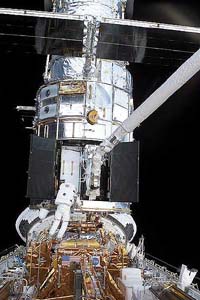
Meanwhile, Griffin said NASA intends to use next space shuttle flight, STS-121 – which tentatively is scheduled for May – to help determine whether the spacecraft “can safely conduct a fifth servicing mission of the Hubble Space Telescope in 2008.” Griffin has said repeatedly over the past few months that he wants to mount a shuttle mission to the orbiting telescope, if it can be accomplished with a reasonable guarantee of success and safety.
Referring to NASA’s recent invitation for proposals for commercial crew and cargo ventures to service the International Space Station, Griffin issued a challenge to the private aerospace industry. “Let me be clear to all venture capitalists and would-be commercial outfits vying for this opportunity,” he said. “If you successfully demonstrate a cost-effective, commercial re-supply capability to the ISS, NASA will welcome that capability and use it.”
