
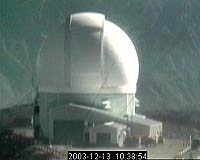
Goodrich Corporation has delivered the optical assemblies for the Southern Astrophysical Research (SOAR) telescope to an 8,800-foot mountain in the Chilean Andes. The effort is funded by a partnership between the U.S. National Optical Astronomy Observatory (NOAO), the Nation of Brazil, Michigan State University, and the University of North Carolina at Chapel Hill.
The telescope will provide astronomers with high quality imaging of heavenly objects. It will also provide imaging spectroscopy — the mapping of specific materials by detection of their chemical composition. The telescope will be operated by the Cerro Tololo Inter-American Observatory, a division of NOAO.
Goodrich’s Danbury, Connecticut-based Optical and Space Systems division was responsible for the design and fabrication of the telescope’s Active Optical System, which consists of three mirror assemblies — a 14-foot primary mirror and smaller secondary and tertiary mirrors. The primary mirror assembly provides a light-gathering power 350,000 times that of the human eye and has an “active” mirror surface for accurate focusing.
The secondary mirror system allows the telescope to align the optics while compensating for the image distorting effects of heat and gravity. The tertiary mirror system directs the images captured to any of nine different scientific cameras and instruments and incorporates a unique fast tip/tilt motion to stabilize images by correcting for atmospheric turbulence jitter.
In addition to the mirrors and the associated drive electronics, Goodrich also developed the software system that controls the actuators and drive mechanism that allow astronomers to control the instrument.
Goodrich’s delivery of the system culminates four years of design and optical fabrication efforts in Danbury. The primary mirror was ground and polished using Goodrich’s computer controlled polisher. In addition, several Goodrich engineers traveled to Chile to assist in installation and initial operation of the telescope. Images captured from the telescope will be provided to observers in the United States via an internet video link.
