
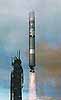
GenCorp Aerojet will provide one additional Stage I and Stage II engine set for a Titan II space launch vehicle with Lockheed Martin that will be used launch NASA’s QuikSCAT mission this November 1 from Vandenberg Air Force Base, Calif.
“Aerojet is very pleased to provide continued service to Lockheed Martin
for the Titan II program,” said Bob Harris, vice president, Strategic and
Space Propulsion. “We are proud of the long-standing success of our Titan
programs.”
Flying without failure on nearly 200 Air Force missions, the Titan liquid
engine program has been instrumental to Aerojet since the late 1950s. The
technology gained throughout the life of the Titan program has been key to
providing expertise for new launch vehicle programs, such as the Kistler
Aerospace K-1.
 The QuikSCAT mission will provide ocean-wind vector data by using a rotating dish antenna with two microwave beams. The antenna will radiate microwaves across 90 percent of the Earth’s ice-free oceans every day. The instrument will collect wind-speed and wind direction data in a continuous 1,118 mile-wide band, making approximately 400,000 measurements each day.
In April of 1998, Aerojet completed negotiation of a $232.3 million dollar
contract change to provide Lockheed Martin with liquid engine flight support for six Titan II and 16 Titan IV launch vehicles through 2002. Liquid engine support for the Titan flights include storage of the engines, preshipment engine maintenance and modification, launch operations support, and aerospace ground equipment design and maintenance. In addition, Aerojet will provide hardware that has a limited shelf life, such as solid start cartridges, and will maintain liquid engine test capability for the Titan IV, the world’s largest operational expendable booster.
Aerojet provides the first and second stage engines for both the Titan II
and Titan IV launch vehicles. The Titan Stage I engine delivers 552,500
pounds of thrust and offers the lowest cost per pound of thrust for any
booster engine in U.S. production. The engine consists of two nearly
identical engine subassemblies mounted on a single frame that can be operated as a single engine or in clusters, depending on the vehicle size and configuration. The Stage II consists of a similar subassembly and delivers 105,000 pounds of thrust.
Aerojet, a leader in propulsion, electronic and weapons systems, and
custom chemicals, is a segment of GenCorp, a technology-driven company with
strong positions in polymer products, automotive, and aerospace and defense
industries.
