

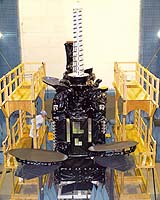
The Optus and Defence C1 communications satellite, built by Space Systems/Loral (SS/L) under contract from Mitsubishi Electric Corporation for Optus of Australia, was successfully launched today at 6:38pm EDT 22:38 GMT, sent into space from the Spaceport at Kourou, French Guiana aboard an Ariane 5 rocket.
Optus and Defence C1 is one of the most advanced communications satellites ever built, carrying a total of 16 antennas that will provide 18 beams across Australia, New Zealand, and the Asia-Pacific region, as well as global beams covering a large area from India to Hawaii.
The advanced communications payload operates in four different frequency bands — commercial services at Ku-band, and military communications at UHF, X- and Ka-bands. It will operate from an orbital slot at 156 degrees East longitude.
“The successful launch of Optus and Defence C1 is the culmination of a unique commercial and military partnership,” said Patrick DeWitt, president of SS/L.
“Optus and Defence C1 will serve as an important example of the benefits that commercial satellites can provide in certain types of military communications – including reduced costs and shorter deployment times. We are proud to have been chosen to participate in this pioneering effort.”
Optus, a leading Australian integrated telecommunications company, will use Optus and Defence C1’s Ku-band payload to distribute video, direct-to-home TV, and telephony and Internet connections to remote areas.
For the Australian Department of Defence, the satellite’s Ka-band payload will provide high-data-rate broadcast coverage for video, and voice and data communications.
The X-band payload will provide medium- to high-data-rate voice and data for land and maritime applications. The UHF payload will provide secure low-rate voice and data communications to mobile platforms.
The Optus and Defence C1 satellite is based on SS/L’s space-proven 1300 geostationary satellite platform, which has an excellent record of reliable operation. The 1300 is designed to achieve a long life, in this case 15 years. The 1300 achieves high stability by using bipropellant propulsion and momentum-bias attitude control systems.
A system of high-efficiency solar arrays and batteries provide uninterrupted electrical power. Total satellite power will be approximately 10 kW at end of life (EOL), and the spacecraft will have a launch mass of nearly five metric tons. In total, SS/L satellites have amassed more than 1,000 years of on-orbit service.
Optus managed the procurement, teamed with the Australian Department of Defence. Japan’s Mitsubishi Electric Corporation (MELCO), the prime contractor, teamed with SS/L, which designed, assembled, integrated and tested the spacecraft at its California facility. SS/L also supplied the Ku-band subsystem. MELCO was responsible for the overall payload.
Optus is Australia’s leading integrated communications company, serving around six million customers each day. The company provides a broad range of communications services including mobile, national and long distance services, local telephony, business network services, Internet and satellite services and subscription television.
