

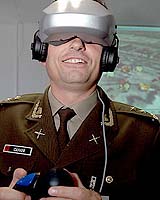
Nine Albanian and Slovakian officers visited the Warrior Preparation Center here Sept. 20-23. The officers were shown hands-on tactics through high-tech training demonstrations at the facility, which is jointly owned by U.S. Army, Europe and U.S. Air Forces in Europe.
Although they were there to gain more understanding of U.S. military training tactics, the visit was more than simulations and demonstrations.
“This type of visit fosters a common understanding of conducting exercises and simulations,” said Air Force Col. Jerry Gandy, Warrior Preparation Center commander. “Our hope is that, with familiarization visits such as this, we can work together in any future exercise but, more importantly, in any real-world operation.”
The visit was incorporated as part of the Theater Security Cooperation program, a collaborative effort between the U.S. military and its allies to counter terrorism, promote regional stability and advance U.S. interest.
Air Force Brig. Gen. Mike Snodgrass, U.S. Air Force Europe Plans and Programs director, noted that the visit was an example of how well the program is working.
“It’s a pleasure to host our Slovakian and Albanian allies this week,” Snodgrass said. “This visit is another success story of how our Theater Security Cooperation program is enhancing relationships between the U.S. and our friends and partners.”
While this isn’t the first time these countries have visited U.S. armed forces in Germany, this visit is unique, explained Albanian Col. Mustafa Xhemalaj, chief of Albanian Armed Forces’ Modernization and Standardization Center.
“With this visit, we’re discovering ways to train our commanders and staff officers on how to fight a war in a simulated environment,” Xhemalaj said. “On one hand, we’re gathering philosophies and concepts on training. On the other hand, we’re learning to fight a common enemy, which is terrorism, and contributing to peace and security not only in Albania but in the rest of the world also.”
Slovakian Capt. Lubos Gulas, chief of the Slovakian Simulator Center, echoed the comments and noted that these types of high-tech simulations are a new form of training for the Slovakian military.
“It’s very useful for us to see the U.S. military’s simulations first-hand, as the simulations we use are based on U.S. software,” Gulas said. “This type of familiarization allows us to bring new ideas to the table when resolving global problems.”
