
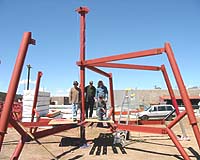
The fabrication of the European Mars Analog Research Station (EuroMARS) has begun in earnest. The work, led by Project Architect Frank Schubert and funded by Starchaser Industries and the United Association of Plumbers and Pipefitters (UA), is being done on the premises of the Rio Grande company in Denver, Colorado.
Fabrication is expected to be complete by the end of May 2002, after which the station will be put on display in a major public exhibit in the United States. It will then be shipped to Europe for deployment in the field in the Spring of 2003.
Several sites are being considered for the EuroMARS, with Iceland as the current leading candidate.
Deployed there, the EuroMARS will provide an opportunity for European and other researchers to engage in a substantial program of Mars exploration operations research, complementing the work the Mars Society will continue to do at its Flashline Mars Arctic Research Station on Devon Island and the Mars Desert Research Station in southern Utah.
The Mars Society plans to follow the building of the EuroMARS with a fourth station located in the Australian desert, which is the site of the discovery of the oldest known fossils of microscopic life on Earth.
