
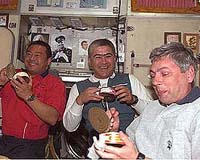
International Space Station mission controllers have cut the astronauts’ food ration in half, Russian cosmonaut Salizhan Sharipov told a local newspaper.
Sharipov told Kyrgyzstan’s Vecherniy Bishkek newspaper he and NASA astronaut Leroy Chiao currently do not have bread, meat or main courses. Instead, they eat soups, kashas and sweets. Kasha is a soft food prepared from hulled and crushed grain.
The reason, Sharipov said, was the previous crew — Russia’s Air Force Col. Gennady Padalka and NASA astronaut Mike Fincke — had eaten more food than planned. As a result, the current mission might have to be cut short, he added.
If for some reason the next resupply mission – Progress M-51 – does not bring the food containers to the station Dec. 26, the crew members will be evacuated Dec. 30, Russian media reported earlier this month.
Food on board was supposed to last the crew until mid-January, dieticians from Moscow’s Institute of Biomedical Problems and specialists from the Russian Mission Control Center told the Itar-Tass news agency.
Russia to ditch space ship in Pacific
In separate news Russia is preparing to ditch a Progress supply ship into the Pacific Ocean this week, Interfax news agency reported Monday.
The Progress-M50 supply ship will be slowed down for re-entry into the atmosphere from its current orbit around the earth. The operation will be conducted Wednesday night and early Thursday, Russian Mission Control spokesman Valery Lyndin said.
After the cargo spaceship disengages itself from the International Space Station …, it will start to slow down, enter the dense layers of the atmosphere, and cease to exist after falling into the Pacific Ocean at 2:24 a.m., Moscow time on Dec. 23 (Thursday).
The area where the ship’s pieces will fall is located about 3,000 kilometers (1,800 miles) east of New Zealand’s capital of Wellington, Lyndin said.
The Mission Control spokesman said de-orbiting a supply ship was a routine operation. The next Progress-M51 supply ship is expected to take off from the Baikonur launch pad Thursday. It will deliver about 2.5 tons of cargo to the ISS, he said.
