

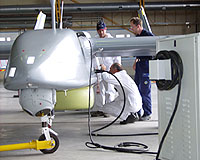
The Swedish Space Corporation has held the first conference in Europe on civilian use of and research into UAVs – unmanned aerial vehicles. As part of the conference, the unmanned vehicle Eagle wrapped up its three-week test program to conincide with the conference that saw delegates from across Europe meet in Sweden to discuss UAV technologies and directions.
In connection with the flights, two conferences, unique in Europe, have taken place in Kiruna. The conferences have dealt with different UAV applications. The first, with around one hundred delegates from 12 countries, focused on military and industrial aspects. The second, with about thirty participants from 8 countries, dealt with civil areas of use.
Examples of the latter are atmospheric research, different types of monitoring (traffic, coastguards, forest fires, disasters etc.) and telecommunications. Unmanned aerial vehicles are well suited to long, monotonous or even hazardous flights (nuclear power accidents, prospecting, high-altitude flights etc.).
One of the conference participants, Dr. David Harari, who has worked with UAVs since the 70s, predicts that “we will experience a technological leap forward comparable with the birth of flight at the beginning of the last century. We are at the dawn of a new era in aviation development where the introduction of UAVs to the national airspace will serve the scientific and civilian users’ communities”.
During day one of the conference, the participants had the chance to look at the air vehicle Eagle and the scientific experiment on board. This comprises an instrument to study the atmosphere, which was produced by scientists from the Department of Meteorology at Stockholm University.
After yesterday’s flight, the scientist in charge, Dr. Kevin Noone, was very pleased when affirming that “science will most probably benefit greatly from UAVs as a complement to today’s space and atmospheric research using balloons, rockets and satellites”.
The Swedish Space Corporation and Swedish Defence Materiel Administration (FMV) have agreed to co-ordinate their two testing bases, Esrange and Vidsel, into the North European Aerospace Test range (NEAT).
NEAT will be an important resource in Europe, in both civil and military areas, thanks to the unique availability of free airspace and uninhabited land area.
Dr. Olle Norberg, manager of Esrange, is optimistic and says that “UAVs will make an excellent complement to existing operations being run at Esrange. The Swedish Space Corporation and FMV together have many years’ experience and have won the confidence of their partners. Therefore NEAT has good prospects of success”.
