
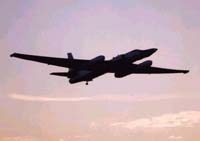
One of NASA’s two ER-2 high-altitude Airborne Science Program aircraft has joined the agency’s DC-8 flying laboratory in supporting the international SAGE III Ozone Loss and Validation Experiment (SOLVE) Campaign currently underway in the Arctic.
The ER-2 departed Jan. 9 for Kiruna, Sweden, staging site of the SOLVE Campaign. The DC-8 took part in the first phase of the campaign Dec. 1 through 15 and returned to Sweden Jan. 13 for the second phase. Both aircraft are based at NASA’s Dryden Flight Research Center, Edwards, Calif.
SOLVE has brought together international scientists in the largest field campaign ever conducted to measure ozone amounts in the Arctic stratosphere. Research activities began in November 1999 and will continue through March 2000.
Scientists believe the results of SOLVE will expand our understanding of polar ozone processes and provide greater confidence in our current ozone monitoring and predicting capabilities. Very low levels of ozone were observed over the Arctic during several winters in the 1990s, raising concerns that an Arctic ozone “hole” might be forming.
The two NASA aircraft join a complement of satellites, small and heavy-lift balloons, European aircraft and ground-based instruments in examining the processes that control ozone amounts during the Arctic winter at mid- to high latitudes.
Kiruna, located north of the Arctic Circle near the average coldest region in the Arctic stratosphere, is an ideally situated base for missions to measure atmospheric phenomena of the Arctic high-latitude region.
This area is where polar stratospheric clouds form and these clouds play an important role in ozone destruction. Both NASA aircraft are being housed in the “Arena Arctica,” a large hangar especially built for research.
The ER-2 is capable of carrying a payload of 2,600 pounds of experiments and instrumentation in a nose bay, the main equipment bay behind the cockpit, two wing-mounted superpods and small underbody and trailing edge pods.
Most ER-2 missions last about six hours with ranges of about 2,200 nautical miles. The aircraft typically flies above 65,000 feet. It is 63 feet long, with a wingspan of 104 feet. Cruising speeds are 410 knots, or 467 miles per hour, at altitude. A single General Electric F-118 turbofan engine powers the ER-2.
The DC-8 flying laboratory is a medium altitude converted airliner powered by four CFM-56 high-bypass turbofan jet engines. The aircraft is carrying a 29,000-pound payload of scientific experiments for the SOLVE Campaign.
The DC-8 flies at altitudes up to 41,000 feet with ranges of 4,800 nautical miles on extended 12-hour flights. The aircraft is 157 feet long with a 148-foot wing span.
The ER-2, with its complement of 17 experiments, will return to Dryden on March 16 after flying the second and third phases of the campaign. The DC-8, with a payload of 18 experiments, ferries back to Dryden on Jan.31.
It will depart for participation in the third and final phase in late February, and will fly science missions between March 2 and 15. The DC-8 will return to Dryden on March 17 after its mission is completed.
