
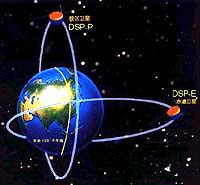
The Chinese National Space Agency (CNSA) and ESA declared the first of the two Double Star spacecraft (TC-1) ready to be shipped to the launch pad.
Double Star will follow in the footsteps of ESA’s ground-breaking Cluster mission by studying the effects of the Sun on the Earth’s environment. Conducting joint studies with Cluster and Double Star should increase the overall scientific return from both missions.
During the meeting on 13-15 November 2003, the launcher, spacecraft, payload and ground segment were reviewed by CNSA and ESA. The launcher will be a Long March 2C associated with the CTS upper stage. The launcher has undergone all necessary qualification tests and was scheduled to be shipped to the launch pad, located in Xichang, Sichuan Province, South-western China, on 20 November 2003.
During the summer, the Double Star spacecraft passed successfully the environment tests. Then in October the magnetic tests were conducted and the results were very good, meeting the very stringent cleanliness requirements. The European and Chinese instruments, integrated on the spacecraft, went also through these tests and have been declared ready to be shipped to the launch site.
The launch campaign will start on 26 November 2003 and last about one month. The main activities will be the final installation of the multi-layer insulation (MLI) foils, the instrument functioning tests, antennas installation and, toward the end of the campaign, the filling of the spacecraft with hydrazine. The spacecraft will then be mated to the launcher and brought to the launch pad. The launch is planned for 28 December 2003 at 1923 UT.
After the launch of TC-1, the instrument and spacecraft teams will continue to work hard to integrate the second Double Star spacecraft (TC-2). The launch of TC-2 is planned for June 2004.
Doubling Up On Payload Technology
A key aspect of Europe’s participation in the Double Star project is the inclusion of eight instruments, seven of which are identical to those currently flying on the four Cluster spacecraft. A further eight experiments will be provided by Chinese institutes.
“We hope it will be possible to make co-ordinated measurements with both Cluster and Double Star.” says Cluster Project Scientist Philippe Escoubet. “For example, we would hope to carry out a joint exploration of the magnetotail, a region where storms of high energy particles are generated. When these particles reach Earth, they can cause power cuts, damage satellites, and disrupt communications.”
Six of the 11 Cluster principal investigators have agreed to provide flight spares or duplicates of the experiments that are currently revolutionising our understanding of near-Earth space. This reuse of Cluster instruments has many advantages for both European and Chinese scientists.
By flying experiments identical to those on Cluster, costs and development time can be reduced. This will minimise risk and help ensure that the project can meet the spacecraft development schedule.
