
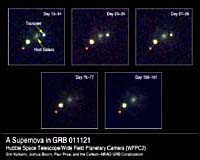
A huge massive burst of gamma-rays 443 million years ago could have caused one of Earth’s worst mass extinctions say a group of astrophysicists and palaeontologists in a report carried by this week’s issue of New Scientist.
Using the pattern of trilobite extinctions at that time the scientists say the pattern meets the expected effects of a nearby gamma-ray burst (GRB). Although other experts have greeted the idea with some scepticism, most agree that it deserves further investigation.
GRBs are the most powerful explosions known. As giant stars collapse into black holes at the end of their lives, they fire incredibly intense pulses of gamma rays from their poles that can be detected even from across the universe for 10 seconds or so.
All the bursts astronomers have recorded so far have come from distant galaxies and been harmless on the ground, but if one occurred within our galaxy and was aimed straight at us, the effects could be devastating, according to astrophysicist Adrian Melott of the University of Kansas in Lawrence.
The Earth’s atmosphere would soak up most of the gamma rays, Melott says, but their energy would rip apart nitrogen and oxygen molecules, creating a witch’s brew of nitrogen oxides, especially the toxic brown gas nitrogen dioxide that colours photochemical smog (see Graphic).
Melott estimates that a burst would produce enough of the gas to darken the sky, blotting out half the visible sunlight reaching the Earth. Nitrogen dioxide would also destroy the ozone layer, exposing surface life to a dangerous overdose of ultraviolet radiation from the sun for a year or more until the ozone recovered.
Melott claims he has palaeontological evidence that this actually happened at the end of the Ordovician period 443 million years ago, causing one of the five largest extinctions of the past 500 million years. Working with Bruce Lieberman, a specialist in fossil trilobites also at the University of Kansas, and other colleagues, he looked at the pattern of extinctions in the late Ordovician.
The researchers found that species of trilobite that spent some of their lives in the plankton layer near the ocean surface were much harder hit than deep-water dwellers, which tended to stay put within quite restricted areas. Usually it is the more widely spread species that fare better in extinctions.
Melott says this unusual pattern could be explained by a GRB, which would probably devastate creatures living on land and near the ocean surface, but leave deep-sea creatures relatively unharmed.
Previous theories blame the two extinctions that occurred in the late Ordovician period on the start and end of an ice age at the time. But it is hard to explain what triggered the ice age itself, which started very suddenly at a time when the climate was quite warm.
