
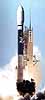
Boeing is set to launch the first mission under NASA’s Deep Space program. Deep Space 1 will be lofted using a Delta II rocket this Saturday October 24 from Cape Canaveral at 8am local time.
The spacecraft, Deep Space 1 will test new technologies for space missions of the next century. The 48-minute launch window opens at 8 a.m. EDT. The Oct. 24 launch is dependent on an on-time launch of a Pegasus rocket currently scheduled for Oct. 22. Should a second-day launch opportunity be required for Pegasus, the NASA launch will be moved to Oct. 25. On that day, the 46-minute launch window opens at 6:59 a.m. EST.
The first of NASA’s New Millennium program missions, Deep Space 1 will test advanced technologies to explore the solar system.
Among the experiments aboard the NASA spacecraft is an ion propulsion engine and software that tracks celestial bodies so the spacecraft can make navigation decisions without the assistance of ground controllers.
Over the years, Delta launch vehicles have carried a host of critical
scientific payloads for NASA, including the Advanced Composition Explorer, Near Earth Asteroid Rendezvous, Mars Pathfinder and Mars Global Surveyor. In a few months, the Delta II team will launch NASA’s Mars Orbiter and Mars Lander spacecraft from Cape Canaveral Air Station.
In addition to Deep Space 1, the Delta II will carry a microsatellite designed and built by students at the University of Alabama in Huntsville. The Students for the Exploration and Development of Space Satellite (SEDSAT) is a secondary payload that will be delivered to orbit following deployment of Deep Space 1.
This will be the first time that a Delta II has flown with three, instead of the usual nine solid rocket motors on the first stage. It will also be the first mission for the NASA Medium Light Expendable Launch Vehicle Services (Med-Lite) program using a Star 37 upper stage built by Thiokol Propulsion, a division of Cordant Technologies.
The Delta II is a medium capacity expendable launch vehicle derived from the Delta family of rockets built and launched since 1960. The Delta II rocket is manufactured in Huntington Beach, Calif., with final assembly in Pueblo, Colo., and is powered by the RS-27A engine built by Boeing in Canoga Park, Calif. The Delta launch team at Cape Canaveral Air Station will handle launch coordination and operations for the NASA mission.
Alliant Techsystems, Magna, Utah, builds the graphite epoxy motors for boost assist; Aerojet, Sacramento, Calif., supplies the second-stage engine; Cordant Technologies, Elkton, Md., builds the upper-stage engine, and AlliedSignal, Teterboro, N.J., provides the guidance and flight control system.
Deep Space 1 Reports From Spacer.Com
(Future Reports)
