

The solar system contains a spectrum of magnetic dynamos in large bodies like the Sun and Jupiter, in more modest-sized bodies like the Earth and in smaller bodies like Mercury and Ganymede.
In ancient times even more solar system objects had operating magnetic dynamos. There have been so many dynamos that comparative planetology in this area shows much promise of providing insight both into the dynamo mechanism and the properties of the dynamo regions.
In fact geochemical and paleomagnetic evidence from the HED meteorites suggests that Vesta formed an iron core and once had an internally generated magnetic field.
This if confirmed would put Vesta as the smallest body on a sequence with the Moon, Mercury, Mars and the Earth as rocky planets at least once having a magnetic dynamo.
Dawn allows us to survey Vesta and Ceres at orbital altitudes well below one body radius, and determine if they possess natural remanent magnetization and, through geologic correlations, when it was produced.
The same instrument measures the transient response of Vesta and Ceres as discontinuous changes in the external magnetic field occur, placing constraints on the electrical conductivity of the interior.

The response time of the Moon to step transients in the solar wind magnetic field is 80 s, and at Vesta should be in the range 2 to 8 s, easily resolvable by the 10 Hz bandwidth and 0.1 nT resolution of the magnetometer. Detection of remanent magnetization or an electrically conducting interior at Ceres would lead to a major revision of our understanding of this body.
The ranges and sensitivity of the magnetometer are tailored to the expected environments to be found at Vesta and Ceres as well as the magnetic environment of the spacecraft. We have conservatively chosen a ¿ 1000 nT range for the magnetometer, sampled at 20 Hz. The data are digitized to 16 bits providing ¿ 0.015 nT digitization.
The UCLA magnetometer derives from a long line of missions including OGO5 (1968); ISEE 1 and 2 (1977), Pioneer Venus (1978); Galileo (1989); Polar (1996) and ST5 (in fabrication).
The main electronics unit, a sensor triad, and a block diagram are shown in Figure 1. The main electronics and the sensors are completely redundant, use a single range and data rate and operate continuously.
A third new technology magnetometer, with a design based on the sigma delta modulator, adds further redundancy. This overall instrument design was chosen because of its low-noise level, simplicity, low cost and its high inheritance from recent missions.
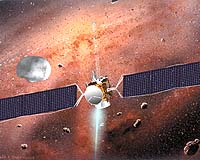
The Dawn mission has been selected as NASA’s ninth Discovery mission to be launched in May 2006 to orbit both Vesta and Ceres.
