
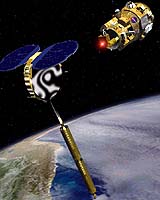
NASA and Orbital Sciences have postponed Thursday’s launch of the Demonstration of Autonomous Rendezvous Technology (DART) spacecraft due to the discovery of particulate contamination found inside the fairing of the Pegasus launch vehicle. The launch team does not expect to launch before Nov. 4, 2004.
During the final flight preparations for the DART/Pegasus launch, closeout team members discovered pieces of aluminum foil from the launch vehicle’s fairing. As a result, the vehicle will be de-mated from the carrier aircraft and returned to the vehicle assembly building, where it will be inspected.
The DART mission was postponed twice this week. The first postponement was due to a dropout of Global Positioning Satellite data of the target vehicle, which was resolved.
NASA has already successfully ground tested technologies that will enable unmanned spacecraft to rendezvous autonomously, something that has never been done in the history of U.S. spaceflight. The ground tests were performed at the Flight Robotics Laboratory at NASA’s Marshall Space Flight Center, Huntsville, Ala.
They demonstrated the capability of hardware and software to communicate with each other and to drive the spacecraft autonomously to achieve a safe, assured rendezvous and close approach to a target.
Video guidance sensor and autonomous rendezvous guidance technologies have also performed flawlessly, according to NASA managers. The tests verified critical autonomous rendezvous technologies, including the ability of the Advanced Video Guidance Sensor to combine with other technologies, such as the Global Positioning System and Automated Rendezvous and Proximity Operations calculations.
The video guidance sensor sees and determines a spacecraft’s exact location, then feeds the information to Automated Rendezvous and Proximity Operations calculations, or algorithms, that function as a brain. The brain commands the spacecraft to turn, throttle, or brake, allowing it to rendezvous with another craft.
The tests were performed using mock-ups of the DART spacecraft and target satellite, demonstrating successful proximity operations with video guidance sensors for target location.
DART navigation guidance transitioned successfully from the Global Positioning System to direct use of the video guidance information. The Dart spacecraft then moved progressively closer to the target satellite under direct video guidance.
A number of maneuvers were demonstrated in the simulated ground tests, including a collision avoidance maneuver, horizontal approaches toward the target satellite, transition to docking guidance, and docking-hold maneuvers to within five meters of the target.
“The successful automation of these types of maneuvers, demonstrated by DART technologies, will benefit future space systems development requiring in-space assembly, services or other autonomous rendezvous operations,” said Jim Snoddy, DART project manager.
