
The most consequential prediction in the recorded history of 19th-century chemistry was made by a Russian professor working on a textbook. Mendeleev had not set out to reorganise the fundamental structure of chemistry. He had set out, in the winter of 1868-1869, to complete the second volume of his textbook Principles of Chemistry (Основы химии) — a comprehensive Russian-language reference work that his students needed and that no comparable text then existed in Russian to provide. The specific problem he encountered in preparing the textbook was that the 63 elements then known to European chemistry had no obvious organising principle. Some elements were metals; some were gases; some were highly reactive; some were inert. Some had atomic weights of approximately one unit (hydrogen); others had weights approaching 240 (uranium). Some formed compounds with oxygen in specific ratios; others formed compounds with hydrogen in different specific ratios. The German chemist Julius Lothar Meyer had, several years earlier, developed a partial arrangement based on atomic weight; the British chemist John Newlands had proposed a “Law of Octaves” in 1865 that had been substantially mocked by the London Chemical Society; the French chemist Alexandre-Émile Béguyer de Chancourtois had drawn a helical arrangement in 1862 that had been ignored. Mendeleev’s substantive innovation, developed across the winter of 1868-1869, was to arrange the elements simultaneously by atomic weight and by chemical periodicity — and then, critically, to leave empty spaces where the pattern required elements that had not yet been observed.
According to Physics World’s retrospective on the 150-year history of the periodic table and Mendeleev’s specific contribution to it, the first version of Mendeleev’s table — published in the journal of the Russian Chemical Society in March 1869 under the title “Attempt at a System of Elements” (Опыт системы элементов) — contained explicit blank spaces marked with question marks at four specific positions. The blanks corresponded to positions immediately below boron (atomic weight ~11), aluminum (~27), silicon (~28), and manganese (~55) in the columns of chemically similar elements the table had established. Mendeleev’s substantive claim was not merely that these positions were empty. It was that the empty positions corresponded to specific elements that must exist — elements whose atomic weights, chemical behaviours, densities, oxide formulas, and metallic characteristics could all be predicted, in advance of their actual discovery, from the pattern of neighbouring elements the table had already positioned. He called the four undiscovered elements eka-boron, eka-aluminum, eka-silicon, and eka-manganese, using the Sanskrit prefix “eka” (meaning “one”) in a naming convention that reflected his broader philological interests and that would subsequently become standard in the international chemistry literature.
The confirmations
The first of Mendeleev’s predicted elements was discovered six years after the initial publication. As detailed in Springer Nature’s academic chapter on the discovery of the three elements predicted by Mendeleev’s table, the French chemist Paul-Émile Lecoq de Boisbaudran identified a new element spectroscopically in a sample of zinc sulfide from the Pyrenees in August 1875. He named it gallium after Gaul (the ancient Latin name for France) and reported its initial properties — including a measured density of approximately 4.7 g/cm³. Mendeleev, reading Boisbaudran’s paper in Saint Petersburg, immediately wrote to the French chemist to inform him that gallium was eka-aluminum, that its actual density should be approximately 5.9 g/cm³, and that the low reported value indicated that Boisbaudran had failed to properly purify his sample. Boisbaudran repurified the sample. The measured density was 5.904 g/cm³. The predicted atomic weight was ~68; the measured weight was 69.72. Every substantive chemical property Mendeleev had specified in advance matched Boisbaudran’s experimental measurements.
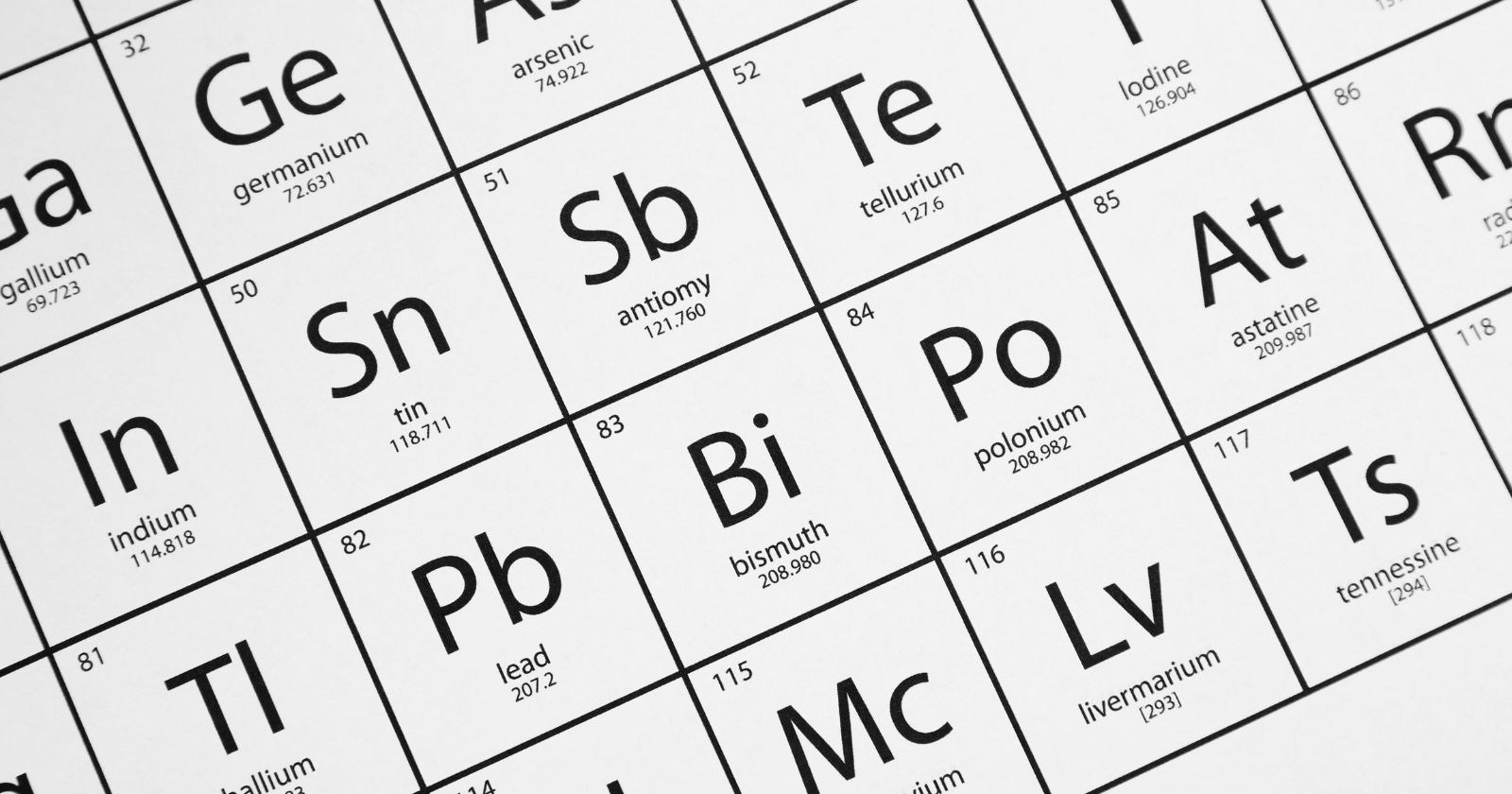
The second discovery came four years later. The Swedish chemist Lars Fredrik Nilson identified a new element in the rare-earth minerals euxenite and gadolinite in 1879, named it scandium after Scandinavia, and measured its atomic weight at approximately 44.96 — matching Mendeleev’s eka-boron prediction of ~44. The third and final discovery came in 1886, when the German chemist Clemens Winkler at the Freiberg School of Mines identified a new element in the recently-discovered silver ore argyrodite, measured its atomic weight at 72.63 (Mendeleev’s prediction: ~72), and named it germanium after Germany. Per the Chemistry LibreTexts summary of Mendeleev’s periodic table and the subsequent experimental confirmations of his predictions, the observed chemical properties of germanium matched Mendeleev’s eka-silicon predictions so precisely — the density, the oxide formula, the volatility of the chloride compound, the specific heat capacity — that Winkler’s 1886 paper on the discovery is generally credited as the moment at which the European chemistry community shifted from skeptical to essentially unanimous acceptance of Mendeleev’s periodic system. Three predictions had been made in 1869. Three discoveries had confirmed them within 17 years.
The fourth prediction
The fourth of Mendeleev’s original 1869 predictions — eka-manganese, the element at atomic weight approximately 100 that should have sat immediately below manganese in the periodic column — was not discovered within the 17-year window that had confirmed the first three. It was not discovered within Mendeleev’s lifetime. It was not discovered within the subsequent 30 years after his death. As reported by Science Notes’ summary of Mendeleev’s periodic table and the confirmations and complications that followed it, eka-manganese was eventually identified in 1937 — 68 years after Mendeleev’s original prediction — by the Italian physicists Emilio Segrè and Carlo Perrier at the University of Palermo, working with molybdenum samples that had been irradiated with deuterons at Ernest Lawrence’s cyclotron at the University of California, Berkeley. They named the element technetium (from the Greek τεχνητός, “artificial”), because the element does not occur in stable form in the Earth’s crust — its longest-lived isotope has a half-life of approximately 4.2 million years, which means that essentially all of the technetium present in the Earth at the planet’s formation approximately 4.5 billion years ago has, by now, radioactively decayed into other elements. This is why the element had not been discovered in 1869, or in 1875, or at any point during Mendeleev’s lifetime: it does not exist in nature in quantities detectable by 19th-century analytical techniques. It exists only in trace amounts as a decay product of uranium, and in the substantial quantities that human nuclear reactors have been producing since 1937. Mendeleev’s 1869 table had, without his knowing, predicted not merely the existence of undiscovered elements — but the existence of a specific element that would need to be manufactured by 20th-century nuclear technology before it could be observed at all. The Russian chemistry professor who had been working on his textbook in the winter of 1868-1869 had produced, in essential respects, a pattern-recognition result substantially more sophisticated than any of his contemporaries had reason to believe possible.