
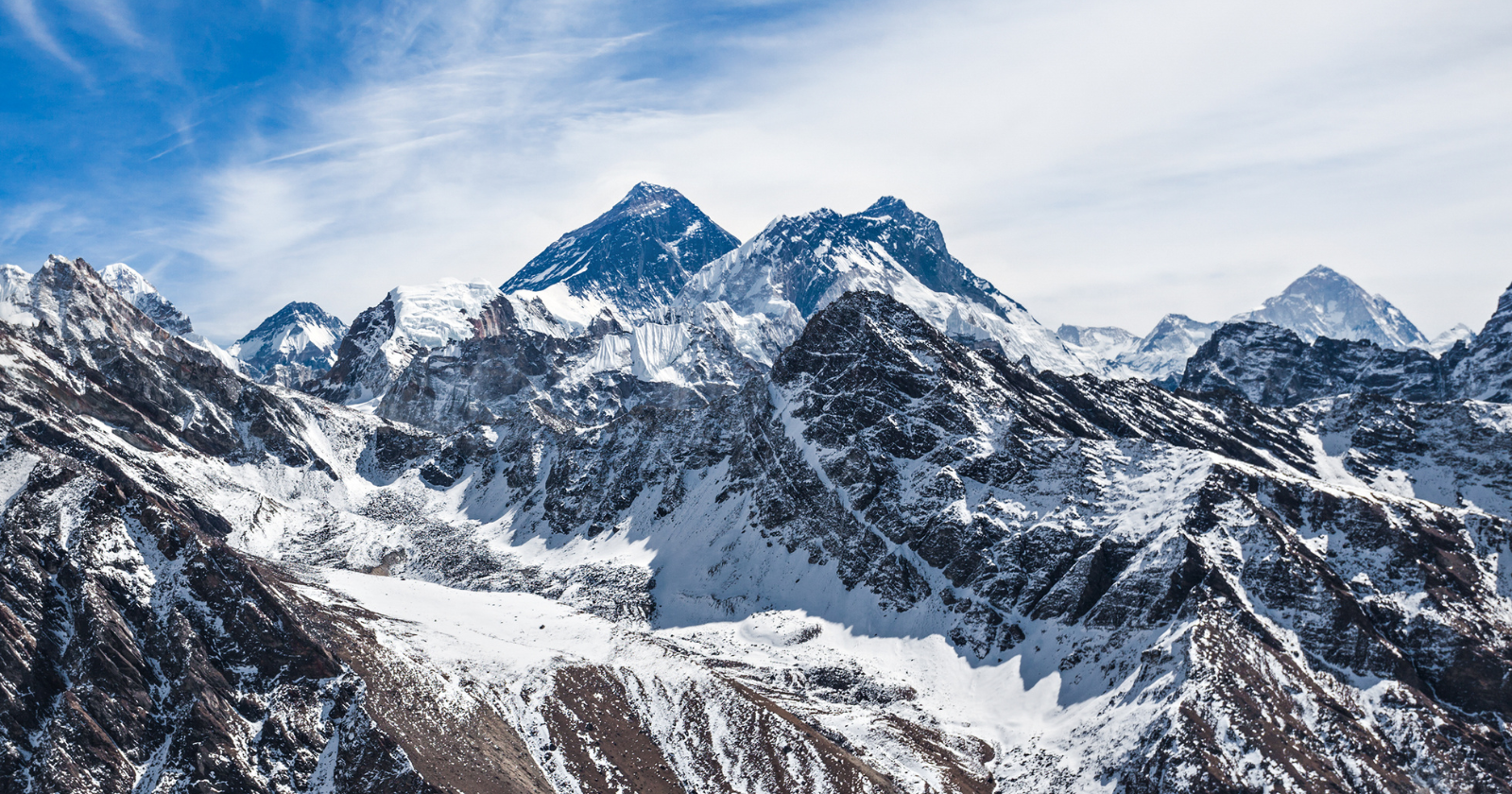
Stand on the summit of Chimborazo, a dormant volcano in the Ecuadorian Andes, and you are farther from the centre of the Earth than you would be standing on top of Everest. Not higher above the sea. Farther from the core.
Everest holds the elevation record without argument. Its summit sits 8,848.86 metres above mean sea level, the figure jointly confirmed by Nepal and China in 2020. Chimborazo reaches only around 6,263 metres by the same measure, roughly two and a half kilometres lower. Yet its summit is about 6,384 kilometres from the centre of the planet, while Everest’s is about 6,382 kilometres. The gap runs to more than two kilometres, and it runs in Chimborazo’s favour.
The shape of the planet is what does the work.
What the equatorial bulge does
Earth is not a sphere. It spins, and the spin pushes mass outward at the middle, giving the planet the shape geodesists call an oblate spheroid. The reference ellipsoid that GPS relies on, the World Geodetic System 1984, fixes the equatorial radius at about 6,378 kilometres and the polar radius at about 6,357 kilometres. The difference, close to 21 kilometres, is a defined geodetic value rather than a contested measurement.
Any peak near the equator therefore begins its climb from ground that already stands about 21 kilometres farther from the centre of the Earth than equivalent ground near the poles.
The United States National Oceanic and Atmospheric Administration’s National Ocean Service identifies Chimborazo, rather than Everest, as the point on Earth’s surface farthest from the centre of the planet. The geometry is why. Chimborazo sits about one and a half degrees south of the equator, almost exactly where the bulge is fattest. Everest sits near 28 degrees north, well up the curve where the planet has already begun to narrow.
Measure both from the core, and the lower mountain on the wider part of the Earth comes out ahead.
The bulge was mapped from nearby
There is a neat historical loop in this. The equatorial bulge that lifts Chimborazo above Everest was first confirmed by measurements taken in the same stretch of the Andes.
In 1735 the French Academy of Sciences sent an expedition to what is now Ecuador, then part of the Spanish Viceroyalty of Peru. It was led by Charles Marie de La Condamine, Pierre Bouguer and Louis Godin, with the Spanish naval officers Jorge Juan and Antonio de Ulloa, and its task was to measure the length of a degree of latitude at the equator. A rival French party went to Lapland to do the same near the Arctic Circle. The exercise was meant to settle an argument. Isaac Newton had predicted that a spinning Earth would bulge at the equator, while the French astronomer Jacques Cassini held that it stretched towards the poles. Compared against the Lapland readings, the equatorial measurements came down on Newton’s side.
Chimborazo carried its own reputation through this period. For a long time it was thought to be the highest mountain on Earth, and in 1802 Alexander von Humboldt attempted the summit, reaching a record altitude for the era without topping out. Himalayan surveying later displaced that claim. The mountain kept a stranger distinction instead.
Why the number is not perfectly settled
The exact size of the gap depends on which elevation you accept for Chimborazo, and that has been argued over for a long time. Older sources quote figures from about 6,263 to 6,310 metres for the main summit. In 1993 a team from the School of Military Survey at Newbury, in the United Kingdom, measured it with differential GPS and recorded 6,268 metres. A French-led expedition in 2016, working with GPS instruments, put the summit’s distance from the centre of the Earth at close to 6,384 kilometres.
Because of that spread, the reported advantage over Everest is not a single fixed number. NOAA gives it as more than 2,072 metres. Other calculations, using slightly different elevation and geoid values, put it closer to 2,168 metres. The honest version is a range, somewhere between about two and 2.2 kilometres depending on the inputs. Whichever figures you use, Chimborazo comes out ahead, and only the size of the margin is in question.
The claim to handle carefully: closest to the sun
Chimborazo is often described as the point on Earth closest to the sun, or closest to space. Both need trimming.
Closest to space is defensible only in one specific sense: the summit is the piece of solid ground that pokes farthest out from the middle of the planet. In terms of altitude, the quantity that actually thins the air and matters to a climber’s lungs, Everest is still far higher. Chimborazo’s summit is more than two and a half kilometres lower above sea level, with correspondingly denser air.
Closest to the sun is the weaker claim. Earth’s distance from the sun changes by about five million kilometres over the course of a year as the planet moves between its nearest and farthest orbital points. Against a swing that large, a two-kilometre lead over Everest counts for nothing. Chimborazo is not meaningfully closer to the sun than anywhere else on Earth at a given moment. It is simply the outermost knob on an uneven ball.
It is not a two-horse race
Chimborazo wins, but narrowly, and not alone. Huascarán in Peru, higher above sea level at 6,768 metres but slightly farther from the equator, trails the summit by only tens of metres. Depending on the measurement, the two are close enough that the ranking has been treated as a near tie.
Below them sits a queue of equatorial and near-equatorial peaks that also beat Everest on this metric. Yerupajá and Huandoy in Peru, Cotopaxi in Ecuador, and Kilimanjaro in Tanzania all clear it. By one count, at least 26 summits are farther from the centre of the Earth than Everest is, purely as a consequence of latitude. Everest is the highest point above the sea. On distance from the core, it does not make the top two dozen.
Which ruler you pick
The Chimborazo fact reads as trivia, and it circulates as trivia. What sits underneath it is a plainer point about measurement. Highest, tallest and farthest from the centre are three different questions, and they produce three different winners.
Everest is the highest above sea level. Chimborazo is the farthest from the centre of the Earth. The tallest by base-to-summit rise is neither: that is Mauna Kea in Hawaii, which climbs more than 10,000 metres from the Pacific seafloor to its peak, most of it underwater.
The mountains stay where they are. What shifts is the reference point you measure from. Everest takes the title when the reference is the ocean surface, and Chimborazo takes it when the reference is the geometric centre of a spinning, bulging planet. Neither ranking is wrong, and neither is the whole story.
For a fact that mostly turns up on globes and in pub arguments, that is the part worth keeping: the winner depends entirely on where you decide to put the zero.
